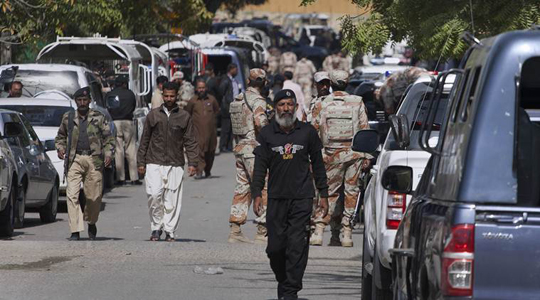
Afghan diplomat shot dead by guard at Karachi Consulate

February 6, 2017

Karachi, Feb 6: An Afghan security guard today shot dead a diplomat with a sub-machine gun following an altercation between the two inside the Afghan Consulate in this Pakistani port city.

Afghand

Private security guard Hayatullah Khan opened fire on the third secretary, Zaki Adu, in the lobby of the Consulate in the high-security Clifton area after a personal disagreement between the two, according to the Deputy Inspector General (DIG) South Azad Khan.

"There is no terrorism element in this sad incident," DIG Khan said. "This is not a premeditated act neither a terrorist act. The guard opened fire on the spur of the moment after he lost his temper following an argument with the deceased over timings," the police official said.

"We have checked the CCTV cameras and recorded eyewitness statements," he said. The Afghan Consulate is located in the heavily secured and posh area of Clifton and the provincial government has deputed security outside the building.

There are a number of other foreign consulates in the area and also the Bhutto family's residence is situated in the locality.

Khan said Hayatullah has been taken into custody and investigations have begun.

The guard was an Afghan national employed by the Consulate. Police cleared the Consulate building for resumption of work after a thorough search.

Security of the area has been increased after the incident, a Sindh government official said. Afghan ambassador to Pakistan Omar Zakhilwal was quoted by The Express Tribune as saying that it was not an act of terrorism. "It seems to be a personal dispute related criminal act," Zakhilwal said.

The Afghan envoy said the firing inside the Afghan Consulate in Karachi at around 12:30 PM was carried out by an Afghan guard inside the compound resulting in the fatality of one of the diplomats.

Comments

Add new comment

  • Coastaldigest.com reserves the right to delete or block any comments.
  • Coastaldigset.com is not responsible for its readers’ comments.
  • Comments that are abusive, incendiary or irrelevant are strictly prohibited.
  • Please use a genuine email ID and provide your name to avoid reject.
News Network
May 20,2020

London, May 20: The current physical distancing guidelines of 6 feet may be insufficient to prevent COVID-19 transmission, according to a study which says a mild cough in low wind speeds can propel saliva droplets by as much as 18 feet.

Researchers, including those from the University of Nicosia in Cyprus, said a good baseline for studying the airborne transmission of viruses, like the one behind the COVID-19 pandemic, is a deeper understanding of how particles travel through the air when people cough.

In the study, published in the journal Physics of Fluids, they said even with a slight breeze of about four kilometres per hour (kph), saliva travels 18 feet in 5 seconds.

"The droplet cloud will affect both adults and children of different heights," said study co-author Dimitris Drikakis from the University of Nicosia.

According to the scientists, shorter adults and children could be at higher risk if they are located within the trajectory of the saliva droplets.

They said saliva is a complex fluid, which travels suspended in a bulk of surrounding air released by a cough, adding that many factors affect how saliva droplets travel in the air.

These factors, the study noted, include the size and number of droplets, how they interact with one another and the surrounding air as they disperse and evaporate, how heat and mass are transferred, and the humidity and temperature of the surrounding air.

In the study, the scientists created a computer simulation to examine the state of every saliva droplet moving through the air in front of a coughing person.

The model considered the effects of humidity, dispersion force, interactions of molecules of saliva and air, and how the droplets change from liquid to vapour and evaporate, along with a grid representing the space in front of a coughing person.

Each grid, the scientists said, holds information about variables like pressure, fluid velocity, temperature, droplet mass, and droplet position.

The study analysed the fates of nearly 1,008 simulated saliva droplets, and solved as many as 3.7 million equations.

"The purpose of the mathematical modelling and simulation is to take into account all the real coupling or interaction mechanisms that may take place between the main bulk fluid flow and the saliva droplets, and between the saliva droplets themselves," explained Talib Dbouk, another co-author of the study.

However, the researchers added that further studies are needed to determine the effect of ground surface temperature on the behaviour of saliva in air.

They also believe that indoor environments, especially ones with air conditioning, may significantly affect the particle movement through air.

This work is important since it concerns safety distance guidelines, and advances the understanding of the transmission of airborne diseases, Drikakis said.

Comments

Add new comment

  • Coastaldigest.com reserves the right to delete or block any comments.
  • Coastaldigset.com is not responsible for its readers’ comments.
  • Comments that are abusive, incendiary or irrelevant are strictly prohibited.
  • Please use a genuine email ID and provide your name to avoid reject.
Agencies
July 1,2020

The ILO has warned that if another Covid-19 wave hits in the second half of 2020, there would be global working-hour loss of 11.9 percent - equivalent to the loss of 340 million full-time jobs.

According to the 5th edition of International Labour Organisation (ILO) Monitor: Covid-19 and the world of work, the recovery in the global labour market for the rest of the year will be uncertain and incomplete.

The report said that there was a 14 percent drop in global working hours during the second quarter of 2020, equivalent to the loss of 400 million full-time jobs.

The number of working hours lost across the world in the first half of 2020 was significantly worse than previously estimated. The highly uncertain recovery in the second half of the year will not be enough to go back to pre-pandemic levels even in the best scenario, the agency warned.

The baseline model – which assumes a rebound in economic activity in line with existing forecasts, the lifting of workplace restrictions and a recovery in consumption and investment – projects a decrease in working hours of 4.9 percent (equivalent to 140 million full-time jobs) compared to last quarter of 2019.

It says that in the pessimistic scenario, the situation in the second half of 2020 would remain almost as challenging as in the second quarter.

“Even if one assumes better-tailored policy responses – thanks to the lessons learned throughout the first half of the year – there would still be a global working-hour loss of 11.9 per cent at the end of 2020, or 340 million full-time jobs, relative to the fourth quarter of 2019,” it said.

The pessimistic scenario assumes a second pandemic wave and the return of restrictions that would significantly slow recovery. The optimistic scenario assumes that workers’ activities resume quickly, significantly boosting aggregate demand and job creation. With this exceptionally fast recovery, the global loss of working hours would fall to 1.2 per cent (34 million full-time jobs).

The agency said that under the three possible scenarios for recovery in the next six months, “none” sees the global job situation in better shape than it was before lockdown measures began.

“This is why we talk of an uncertain but incomplete recovery even in the best of scenarios for the second half of this year. So there is not going to be a simple or quick recovery,” ILO Director-General Guy Ryder said.

The new figures reflect the worsening situation in many regions over the past weeks, especially in developing economies. Regionally, working time losses for the second quarter were: Americas (18.3 percent), Europe and Central Asia (13.9 percent), Asia and the Pacific (13.5 percent), Arab States (13.2 percent), and Africa (12.1 percent).

The vast majority of the world’s workers (93 per cent) continue to live in countries with some sort of workplace closures, with the Americas experiencing the greatest restrictions.

During the first quarter of the year, an estimated 5.4 percent of global working hours (equivalent to 155 million full-time jobs) were lost relative to the fourth quarter of 2019. Working- hour losses for the second quarter of 2020 relative to the last quarter of 2019 are estimated to reach 14 per cent worldwide (equivalent to 400 million full-time jobs), with the largest reduction (18.3 per cent) occurring in the Americas.

The ILO Monitor also found that women workers have been disproportionately affected by the pandemic, creating a risk that some of the modest progress on gender equality made in recent decades will be lost, and that work-related gender inequality will be exacerbated.

The severe impact of Covid-19 on women workers relates to their over-representation in some of the economic sectors worst affected by the crisis, such as accommodation, food, sales and manufacturing.

Globally, almost 510 million or 40 percent of all employed women work in the four most affected sectors, compared to 36.6 percent of men, it said.

The report said that women also dominate in the domestic work and health and social care work sectors, where they are at greater risk of losing their income and of infection and transmission and are also less likely to have social protection.

The pre-pandemic unequal distribution of unpaid care work has also worsened during the crisis, exacerbated by the closure of schools and care services.

Even as countries have adopted policy measures with unprecedented speed and scope, the ILO Monitor highlights some key challenges ahead, including finding the right balance and sequencing of health, economic and social and policy interventions to produce optimal sustainable labour market outcomes; implementing and sustaining policy interventions at the necessary scale when resources are likely to be increasingly constrained and protecting and promoting the conditions of vulnerable, disadvantaged and hard-hit groups to make labour markets fairer and more equitable.

“The decisions we adopt now will echo in the years to come and beyond 2030. Although countries are at different stages of the pandemic and a lot has been done, we need to redouble our efforts if we want to come out of this crisis in a better shape than when it started,” Ryder said. 

Comments

Add new comment

  • Coastaldigest.com reserves the right to delete or block any comments.
  • Coastaldigset.com is not responsible for its readers’ comments.
  • Comments that are abusive, incendiary or irrelevant are strictly prohibited.
  • Please use a genuine email ID and provide your name to avoid reject.
News Network
February 9,2020

Nakhon Ratchasima, Feb 9: The Thai soldier who killed at least 20 people and holed up in a mall overnight was shot dead Sunday morning by commandos, ending a near-17-hour ordeal which left dozens wounded and stunned the country.

It was unclear how many people remained trapped inside the Terminal 21 mall in Nakhon Ratchasima -- also known as Korat -- where the gunman held out through the night, armed with assault weapons stolen from his barracks.

Volleys of gunfire rang out as the siege ran into dawn, hours after Thai security services stormed the ground floor and freed scores of stunned, terrified shoppers from a bloody rampage that the gunman -- a junior army officer identified as Sergeant-Major Jakrapanth Thomma -- had relayed via Facebook posts.

"He was shot dead thirty minutes ago" (0200 GMT), chief of the Crime Suppression Division Jirabhob Bhuridej told AFP.

Commandos from elite Thai police units killed the gunman, a police spokesman added, after an operation involving hundreds of security personnel.

"The official death toll is 20 and wounded 42... nine are in surgery," Narinrat Pitchayakamin, a Korat doctor told reporters, revising down an initial death toll of 21.

But it was unclear if there were more victims inside the multi-level complex which was packed with Saturday shoppers when the gunman stormed in.

A fleet of ambulances left the front of the complex and forensic police poured into the grim crime scene, shortly before the gunman's death was confirmed.

The night was peppered with heavy exchanges of gunfire and sporadic evacuations.

A police officer who took part in a raid to flush out the gunman died, according to deputy prime minister Anutin Charnvirakul. "He had been hit and unfortunately, he couldn't make it," said Anutin.

Shocked evacuees recounted how an ordinary Saturday shopping day at the busy mall descended into horror as the gunman entered.

"It was like a dream... I'm grateful I survived," Sottiyanee Unchalee, 48, told AFP, explaining she hid in the toilet of a gym inside the mall as she heard the gunfire.

"I'm so sorry for those who died... (and) the people still trapped inside."

Stolen weapons

Jakrapanth relayed his shooting spree through Facebook posts which charted the attack from the army barracks in the city to the mall, where an unknown number of shoppers remained trapped.

A volunteer rescue worker recounted a bloody scene of horror after his team carried four corpses to the hospital.

"I've never seen anything like this," Peerapong Chatadee told AFP.

"I just feel so sad. He is a soldier, he should not have fired at unarmed people."

The bloodshed began Saturday afternoon when Jakrapanth shot three people -- among them at least one soldier -- at a senior officer's house and then at the nearby army barracks, before driving an army vehicle to the town centre.

There the gunman used weapons stolen from the military arsenal to unleash carnage in the town centre.

He "used a machine gun and shot innocent victims resulting in many injured and dead", said police spokesman Krissana Pattanacharoen.

Throughout the day, Jakrapanth posted images of himself and wrote several posts on his Facebook page as the attack unfolded.

In one Facebook video -- since deleted -- the assailant, wearing an army helmet, filmed from an open-top jeep, saying, "I'm tired... I can't pull my finger anymore" as he made a trigger symbol with his hand.

There were also photos of a man in a ski mask holding up a pistol.

A Facebook spokesperson said: "We have removed the gunman's accounts from our services and will work around the clock to remove any violating content related to this attack as soon as we become aware of it."

The city is home to one of the largest barracks in Thailand, a country where the military is enmeshed in politics and society.

The nation also has one of the highest rates of gun ownership in the world, and several shootings at courthouses last year renewed concern about gun violence.

Comments

Add new comment

  • Coastaldigest.com reserves the right to delete or block any comments.
  • Coastaldigset.com is not responsible for its readers’ comments.
  • Comments that are abusive, incendiary or irrelevant are strictly prohibited.
  • Please use a genuine email ID and provide your name to avoid reject.