



Afghanistan, Pak earthquake: Over 260 dead, 1200 injured

October 27, 2015

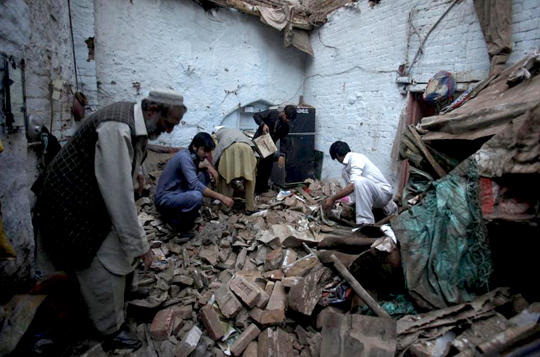
Islamabad, Oct 27: A massive earthquake struck remote and impoverished regions of northern Afghanistan and Pakistan on Monday, killing at least 263 people as it shook buildings across South Asia and knocked out power and communications to already-isolated areas.
earthquake copy

The 7.5-magnitude quake was centered deep beneath the Hindu Kush mountains in Afghanistan's sparsely populated Badakhshan province, which borders Pakistan, Tajikistan and China, the US Geological Survey said.

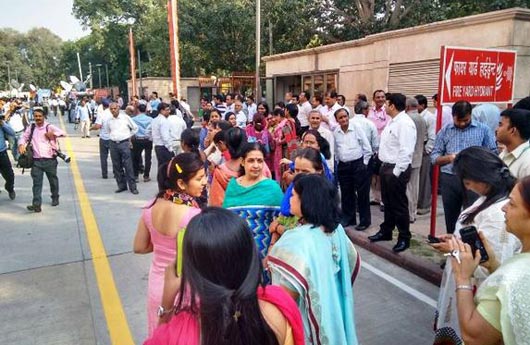
In the Afghan capital of Kabul, buildings shook for up to 45 seconds, walls cracked and cars rolled in the streets as electricity went out. Frightened workers who had just returned from lunch also rushed from swaying buildings in the Pakistani capital of Islamabad and to the south in the Indian capital of New Delhi.

"I was praying when the massive earthquake rattled my home. I came out in a panic," said Munir Anwar of Liaquat Pur in Pakistan's eastern Punjab province.

At least 228 people were killed in Pakistan, with more than 1,000 injured, while Afghan officials reported 33 dead and more than 200 injured, and authorities in the Indian-controlled Kashmir region reported two deaths. Officials expected the casualty toll to rise as they reached the remote areas.

Authorities struggled to reach the hardest-hit areas in Afghanistan near the epicenter, located 73 kilometers (45 miles) south of Fayzabad, the capital of Badakhshan province.

Abdul Humayoon Dehqan, the head of the National Disaster Management Authority's provincial office, said he knew of only 12 dead and 20 injured in the province, mostly in collapsed buildings, and that his teams would not reach affected areas until Tuesday morning to get a better count.

Despite vast mineral deposits, Badakhshan is one of Afghanistan's poorest provinces. It is often hit by earthquakes, but casualty figures are usually low because it is so sparsely populated, with fewer than 1 million people spread across its vast mountains and valleys. It also suffers from floods, snowstorms and mudslides.

Taliban-led insurgents have used its remote valleys as cover recently to seize districts as they spread their footprint across the country. Dehqan said some districts remain under Taliban control "and we don't know how we will be able to help people in those areas."

In Takhar province, west of Badakhshan, 12 students at a girls' school were killed in a stampede as they fled shaking buildings, said Sonatullah Taimor, the spokesman for the provincial governor. Another 42 girls were taken to a hospital in the provincial capital of Taluqan.

Afghanistan's Chief Executive Abdullah Abdullah convened an emergency meeting of disaster officials and urged them to ensure that people were prepared for aftershocks. That could mean many hundreds would be forced to sleep outdoors in nighttime temperatures dropping below freezing. He instructed doctors and hospitals to be prepared to receive casualties.

President Ashraf Ghani sent condolences to those who lost relatives and property and appointed an "assessment committee" to ensure emergency relief reached the needy as soon as possible, his office said.

The US said it has emergency shelters and relief supply kits stored in warehouses throughout Afghanistan that could be used.

White House spokesman Josh earnest says the US government has been in touch with officials in Afghanistan and Pakistan and is ready to provide any additional support.

Pakistan Prime Minister Nawaz Sharif, who was completing a trip to the US, said in a televised comment from London that he planned to fly to the quake-affected region Tuesday. He called the quake a "tragedy," saying most of the casualties and damage were reported in remote areas in the country's northwest.

Pakistan's army chief, Gen. Raheel Sharif, ordered troops to the areas, the military said.

Indian Prime Minister Narendra Modi had contacted Sharif to offer help, Pakistani state-run media said. Pakistani TV said Sharif thanked Modi for the offer but provided no further details.

Pakistan will not issue any appeals to the international community for help as the country has the required resources to carry out the rescue and relief work, said Information Minister Pervez Rashid.

"We have enough resources to handle the situation. Our top priority is to help those affected because of the earthquake," Rashid told a news conference.

Pakistani meteorological department official Zahid Rafiq said the quake was felt across the country. As buildings in Islamabad shook, panicked residents poured into the streets, and many recited verses from the Quran.

Many Pakistanis recall the 7.6-magnitude earthquake of October 8, 2005, that killed more than 80,000 people and left more than 3 million homeless, most in the northwest of the country and in the divided region of Kashmir.

That quake was much shallower than Monday's — 10 kilometers (6 miles) below the surface, compared with 213 kilometers (130 miles) — and thus caused greater damage, said Mohammad Hanif, an official at the Meteorological Department.

In Srinagar, the main city in the India-controlled portion of Kashmir, tremors lasted at least 40 seconds, with buildings swaying and electrical wires swinging wildly, residents said. People ran from buildings shouting, crying and chanting religious hymns to try to keep calm.

"I thought it was the end of the world," shopkeeper Iqbal Bhat said. Kashmir's Chief Secretary BR Sharma said the quake had caused limited damage, though in some areas "many houses and government buildings have developed cracks, and some have also partially collapsed."

quake

Comments

Add new comment

  • Coastaldigest.com reserves the right to delete or block any comments.
  • Coastaldigset.com is not responsible for its readers’ comments.
  • Comments that are abusive, incendiary or irrelevant are strictly prohibited.
  • Please use a genuine email ID and provide your name to avoid reject.
News Network
April 4,2020

Madrid, Apr 4: Spain recorded a second successive daily drop in coronavirus-related deaths with 809 fatalities, official figures showed Saturday.

The total number of deaths in Spain now stands at 11,744, second only to Italy. A record 950 people died on Thursday.

The number of new cases also slowed at 7,026, taking the total to 124,736.

Recoveries over the last 24 hours stood at 3,706, taking that total to 34,219.

The Madrid region was the worst affected accounting for 40 percent of the deaths, 4,723, and 29 percent of the cases at 36,249. The northeastern region of Catalonia was in second place with 2,508 deaths.

Prime Minister Pedro Sanchez is due to decide whether to prolong the emergency measures and confinement declared on March 14 for another two weeks in order to get on top of the outbreak.

Comments

Add new comment

  • Coastaldigest.com reserves the right to delete or block any comments.
  • Coastaldigset.com is not responsible for its readers’ comments.
  • Comments that are abusive, incendiary or irrelevant are strictly prohibited.
  • Please use a genuine email ID and provide your name to avoid reject.
Agencies
July 2,2020

Moscow, Jul 2: Russian voters approved changes to the constitution that will allow President Vladimir Putin to hold power until 2036, but the weeklong plebiscite that concluded Wednesday was tarnished by widespread reports of pressure on voters and other irregularities.

With most of the nation's polls closed and 20% of precincts counted, 72% voted for the constitutional amendments, according to election officials.

For the first time in Russia, polls were kept open for a week to bolster turnout without increasing crowds casting ballots amid the coronavirus pandemic a provision that Kremlin critics denounced as an extra tool to manipulate the outcome.

A massive propaganda campaign and the opposition's failure to mount a coordinated challenge helped Putin get the result he wanted, but the plebiscite could end up eroding his position because of the unconventional methods used to boost participation and the dubious legal basis for the balloting.

By the time polls closed in Moscow and most other parts of Western Russia, the overall turnout was at 65%, according to election officials. In some regions, almost 90% of eligible voters cast ballots.

On Russia's easternmost Chukchi Peninsula, nine hours ahead of Moscow, officials quickly announced full preliminary results showing 80% of voters supported the amendments, and in other parts of the Far East, they said over 70% of voters backed the changes.

Kremlin critics and independent election observers questioned the turnout figures.

We look at neighboring regions, and anomalies are obvious there are regions where the turnout is artificially (boosted), there are regions where it is more or less real, Grigory Melkonyants, co-chair of the independent election monitoring group Golos, told The Associated Press.

Putin voted at a Moscow polling station, dutifully showing his passport to the election worker. His face was uncovered, unlike most of the other voters who were offered free masks at the entrance.

The vote completes a convoluted saga that began in January, when Putin first proposed the constitutional changes.

He offered to broaden the powers of parliament and redistribute authority among the branches of government, stoking speculation he might seek to become parliamentary speaker or chairman of the State Council when his presidential term ends in 2024.

His intentions became clear only hours before a vote in parliament, when legislator Valentina Tereshkova, a Soviet-era cosmonaut who was the first woman in space in 1963, proposed letting him run two more times.

The amendments, which also emphasize the primacy of Russian law over international norms, outlaw same-sex marriages and mention a belief in God as a core value, were quickly passed by the Kremlin-controlled legislature.

Putin, who has been in power for more than two decades longer than any other Kremlin leader since Soviet dictator Josef Stalin said he would decide later whether to run again in 2024.

He argued that resetting the term count was necessary to keep his lieutenants focused on their work instead of darting their eyes in search for possible successors.

Analyst Gleb Pavlovsky, a former Kremlin political consultant, said Putin's push to hold the vote despite the fact that Russia has thousands of new coronavirus infections each day reflected his potential vulnerabilities.

Putin lacks confidence in his inner circle and he's worried about the future, Pavlovsky said.

He wants an irrefutable proof of public support.

Even though the parliament's approval was enough to make it law, the 67-year-old Russian president put his constitutional plan to voters to showcase his broad support and add a democratic veneer to the changes.

But then the coronavirus pandemic engulfed Russia, forcing him to postpone the April 22 plebiscite.

The delay made Putin's campaign blitz lose momentum and left his constitutional reform plan hanging as the damage from the virus mounted and public discontent grew.

Plummeting incomes and rising unemployment during the outbreak have dented his approval ratings, which sank to 59%, the lowest level since he came to power, according to the Levada Center, Russia's top independent pollster.

Moscow-based political analyst Ekaterina Schulmann said the Kremlin had faced a difficult dilemma: Holding the vote sooner would have brought accusations of jeopardizing public health for political ends, while delaying it raised the risks of defeat.

Holding it in the autumn would have been too risky, she said.

In Moscow, several activists briefly lay on Red Square, forming the number 2036 with their bodies in protest before police stopped them.

Some others in Moscow and St. Petersburg staged one-person pickets and police didn't intervene.

Several hundred opposition supporters rallied in central Moscow to protest the changes, defying a ban on public gatherings imposed for the coronavirus outbreak. Police didn't intervene and even handed masks to the participants.

Authorities mounted a sweeping effort to persuade teachers, doctors, workers at public sector enterprises and others who are paid by the state to cast ballots. Reports surfaced from across the vast country of managers coercing people to vote.

The Kremlin has used other tactics to boost turnout and support for the amendments.

Comments

Add new comment

  • Coastaldigest.com reserves the right to delete or block any comments.
  • Coastaldigset.com is not responsible for its readers’ comments.
  • Comments that are abusive, incendiary or irrelevant are strictly prohibited.
  • Please use a genuine email ID and provide your name to avoid reject.
News Network
February 19,2020

Washington, Feb 19: US President Donald Trump has said he is "saving the big deal" with India for later and he "does not know" if it will be done before the presidential election in November, clearly indicating that a major bilateral trade deal during his visit to Delhi next week might not be on the cards.

"We can have a trade deal with India. But I'm really saving the big deal for later," he told reporters at Joint Base Andrews Tuesday afternoon (local time).

The US and India could sign a "trade package" during the visit, according to media reports.

Asked whether he expects a trade deal with India before the visit, Trump said, "We're doing a very big trade deal with India. We'll have it. I don't know if it'll be done before the election, but we'll have a very big deal with India."

US Trade Representative Robert Lighthizer, the point-person for trade negotiations with India, is likely to not accompany Trump to India, sources said. However, officials have not ruled it out altogether.

In an apparent dissatisfaction over US-India trade ties, Trump said, "We're not treated very well by India." But he praised Prime Minister Narendra Modi and said he is looking forward to his visit to India.

"I happen to like Prime Minister Modi a lot," Trump said.

"He told me we'll have seven million people between the airport and the event. And the stadium, I understand, is sort of semi under construction, but it's going to be the largest stadium in the world. So it's going to be very exciting... I hope you all enjoy it," he told reporters.

Meanwhile, the US-India Strategic and Partnership Forum (USISPF) in a report said the latest quarterly data depict continuation of overall positive bilateral trade trends. The third quarter data reflects some downslide in growth rates.

"It may be due to several reasons, including the unexpected economic slowdown in India's economic growth, impact of US-China trade war, GSP withdrawal from the US side and retaliatory tariffs on specific US goods from the Indian side," USISPF said.

According to the report, the data available for the first three quarters of 2019 (January-September) pulled the overall growth rate in cumulative bilateral trade down to 4.5 percent from 8.4 percent registered for the first two quarters.

Goods and services trade performance in third quarter was dismal at -2.3 percent, in contrast with the impressive 9.6 percent growth witnessed for the first two quarters of the year; while trade in services was up two percent goods trade dropped five percent, the report said.

The cumulative US-India trade in goods and services (USD 110.9 billion) for the first three quarters of 2019 increased 4.5 percent with US exports and imports growing at four percent and five percent respectively.

The US exported USD 45.3 billion worth of goods and services to India in the first three quarters 2019, up 4 percent from the corresponding period in the previous year; and the US imported USD 65.6 billion worth of goods and services from India, up five percent from the previous year's USD 62.5 billion level for the same period, it said.

The USISPF has projected that the total bilateral trade can touch USD 238 billion by 2025 if the current 7.5 percent average annual rate of growth sustains; however, higher growth rates can result in bilateral trade in the range of USD 283 billion and USD 327 billion.

The US remains the top trading partner for India in terms of trade in goods and services, followed by China. While the bilateral trade between US and India is approximately 62 percent in goods and 38 percent in services, the bilateral trade between India and China is dominated by goods.

China had a huge trade surplus of USD 58 billion with India, indicating Beijing's strength in the Indian market, especially in sectors, such as electronics, machinery, organic chemicals, plastics and medical devices.

The US goods exports to India, in comparison, were mainly concentrated in mineral fuels, precious stones, and aircraft. The US faces tough competition with China in the Indian market in areas such as electronics, machinery, organic chemicals and medical devices.

Comments

Add new comment

  • Coastaldigest.com reserves the right to delete or block any comments.
  • Coastaldigset.com is not responsible for its readers’ comments.
  • Comments that are abusive, incendiary or irrelevant are strictly prohibited.
  • Please use a genuine email ID and provide your name to avoid reject.