



Afghanistan, Pak earthquake: Over 260 dead, 1200 injured

October 27, 2015

Islamabad, Oct 27: A massive earthquake struck remote and impoverished regions of northern Afghanistan and Pakistan on Monday, killing at least 263 people as it shook buildings across South Asia and knocked out power and communications to already-isolated areas.
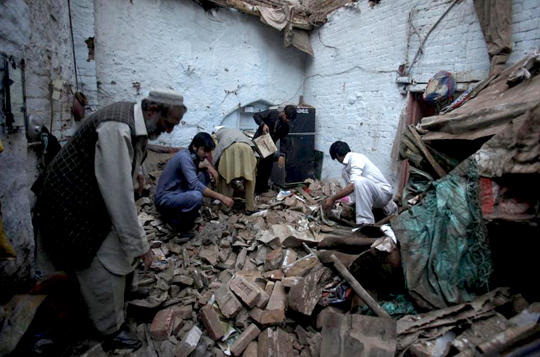
earthquake copy

The 7.5-magnitude quake was centered deep beneath the Hindu Kush mountains in Afghanistan's sparsely populated Badakhshan province, which borders Pakistan, Tajikistan and China, the US Geological Survey said.

In the Afghan capital of Kabul, buildings shook for up to 45 seconds, walls cracked and cars rolled in the streets as electricity went out. Frightened workers who had just returned from lunch also rushed from swaying buildings in the Pakistani capital of Islamabad and to the south in the Indian capital of New Delhi.

"I was praying when the massive earthquake rattled my home. I came out in a panic," said Munir Anwar of Liaquat Pur in Pakistan's eastern Punjab province.

At least 228 people were killed in Pakistan, with more than 1,000 injured, while Afghan officials reported 33 dead and more than 200 injured, and authorities in the Indian-controlled Kashmir region reported two deaths. Officials expected the casualty toll to rise as they reached the remote areas.

Authorities struggled to reach the hardest-hit areas in Afghanistan near the epicenter, located 73 kilometers (45 miles) south of Fayzabad, the capital of Badakhshan province.

Abdul Humayoon Dehqan, the head of the National Disaster Management Authority's provincial office, said he knew of only 12 dead and 20 injured in the province, mostly in collapsed buildings, and that his teams would not reach affected areas until Tuesday morning to get a better count.

Despite vast mineral deposits, Badakhshan is one of Afghanistan's poorest provinces. It is often hit by earthquakes, but casualty figures are usually low because it is so sparsely populated, with fewer than 1 million people spread across its vast mountains and valleys. It also suffers from floods, snowstorms and mudslides.

Taliban-led insurgents have used its remote valleys as cover recently to seize districts as they spread their footprint across the country. Dehqan said some districts remain under Taliban control "and we don't know how we will be able to help people in those areas."

In Takhar province, west of Badakhshan, 12 students at a girls' school were killed in a stampede as they fled shaking buildings, said Sonatullah Taimor, the spokesman for the provincial governor. Another 42 girls were taken to a hospital in the provincial capital of Taluqan.

Afghanistan's Chief Executive Abdullah Abdullah convened an emergency meeting of disaster officials and urged them to ensure that people were prepared for aftershocks. That could mean many hundreds would be forced to sleep outdoors in nighttime temperatures dropping below freezing. He instructed doctors and hospitals to be prepared to receive casualties.

President Ashraf Ghani sent condolences to those who lost relatives and property and appointed an "assessment committee" to ensure emergency relief reached the needy as soon as possible, his office said.

The US said it has emergency shelters and relief supply kits stored in warehouses throughout Afghanistan that could be used.

White House spokesman Josh earnest says the US government has been in touch with officials in Afghanistan and Pakistan and is ready to provide any additional support.

Pakistan Prime Minister Nawaz Sharif, who was completing a trip to the US, said in a televised comment from London that he planned to fly to the quake-affected region Tuesday. He called the quake a "tragedy," saying most of the casualties and damage were reported in remote areas in the country's northwest.

Pakistan's army chief, Gen. Raheel Sharif, ordered troops to the areas, the military said.

Indian Prime Minister Narendra Modi had contacted Sharif to offer help, Pakistani state-run media said. Pakistani TV said Sharif thanked Modi for the offer but provided no further details.

Pakistan will not issue any appeals to the international community for help as the country has the required resources to carry out the rescue and relief work, said Information Minister Pervez Rashid.

"We have enough resources to handle the situation. Our top priority is to help those affected because of the earthquake," Rashid told a news conference.

Pakistani meteorological department official Zahid Rafiq said the quake was felt across the country. As buildings in Islamabad shook, panicked residents poured into the streets, and many recited verses from the Quran.

Many Pakistanis recall the 7.6-magnitude earthquake of October 8, 2005, that killed more than 80,000 people and left more than 3 million homeless, most in the northwest of the country and in the divided region of Kashmir.

That quake was much shallower than Monday's — 10 kilometers (6 miles) below the surface, compared with 213 kilometers (130 miles) — and thus caused greater damage, said Mohammad Hanif, an official at the Meteorological Department.

In Srinagar, the main city in the India-controlled portion of Kashmir, tremors lasted at least 40 seconds, with buildings swaying and electrical wires swinging wildly, residents said. People ran from buildings shouting, crying and chanting religious hymns to try to keep calm.

"I thought it was the end of the world," shopkeeper Iqbal Bhat said. Kashmir's Chief Secretary BR Sharma said the quake had caused limited damage, though in some areas "many houses and government buildings have developed cracks, and some have also partially collapsed."


quake

Comments

Add new comment

  • Coastaldigest.com reserves the right to delete or block any comments.
  • Coastaldigset.com is not responsible for its readers’ comments.
  • Comments that are abusive, incendiary or irrelevant are strictly prohibited.
  • Please use a genuine email ID and provide your name to avoid reject.
News Network
March 25,2020

Wellington, Mar 25: New Zealand has declared a state of emergency as it prepares to go into an unprecedented lockdown late Wednesday for about a month.

The declaration temporarily gives police and the military extra powers. And Prime Minister Jacinda Ardern says any New Zealanders returning home from overseas who show symptoms of COVID-19 will be put in isolation at an approved facility.

“I have one simple message for New Zealanders today as we head into the next four weeks: ‘stay at home,’” Ardern said. “It will break the chain of transmission and it will save lives.”

Ardern said exceptions include people working crucial jobs, those leaving to pick up essentials like groceries, and those engaging in solitary exercise.

The country has 205 reported cases of the virus, although Ardern said that number could rise into the thousands before it begins to recede even with the strict measures being taken.

Comments

Add new comment

  • Coastaldigest.com reserves the right to delete or block any comments.
  • Coastaldigset.com is not responsible for its readers’ comments.
  • Comments that are abusive, incendiary or irrelevant are strictly prohibited.
  • Please use a genuine email ID and provide your name to avoid reject.
Agencies
January 20,2020

For the first time in the 15 years of the Global Risks Report, the climate change and environment risk has occupied all the top five slots.

According to the 15th edition of the World Economic Forum's (WEF) Global Risks Report, the top five risks in terms of likelihood are extreme weather, climate action failure, natural disasters, biodiversity loss and human-made environmental disasters. They all fall in the one category of climate change and related environmental disasters.

WEF President Borge Brende said the world was feeling long-mounting and interconnected risks.

The report also points to how citizens are protesting across the world as discontent rises with failed systems that are creating inequality. The citizens' discontent had hardened with systems that had failed to promote advancement, it said.

"Disapproval of how governments are addressing profound economic and social issues has sparked protests throughout the world, potentially weakening the ability of governments to take decisive action should a downturn occur. Without economic and social stability, countries could lack the financial resources, fiscal margin, political capital or social support needed to confront key global risks," it said.

Listing the grim scenario, Borge said the global economy was faced with "synchronised slowdown", the past five years had been the warmest on record and cyber attacks were expected to increase this year.

The report warns that while the myriad risks were rising, time was running out on how to prevent them.

Borge said the growing palpability of shared economic, environmental and societal risks indicated that the horizon had shortened for preventing "or even mitigating" some of the direst consequences of global risks.

"It's sobering that in the face of this development, when the challenges before us demand immediate collective action, fractures within the global community appear to only be widening," he said.

The report points to grave concern about the consequences of continued environmental degradation, including the record pace of species decline.

Pointing to an unsettled geopolitical environment, the report said today's risk landscape was one in which new centres of power and influence were forming and old alliance structures and global institutions were being tested.

"While these changes can create openings for new partnership structures in the immediate term, they are putting stress on systems of coordination and challenging norms around shared responsibility. Unless stakeholders adapt multilateral mechanisms for this turbulent period, the risks that were once on the horizon will continue to arrive," it said.

Calling it a "an unsettled world", the WEF report notes that powerful economic, demographic and technological forces were shaping a new balance of power. "The result is an unsettled geopolitical landscape in which states are increasingly viewing opportunities and challenges through unilateral lenses," it said.

"What were once givens regarding alliance structures and multilateral systems no longer hold as states question the value of long-standing frameworks, adopt more nationalist postures in pursuit of individual agendas and weigh the potential geopolitical consequences of economic decoupling. Beyond the risk of conflict, if stakeholders concentrate on immediate geo-strategic advantage and fail to re-imagine or adapt mechanisms for coordination during this unsettled period, opportunities for action on key priorities may slip away," the WEF said.

In a chapter on risks to economic stability and social cohesion, it said a challenging economic climate might persist this year and members of the multi-stakeholder community saw "economic confrontations" and "domestic political polarisation" as the top risks in 2020.

The report also warned of downward pressure on the global economy from macroeconomic fragilities and financial inequality. These pressures continued to intensify in 2019, increasing the risk of economic stagnation.

Low trade barriers, fiscal prudence and strong global investment, once seen as fundamentals for economic growth, are fraying as leaders advance nationalist policies. The margins for monetary and fiscal stimuli are also narrower than before the 2008-2009 financial crisis, creating uncertainty about how well countercyclical policies will work.

The strategic partners for the WEF report included Marsh & McLennan and Zurich Insurance Group. The academic advisers were National University of Singapore, Oxford Martin School, University of Oxford and Wharton Risk Management and Decision Processes Center, University of Pennsylvania.

Comments

Add new comment

  • Coastaldigest.com reserves the right to delete or block any comments.
  • Coastaldigset.com is not responsible for its readers’ comments.
  • Comments that are abusive, incendiary or irrelevant are strictly prohibited.
  • Please use a genuine email ID and provide your name to avoid reject.
News Network
March 21,2020

Beijing, Mar 21: China reported no domestically transmitted coronavirus cases for the third consecutive day even as seven more fatalities have been confirmed, taking the death toll in the country to 3255.

No new domestically transmitted cases of COVID-19 were reported on the Chinese mainland for the third day in a row on Friday, China's National Health Commission (NHC) said on Saturday.

The overall confirmed cases on the mainland had reached 81,008 by the end of Friday, which included 3,255 who died, 6,013 patients still undergoing treatment, 71,740 patients who had been discharged after recovery, the NHC said.

The NHC said 41 new confirmed COVID-19 cases were reported on the Chinese mainland on Friday from the people arriving from abroad, taking the total number of imported cases to 269.

Comments

Add new comment

  • Coastaldigest.com reserves the right to delete or block any comments.
  • Coastaldigset.com is not responsible for its readers’ comments.
  • Comments that are abusive, incendiary or irrelevant are strictly prohibited.
  • Please use a genuine email ID and provide your name to avoid reject.