



Afghanistan, Pak earthquake: Over 260 dead, 1200 injured

October 27, 2015

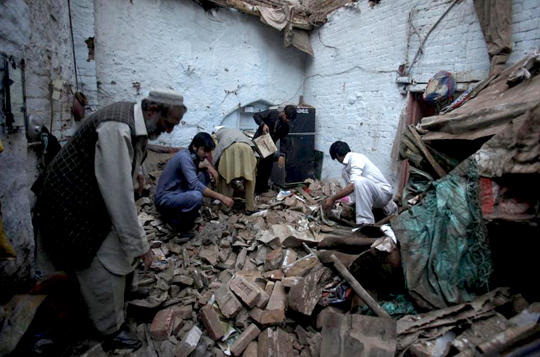
Islamabad, Oct 27: A massive earthquake struck remote and impoverished regions of northern Afghanistan and Pakistan on Monday, killing at least 263 people as it shook buildings across South Asia and knocked out power and communications to already-isolated areas.
earthquake copy

The 7.5-magnitude quake was centered deep beneath the Hindu Kush mountains in Afghanistan's sparsely populated Badakhshan province, which borders Pakistan, Tajikistan and China, the US Geological Survey said.

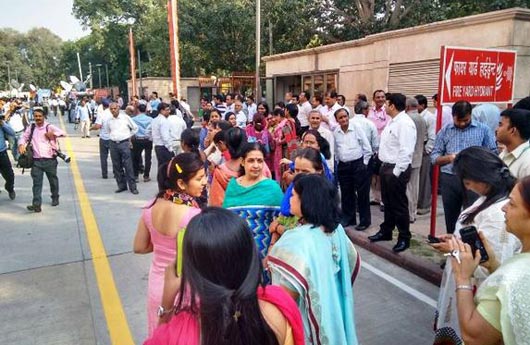
In the Afghan capital of Kabul, buildings shook for up to 45 seconds, walls cracked and cars rolled in the streets as electricity went out. Frightened workers who had just returned from lunch also rushed from swaying buildings in the Pakistani capital of Islamabad and to the south in the Indian capital of New Delhi.

"I was praying when the massive earthquake rattled my home. I came out in a panic," said Munir Anwar of Liaquat Pur in Pakistan's eastern Punjab province.

At least 228 people were killed in Pakistan, with more than 1,000 injured, while Afghan officials reported 33 dead and more than 200 injured, and authorities in the Indian-controlled Kashmir region reported two deaths. Officials expected the casualty toll to rise as they reached the remote areas.

Authorities struggled to reach the hardest-hit areas in Afghanistan near the epicenter, located 73 kilometers (45 miles) south of Fayzabad, the capital of Badakhshan province.

Abdul Humayoon Dehqan, the head of the National Disaster Management Authority's provincial office, said he knew of only 12 dead and 20 injured in the province, mostly in collapsed buildings, and that his teams would not reach affected areas until Tuesday morning to get a better count.

Despite vast mineral deposits, Badakhshan is one of Afghanistan's poorest provinces. It is often hit by earthquakes, but casualty figures are usually low because it is so sparsely populated, with fewer than 1 million people spread across its vast mountains and valleys. It also suffers from floods, snowstorms and mudslides.

Taliban-led insurgents have used its remote valleys as cover recently to seize districts as they spread their footprint across the country. Dehqan said some districts remain under Taliban control "and we don't know how we will be able to help people in those areas."

In Takhar province, west of Badakhshan, 12 students at a girls' school were killed in a stampede as they fled shaking buildings, said Sonatullah Taimor, the spokesman for the provincial governor. Another 42 girls were taken to a hospital in the provincial capital of Taluqan.

Afghanistan's Chief Executive Abdullah Abdullah convened an emergency meeting of disaster officials and urged them to ensure that people were prepared for aftershocks. That could mean many hundreds would be forced to sleep outdoors in nighttime temperatures dropping below freezing. He instructed doctors and hospitals to be prepared to receive casualties.

President Ashraf Ghani sent condolences to those who lost relatives and property and appointed an "assessment committee" to ensure emergency relief reached the needy as soon as possible, his office said.

The US said it has emergency shelters and relief supply kits stored in warehouses throughout Afghanistan that could be used.

White House spokesman Josh earnest says the US government has been in touch with officials in Afghanistan and Pakistan and is ready to provide any additional support.

Pakistan Prime Minister Nawaz Sharif, who was completing a trip to the US, said in a televised comment from London that he planned to fly to the quake-affected region Tuesday. He called the quake a "tragedy," saying most of the casualties and damage were reported in remote areas in the country's northwest.

Pakistan's army chief, Gen. Raheel Sharif, ordered troops to the areas, the military said.

Indian Prime Minister Narendra Modi had contacted Sharif to offer help, Pakistani state-run media said. Pakistani TV said Sharif thanked Modi for the offer but provided no further details.

Pakistan will not issue any appeals to the international community for help as the country has the required resources to carry out the rescue and relief work, said Information Minister Pervez Rashid.

"We have enough resources to handle the situation. Our top priority is to help those affected because of the earthquake," Rashid told a news conference.

Pakistani meteorological department official Zahid Rafiq said the quake was felt across the country. As buildings in Islamabad shook, panicked residents poured into the streets, and many recited verses from the Quran.

Many Pakistanis recall the 7.6-magnitude earthquake of October 8, 2005, that killed more than 80,000 people and left more than 3 million homeless, most in the northwest of the country and in the divided region of Kashmir.

That quake was much shallower than Monday's — 10 kilometers (6 miles) below the surface, compared with 213 kilometers (130 miles) — and thus caused greater damage, said Mohammad Hanif, an official at the Meteorological Department.

In Srinagar, the main city in the India-controlled portion of Kashmir, tremors lasted at least 40 seconds, with buildings swaying and electrical wires swinging wildly, residents said. People ran from buildings shouting, crying and chanting religious hymns to try to keep calm.

"I thought it was the end of the world," shopkeeper Iqbal Bhat said. Kashmir's Chief Secretary BR Sharma said the quake had caused limited damage, though in some areas "many houses and government buildings have developed cracks, and some have also partially collapsed."

quake

Comments

Add new comment

  • Coastaldigest.com reserves the right to delete or block any comments.
  • Coastaldigset.com is not responsible for its readers’ comments.
  • Comments that are abusive, incendiary or irrelevant are strictly prohibited.
  • Please use a genuine email ID and provide your name to avoid reject.
News Network
March 28,2020

London: Italy on Friday recorded the most daily deaths of any country since the start of the coronavirus pandemic and Spain had its deadliest day, as British Prime Minister Boris Johnson became the first major world leader to test positive.

Italy reported 969 new deaths, Spain 769 and France 299 as Europe reeled from a crisis that has put millions at risk around the world and threatened a global economic meltdown.

In other grim milestones, AFP tallies showed a total of 300,000 cases now recorded in Europe with more than 26,000 deaths worldwide, and the United States overtook China as the country with the most infections.

Italy showed infection rates continuing a downward trend and Spain said its rate of new infections appeared to be slowing, but other countries were bracing to feel the full impact of the virus's spread.

The World Health Organization's regional director for Africa warned the continent faced a "dramatic evolution" of the pandemic, as South Africa became the latest nation to start life under lockdown and reported its first COVID-19 deaths.

Johnson, whose country has seen more than 14,000 declared coronavirus cases and 759 deaths, said he had developed mild symptoms over the previous 24 hours and was self-isolating after testing positive.

Britain's Health Secretary Matt Hancock also tested positive with mild symptoms.

Europe has suffered the brunt of the coronavirus crisis in recent weeks, with millions across the continent on lockdown and the streets of Paris, Rome and Madrid eerily empty.

In France — where nearly 2,000 people have died -- the government announced it was extending its stay-at-home order until at least April 15. While severe, the 299 new deaths it recorded on Friday was lower than the 365 reported the previous day.

The death of a 16-year-old girl from the virus has particularly shaken France, and shattered the belief of many young people that they are immune.

The girl's mother Sabine told AFP that Julie "just had a cough" at first but deteriorated quickly. She died on Wednesday, less than a week after showing her first symptoms.

"It's unbearable," Sabine said. "We were supposed to have a normal life."

Focus was also turning to the United States, where the number of known infections jumped by 18,000 on Friday, reaching more than 97,000 -- higher than both China and Italy. The US also recorded 345 deaths over the past 24 hours, with a total toll of 1,478.

In New York City, health workers are battling a surging toll of dead and infected at the US epicentre of the crisis, including an increasing number of younger patients.

"Now it's 50-year-olds, 40-year-olds, 30-year-olds," said one respiratory therapist at the Jewish Medical Center in Queens.

They "didn't listen about not going out or protecting themselves and washing their hands", he said.

- 'Afraid and lost' -

The coronavirus first emerged in China late last year before spreading globally, with more than half a million declared cases in 183 countries and territories.

Over the last six days, as many new cases have been diagnosed around the world as in the previous 80 days.

Beijing managed to contain its spread with lockdowns and quarantines and its epicentre Wuhan is in the process of easing severe movement restrictions in place for two months.

Three billion people around the world have been told to stay indoors.

In a historic first, Pope Francis performed the rarely recited "Urbi et Orbi" blessing to an empty Saint Peter's Square.

"Thick darkness has gathered over our squares, our streets and our cities; it has taken over our lives, filling everything with a deafening silence and a distressing void, that stops everything as it passes by," he said.

"We find ourselves afraid and lost," he said, describing the coronavirus as a "tempest".

Health care systems even in the most developed nations are stretched to breaking point and medical workers have been having to make difficult choices.

"If I've got five patients and only one bed, I have to choose who gets it," Sara Chinchilla, a paediatrician at a hospital near Madrid, told AFP.

The WHO's chief Tedros Adhanom Ghebreyesus said the dire lack of protective gear for frontline health workers was one of the most pressing problems in the fight to prevent deaths.

"The chronic global shortage of personal protective equipment is now one of the most urgent threats to our collective ability to save lives," he told a virtual news conference in Geneva.

Lockdowns and other measures are wreaking havoc on the global economy, with fears of a downturn worse than the Great Depression of the 1930s.

"It is clear that we have entered a recession" that will be worse than in 2009 following the global financial crisis, International Monetary Fund chief Kristalina Georgieva said Friday.

Unprecedented stimulus measures have helped markets bounce back after a brutal month, but people around the world are bracing for economic hardship.

The United States reported that 3.3 million people applied for unemployment benefits last week -- by far the highest number ever recorded.

Retail workers in particular have suffered as many countries shutter non-essential business, while airlines and the global tourism industry have been dealt devastating blows.

The fashion industry was the latest hit on Friday, with Paris men's fashion week and haute couture shows cancelled along with Milan men's fashion week.

- Armies of volunteers -

The World Tourism Organization said Friday it expected tourist arrivals to fall by 20-30 percent this year, with losses of $300 billion-450 billion in international tourism receipts.

But there have been rays of hope in the midst of the crisis.

Armed groups in Cameroon, the Philippines and Yemen have moved in recent days to reduce violence after UN Secretary General Antonio Guterres issued an appeal for ceasefires.

And armies of volunteers have emerged in many countries to bring help to the needy, with food deliveries for the elderly, free taxi rides, accommodation for health workers, and even home-sewn face masks.

Comments

Add new comment

  • Coastaldigest.com reserves the right to delete or block any comments.
  • Coastaldigset.com is not responsible for its readers’ comments.
  • Comments that are abusive, incendiary or irrelevant are strictly prohibited.
  • Please use a genuine email ID and provide your name to avoid reject.
News Network
February 9,2020

Wuhan, Feb 9: President Xi Jinping strode onstage before an adoring audience in the Great Hall of the People in Beijing less than three weeks ago, trumpeting his successes in steering China through a tumultuous year and promising "landmark" progress in 2020.

"Every single Chinese person, every member of the Chinese nation, should feel proud to live in this great era," he declared to applause on the day before the Lunar New Year holiday. "Our progress will not be halted by any storms and tempests."

Xi made no mention of a dangerous new coronavirus that had already taken tenacious hold in the country. As he spoke, the government was locking down Wuhan, a city of 11 million people, in a frantic attempt to stop the virus spreading from its epicenter.

The coronavirus epidemic, which has killed more than 800 people in China as of Sunday and sickened tens of thousands, comes as Xi has struggled with a host of other challenges: a slowing economy, huge protests in Hong Kong, an election in Taiwan that rebuffed Beijing and a protracted trade war with the United States.

Now Xi faces an accelerating health crisis that is also a political one: a profound test of the authoritarian system he has built around himself over the past seven years. As the Chinese government struggles to contain the virus amid rising public discontent with its performance, the changes that Xi has ushered in could make it difficult for him to escape blame.

"It’s a big shock to the legitimacy of the ruling party. I think it could be only second to the June 4 incident of 1989. It’s that big," said Rong Jian, a writer about politics in Beijing, referring to the armed crackdown on Tiananmen Square protesters that year.

"There’s no doubt about his control over power," he added, "but the manner of control and its consequences have hurt his legitimacy and reputation."

Xi himself has recognized what is at stake, calling the outbreak "a major test of China’s system and capacity for governance."

Yet as China’s battle with the coronavirus intensified, Xi put the country’s No. 2 leader, Li Keqiang, in charge of a leadership group handling the emergency, effectively turning him into the public face of the government’s response. It was Li Keqiang who traveled to Wuhan to visit doctors.

Xi, by contrast, receded from public view for several days. That was not without precedent, though it stood out in this crisis, after previous Chinese leaders had used times of disaster to try to show a more common touch. State television and newspapers almost always lead with fawning coverage of Xi’s every move.

That retreat from the spotlight, some analysts said, signaled an effort by Xi to insulate himself from a campaign that may falter and draw public ire. Yet Xi has consolidated power, sidelining or eliminating rivals, so there are few people left to blame when something goes wrong.

"Politically, I think he is discovering that having total dictatorial power has a downside, which is that when things go wrong or have a high risk of going wrong, then you also have to bear all the responsibility," said Victor Shih, an associate professor at the University of California San Diego who studies Chinese politics.

Much of the country’s population has been told to stay at home, factories remain closed, and airlines have cut service. Experts warn that the coronavirus could slam the economy if not swiftly contained.

The government is also having trouble controlling the narrative. Xi now faces unusually sharp public discontent that even China’s rigorous censorship apparatus has been unable to stifle entirely.

The death of an ophthalmologist in Wuhan, Dr. Li Wenliang, who was censured for warning his medical school classmates of the spread of a dangerous new disease in December, has unleashed a torrent of pent-up public grief and rage over the government’s handling of the crisis. Chinese academics have launched at least two petitions in the wake of Li’s death, each calling for freedom of speech.

State media still portray Xi as ultimately in control, and there’s no sign that he faces a serious challenge from within the party leadership. The crisis, though, has already tainted China’s image as an emerging superpower — efficient, stable and strong — that could eventually rival the United States.

How much the crisis might erode Xi’s political standing remains to be seen, but it could weaken his position in the long run as he prepares to take a likely third term as Communist Party general secretary in 2022.

In 2018, Xi won approval to remove the constitutional limits on his term as the country’s president, making his plan for another five-year term seem all but certain.

If Xi comes out of this crisis politically insecure, the consequences are unpredictable. He may become more open to compromise within the party elite. Or he may double down on the imperious ways that have made him China’s most powerful leader in generations.

"Xi’s grip on power is not light," said Jude Blanchette, the Freeman Chair in China Studies at the Center for Strategic and International Studies.

"While the ham-fisted response to this crisis undoubtedly adds a further blemish to Xi’s tenure in office," Blanchette added, "the logistics of organizing a leadership challenge against him remain formidable."

In recent days, despite a dearth of public appearances, state media have portrayed Xi as a tireless commander-in-chief. This week they began calling the government’s fight against the virus the "people’s war," a phrase used in the official readout of Xi’s telephone call with President Donald Trump on Friday.

There are increasing signs that the propaganda this time is proving less than persuasive.

The Lunar New Year reception in Beijing where Xi spoke became a source of popular anger, a symbol of a government slow to respond to the suffering in Wuhan. Xi and other leaders appear to have been caught off guard by the ferocity of the epidemic.

Senior officials would almost certainly have been informed of the emerging crisis by the time national health authorities told the World Health Organization on Dec. 31, but neither Xi nor other officials in Beijing informed the public.

Xi’s first acknowledgment of the epidemic came Jan. 20, when brief instructions were issued under his name. His first public appearance after the lockdown of Wuhan on Jan. 23 came two days later, when he presided over a meeting of the Communist Party’s top body, the Politburo Standing Committee, which was shown at length on Chinese television. "We’re sure to be able to win in this battle," he proclaimed.

Back then, the death toll was 106. As it rose, Xi allowed other officials to take on more visible roles. Xi’s only appearances have been meeting foreign visitors in the Great Hall of the People or presiding over Communist Party meetings.

On Jan. 28, Xi met with the executive director of the World Health Organization, Dr. Tedros Adhanom Ghebreyesus, and told Tedros that he "personally directed" the government’s response. Later reports in state media omitted the phrase, saying instead that Xi’s government was "collectively directing" the response.

Since nothing about how Xi is portrayed in state media happens by accident, the tweak suggested a deliberate effort to emphasize shared responsibility.

Xi did not appear on official broadcasts again for a week — until a highly scripted meeting Wednesday with the authoritarian leader of Cambodia, Hun Sen.

There is little evidence that Xi has given up power behind the scenes. Li Keqiang, the premier in formal charge of the leadership group for the crisis, and other officials have said that they take their orders from Xi. The group is filled with officials who work closely under Xi, and its directives emphasize his authority.

"The way the epidemic is being handled now from the top just doesn’t fit with the argument that there’s been a clear shift toward more collective, consultative leadership," said Holly Snape, a British Academy Fellow at the University of Glasgow who studies Chinese politics.

The scale of discontent and the potential challenges for Xi could be measured by repeated references online to the nuclear accident at Chernobyl. Many of them came under the guise of viewer reviews of the popular television miniseries of the same name, which is still available for streaming inside China.

"In any era, any country, it’s the same. Cover everything up," one reviewer wrote.

The Soviet Union of 1986, however, was a different country than China in 2020.

The Soviet state was foundering when Chernobyl happened, said Sergey Radchenko, a professor of international relations at Cardiff University in Wales who has written extensively on Soviet and Chinese politics.

"The Chinese authorities, by contrast, are demonstrating an ability to cope, a willingness to take unprecedented measures — logistical feats that may actually increase the regime’s legitimacy," he added.

Radchenko compared Xi’s actions to those of previous leaders in moments of crisis: Mao Zedong after the Cultural Revolution or Deng Xiaoping after the Tiananmen Square crackdown.

"He’s doing what Mao and Deng would have done in similar circumstances: stepping back into the shadows while remaining firmly in charge."

Comments

Add new comment

  • Coastaldigest.com reserves the right to delete or block any comments.
  • Coastaldigset.com is not responsible for its readers’ comments.
  • Comments that are abusive, incendiary or irrelevant are strictly prohibited.
  • Please use a genuine email ID and provide your name to avoid reject.
Agencies
May 23,2020

Washington, May 23: President Donald Trump has labeled churches and other houses of worship as “essential" and called on governors nationwide to let them reopen this weekend even though some areas remain under coronavirus lockdown.

The president threatened Friday to “override” governors who defy him, but it was unclear what authority he has to do so.

“Governors need to do the right thing and allow these very important essential places of faith to open right now — for this weekend," Trump said at a hastily arranged press conference at the White House. Asked what authority Trump might have to supersede governors, White House press secretary Kayleigh McEnany said she wouldn't answer a theoretical question.

Trump has been pushing for the country to reopen as he tries to reverse an economic free fall playing out months before he faces reelection. White evangelical Christians have been among the president's most loyal supporters, and the White House has been careful to attend to their concerns throughout the crisis.

Following Trump's announcement, the Centers for Disease Control and Prevention released new guidelines for communities of faith on how to safely reopen, including recommendations to limit the size of gatherings and consider holding services outdoors or in large, well-ventilated areas.

Public health agencies have generally advised people to avoid gatherings of more than 10 people and encouraged Americans to remain 6 feet (1.8 meters) away from others when possible. Some parts of the country remain under some version of remain-at-home orders.

In-person religious services have been vectors for transmission of the virus. A person who attended a Mother's Day service at a church in Northern California that defied the governor's closure orders later tested positive, exposing more than 180 churchgoers. And a choir practice at a church in Washington state was labeled by the CDC as an early “superspreading" event.

But Trump on Friday stressed the importance of churches in many communities and said he was “identifying houses of worship — churches, synagogues and mosques — as essential places that provide essential services.”

“Some governors have deemed liquor stores and abortion clinics as essential” but not churches, he said. “It's not right. So I'm correcting this injustice and calling houses of worship essential." “These are places that hold our society together and keep our people united,” he added.

Dr. Deborah Birx, coordinator of the White House coronavirus task force, said faith leaders should be in touch with local health departments and can take steps to mitigate risks, including making sure those who are at high risk of severe complications remain protected.

“There's a way for us to work together to have social distancing and safety for people so we decrease the amount of exposure that anyone would have to an asymptomatic," she said.

A person familiar with the White House's thinking who spoke on condition of anonymity to discuss internal deliberations said Trump had called the news conference, which had not been on his public schedule, because he wanted to be the face of church reopenings, knowing how well it would play with his political base.

Churches around the country have filed legal challenges opposing virus closures.

In Minnesota, after Democratic Gov. Tim Walz this week declined to lift restrictions on churches, Roman Catholic and some Lutheran leaders said they would defy his ban and resume worship services. They called the restrictions unconstitutional and unfair since restaurants, malls and bars were allowed limited reopening.

Some hailed the president's move, including Kelly Shackelford, president of the conservative First Liberty Institute.

“The discrimination that has been occurring against churches and houses of worship has been shocking," he said in a statement. "Americans are going to malls and restaurants. They need to be able to go to their houses of worship.” But Rabbi Jack Moline, president of Interfaith Alliance, said it was “completely irresponsible” for Trump to call for a mass reopening of houses of worship.

“Faith is essential and community is necessary; however, neither requires endangering the people who seek to participate in them,” he said.

“The virus does not discriminate between types of gatherings, and neither should the president." Rhode Island Gov. Gina Raimondo, a Democrat, made clear that churches and other houses of worship will not resume in-person services in her state until at least next weekend and said she was skeptical Trump had the authority to impose such a requirement.

“It's reckless to force them to reopen this weekend. They're not ready,” she said. “We've got a good plan. I'm going to stick with it.” New Hampshire Gov. Chris Sununu, a Republican, said he would review the federal guidance, while maintaining a decision rests with him.

"Obviously we'd love to get to the point where we can get those open, but we'll look at the guidance documents and try to make some decisions rather quickly, depending on what it might say,” he said. “It's the governor's decision, of course.”

The CDC more than a month ago sent the Trump administration documents the agency had drafted outlining specific steps various kinds of organizations, including houses of worship, could follow as they worked to reopen safely.

But the White House dragged its feet, concerned that the recommendations were too specific and could give the impression the administration was interfering in church operations.

The guidance posted Friday contains most of the same advice as the draft guidance. It calls for the use of face coverings and recommends keeping worshippers 6 feet from one another and cutting down on singing, which can spread aerosolized drops that carry the virus.

Comments

Add new comment

  • Coastaldigest.com reserves the right to delete or block any comments.
  • Coastaldigset.com is not responsible for its readers’ comments.
  • Comments that are abusive, incendiary or irrelevant are strictly prohibited.
  • Please use a genuine email ID and provide your name to avoid reject.