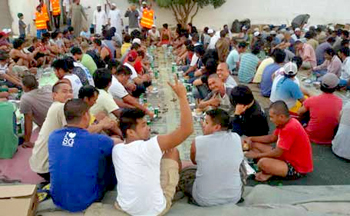
After having Iftar with Muslims, 220 Filipinos embrace Islam in Saudi Arabia

June 28, 2015

embrace IslamMakkah, June 27: About 220 Filipinos converted to Islam on the same day in Saudi Arabia after having Iftar (Ramadan evening meal) with Muslims.

The 220 workers at a local company decided to embrace Islam after they were invited to the religion by the Islamic Guidance Office near the Western town of Makkah.

"They had Iftar with us for a few days... we then decided to invite them to Islam and they all agreed to embrace the religion," the Office's director Sheikh Salim Al Maabadi said, quoted by Sabq daily.

Comments

Add new comment

  • Coastaldigest.com reserves the right to delete or block any comments.
  • Coastaldigset.com is not responsible for its readers’ comments.
  • Comments that are abusive, incendiary or irrelevant are strictly prohibited.
  • Please use a genuine email ID and provide your name to avoid reject.
News Network
March 9,2020

Riyadh, Mar 9: Schools and universities will be closed in Saudi Arabia from Monday to control the spread of coronavirus.

The Saudi Ministry of Education said the “preventive and precautionary” measures were recommended by the health authorities and are designed to protect students and staff.

The decision covers all educational institutions, including public and private schools, and technical and vocational training institutions.

“The Minister of Education directed that virtual schools and distance education be activated while the schools are closed to ensure that the educational process continues in an effective and quality manner,” the ministry said.

The Kingdom's Education Minister, Hamad bin Mohammed Al-Asheikh, confirmed that the decision was a precautionary step and said that they are conducting daily and weekly evaluations before returning to school.

Meanwhile, the Minister of Health, Tawfiq Al-Rabiah, confirmed that there have been no coronavirus cases in any educational facility in the Kingdom.

“Thank God, the situation is reassuring, and there has been no case in any educational facility. However, the increasing cases in countries have made us keen to enhance the safety of our sons and daughters. So we coordinated with the Ministry of Education to close the schools temporarily,” he said in a tweet on Sunday.

The education ministry has set up supervision offices to help coordinate the distance learning, and respond to parents’ inquiries.

A new committee set up by the ministry will also ensure the virtual schools are functioning through the distance learning methods provided by the ministry.

These include the virtual school platform (Vschool.sa) and mwterials available from the Apple and Android stores.

It will also provide lessons through the “Ain” TV channeland as well as on YouTube via this link: www.youtube.com/dorosien.

The General Presidency for the Affairs of the Grand Mosque and the Prophet’s Mosque also said on Sunday that it will suspend the visitation programs in its external facilities as part of recommended precautions to prevent the spread of the coronavirus and ensure the safety of visitors.

The facilities include the King Abdulaziz Complex for the Covering of the Holy Kaaba, the Gallery of the Two Holy Mosques, and the Library of the Holy Mosque of Makkah.

“The presidency has taken a series of precautionary measures to prevent the spread of the virus, by intensifying sterilization work that is taking place around the clock, and has been keen on coordination and joint cooperation with all relevant government sectors,” it said in a statement issued on SPA.

It added that these preventive efforts come within the procedures that are being implemented by the Saudi government seeking to combat the spread of the new virus, to protect the people of the Two Holy Mosques in particular, and citizens and residents in the Kingdom in general.

Comments

Add new comment

  • Coastaldigest.com reserves the right to delete or block any comments.
  • Coastaldigset.com is not responsible for its readers’ comments.
  • Comments that are abusive, incendiary or irrelevant are strictly prohibited.
  • Please use a genuine email ID and provide your name to avoid reject.
News Network
July 1,2020

Riyadh, Jul 1: Saudis braced Wednesday for a tripling in value added tax, another unpopular austerity measure after the twin shocks of coronavirus and an oil price slump triggered the kingdom's worst economic decline in decades.

Retailers in the country reported a sharp uptick in sales this week of everything from gold and electronics to cars and building materials, as shoppers sought to stock up before VAT is raised to 15 percent.

The hike could stir public resentment as it weighs on household incomes, pushing up inflation and depressing consumer spending as the kingdom emerges from a three-month coronavirus lockdown.

"Cuts, cuts, cuts everywhere," a Saudi teacher in Riyadh told AFP, bemoaning vanishing subsidies as salaries remain stagnant.

"Air conditioner, television, electronic items," he said, rattling off a list of items he bought last week ahead of the VAT hike.

"I can't afford these things from Wednesday."

With its vast oil wealth funding the Arab world's biggest economy, the kingdom had for decades been able to fund massive spending with no taxes at all.

It only introduced VAT in 2018, as part of a push to reduce its dependence on crude revenues.

Then, seeking to shore up state finances battered by sliding oil prices and the coronavirus crisis, it announced in May that it would triple VAT and halt a cost-of-living monthly allowance to citizens.

The austerity push underscores how Saudi Arabia's once-lavish spending is becoming a thing of the past, with the erosion of the welfare system leaving a mostly young population to cope with reduced incomes and a lifestyle downgrade.

That could pile strain on a decades-old social contract whereby citizens were given generous subsidies and handouts in exchange for loyalty to the absolute monarchy.

The rising cost of living may prompt many to ask why state funds are being lavished on multi-billion-dollar projects and overseas assets, including the proposed purchase of English football club Newcastle United.

Shopping malls in the kingdom have drawn large crowds in recent days as retailers offered "pre-VAT sales" and discounts before the hike kicks in.

A gold shop in Riyadh told AFP it saw a 70 percent jump in sales in recent weeks, while a car dealership saw them tick up by 15 percent.

Once the new rate is in place, businesses are predicting depressed sales of everything from cars to cosmetics and home appliances.

Capital Economics forecast inflation will jump up to six percent year-on-year in July, from 1.1 percent in May, as a result.

"The government ended the country's lockdown (in June) and there are signs that economic activity has started to recover," Capital Economics said in a report.

"Nonetheless, we expect the recovery to be slow-going as fiscal austerity measures bite."

The kingdom also risks losing its edge against other Gulf states, including its principal ally the United Arab Emirates, which introduced VAT at the same time but has so far refrained from raising it beyond five percent.

"Saudi Arabia is taking massive risks with contractionary fiscal policies," said Tarek Fadlallah, chief executive officer of the Middle East unit of Nomura Asset Management.

But the kingdom has few choices as oil revenue declines.

Its finances have taken another blow as authorities massively scaled back this year's hajj pilgrimage, from 2.5 million pilgrims last year to around a thousand already inside the country, and suspended the lesser umrah because of coronavirus.

Together the rites rake in some $12 billion annually.

The International Monetary Fund warned the kingdom's GDP will shrink by 6.8 percent this year -- its worst performance since the 1980s oil glut.

The austerity drive would boost state coffers by 100 billion riyals ($26.6 billion), according to state media.

But the measures are unlikely to plug the kingdom's huge budget deficit.

The Saudi Jadwa Investment group forecasts the shortfall will rise to a record $112 billion this year.


Comments

Add new comment

  • Coastaldigest.com reserves the right to delete or block any comments.
  • Coastaldigset.com is not responsible for its readers’ comments.
  • Comments that are abusive, incendiary or irrelevant are strictly prohibited.
  • Please use a genuine email ID and provide your name to avoid reject.
Arab News
March 9,2020

Dubai, Mar 9: The eyes of the world will be on the oil markets when the big trading hubs in Europe and North America open following the end of the deal between Saudi Arabia and Russia that has helped to sustain crude at relatively high levels for the past three years.

There were big falls on Friday when ministers from the Organization of the Petroleum Exporting Countries (OPEC) failed to get a deal with non-OPEC members — the so-called OPEC+ — to extend output agreements. Brent oil was down nearly 10 percent at $45.27 going into the western weekend.

Saudi Aramco took immediate action to cut prices after the OPEC+ collapse, offering big discounts for crude deliveries from next month, when the current output restrictions end.

According to a notification sent to customers by Saudi Aramco, seen by Arab News, the Kingdom’s oil giant will cut between $4 and $8 per barrel, with the biggest discounts being offered to buyers in northwest Europe and the US.

Roger Diwan, an oil analyst at consultancy IHS Market, said: “We are likely to see the lowest oil prices of the past 20 years in the next quarter.”

West Texas Intermediate, the US oil benchmark, fell to $28.27 in November 2001.

The move raises the possibility of a “crude war” between the three biggest oil blocs — the US, Russia and the Arabian Gulf. Some analysts believe the American shale industry is more vulnerable to low prices than either the Russians or the Saudis.

Robin Mills, head of the Qamar consultancy, told Arab News: “I don’t think this was premeditated but Saudi Arabia has clearly swung quickly into action to put the Russians under pressure. But the Russians, with low debt and a flexible exchange rate, can cope with a few months of low prices.”

The boom in US shale has made the country the biggest oil producer in the world, but with high financing costs. Lower global prices would put a lot of shale companies out of business.

On the other hand, American motorists, and President Donald Trump, would be pleased to see lower fuel prices in an election year.

In Moscow, one prominent financier with ties to the Kingdom played down the long-term significance of the Vienna fallout.

Kirill Dmitriev, chief executive of the Russian Direct Investment Fund, told Arab News: “Saudi Arabia is our strategic partner, and cooperation between our two countries will continue in all areas. We will also continue to work within the framework of the Russia-Saudi Economic Council.”

One Russian official, who asked not to be named, added: “There is a good relationship between Alexander Novak, Russian energy minister, and his Saudi counterpart Prince Abdul Aziz bin Salman, and I am sure they will continue talking to each other less formally.”

Comments

Add new comment

  • Coastaldigest.com reserves the right to delete or block any comments.
  • Coastaldigset.com is not responsible for its readers’ comments.
  • Comments that are abusive, incendiary or irrelevant are strictly prohibited.
  • Please use a genuine email ID and provide your name to avoid reject.