


AirAsia jet's black box found, to be retrieved tomorrow

January 11, 2015

Jakarta/Singapore, Jan 11: The crucial black box of the crashed AirAsia jet was today found in the Java Sea stuck under debris from the plane's fuselage and will be retrieved tomorrow as the major breakthrough in the search raised hopes of unravelling the mystery of the crash soon.Air Asia found
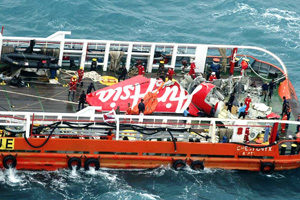
Indonesia's Directorate General of Marine Transport confirmed that the black box of AirAsia Flight QZ8501 has been found. The breakthrough comes exactly two weeks after the flight from Surabaya to Singapore went down with 162 people on board.

Coordinator of the Directorate General of Marine Transport Tonny Budiono said navy divers from Indonesia navy ship KN Jadayat found the black box at a depth of 30 to 32 metres.

The black box is currently wedged between pieces of wreckage making it difficult for divers to retrieve, and due to time constraints, retrieval will take place tomorrow morning, said Budiono.

The search crew will attempt to retrieve the black box by moving parts of wreckage to loosen it from where it is currently stuck, and if that fails, the same balloon method used to lift the tail of the plane will be employed, he said.

To facilitate recovery efforts, a marker buoy has been installed at the site where the black box is, Budiono said.

The black box was found after strong "pings" were heard in the Java Sea and a large object likely to be the plane's fuselage was located near the spot from where the tail section was retrieved.

The black box was located amid poor weather conditions which continued to hamper search efforts to locate the wreckage of the Airbus A320-200.

The developments come a day after the tail of the doomed AirAsia jet was lifted out of the choppy waters of the Java Sea using inflatable balloons.

The black box was not found inside the section. The 10-metre-long metal chunk, with the words "AirAsia" clearly visible across it, became the first major wreckage lifted off the seabed.

The recorders are important because they should contain the pilots' final words and possibly various flight data.

Indonesia AirAsia plane lost contact with ground control on December 28, less than half way into a two-hour flight from Indonesia to Singapore and crashed possibly due to bad weather.

Only 48 bodies, including at least two strapped to their seats, have been found in the Java Sea.

The Indonesian meteorological agency has said weather was the "triggering factor" for the crash, with ice likely damaging the engines of the plane.

Comments

Add new comment

  • Coastaldigest.com reserves the right to delete or block any comments.
  • Coastaldigset.com is not responsible for its readers’ comments.
  • Comments that are abusive, incendiary or irrelevant are strictly prohibited.
  • Please use a genuine email ID and provide your name to avoid reject.
News Network
May 7,2020

Mumbai, May 7: Maharashtra Minister Nawab Malik on Wednesday accused the BJP-led Uttar Pradesh and Karnataka governments of adopting an uncooperative approach in taking back migrant workers hailing from these two states.

Mr Malik said that such a problem has not arisen with other states like Bihar, Rajasthan and another BJP-ruled state, Madhya Pradesh.

"They are creating new hurdles. There are no such problems in case of other states like Bihar, Rajasthan, Madhya Pradesh and West Bengal though.

"The process (of sending back migrants) has been smooth in the case of these states," Mr Malik said.

The NCP leader alleged that the Uttar Pradesh and Karnataka governments either don't want the people hailing from their states to return or are deliberately creating hurdles so that out of job workers do not go back in big numbers.

The Uttar Pradesh and Karnataka government should understand that the migrant workers are not ready mentally to stay back in Maharashtra and want to return to their native states, Mr Malik said.

The NCP minister said the Maharashtra government has been sending the applications received from migrant workers to the nodal officers of their respective native districts.

Once the nodal officers (of the native districts) concerned approve the applications, the workers are sent back either by trains or private vehicles following their medical tests, Mr Malik added.

Comments

Add new comment

  • Coastaldigest.com reserves the right to delete or block any comments.
  • Coastaldigset.com is not responsible for its readers’ comments.
  • Comments that are abusive, incendiary or irrelevant are strictly prohibited.
  • Please use a genuine email ID and provide your name to avoid reject.
News Network
March 3,2020

Mar 3: Just hours after the ending of a week-long “reduction” in violence that was crucial for Donald Trump’s peace deal in Afghanistan, the Taliban struck again: On Monday, they killed three people and injured about a dozen at a football match in Khost province. This resumption of violence will not surprise anyone actually invested in peace for that troubled country. The point of the U.S.-Taliban deal was never peace. It was to try and cover up an ignominious exit for the U.S., driven by an election-bound president who feels no responsibility toward that country or to the broader region.

Seen from South Asia, every point we know about in the agreement is a concession by Trump to the Taliban. Most importantly, it completes a long-term effort by the U.S. to delegitimize the elected government in Kabul — and, by extension, Afghanistan’s constitution. Afghanistan’s president is already balking at releasing 5,000 Taliban prisoners before intra-Afghan talks can begin — a provision that his government did not approve.

One particularly cringe-worthy aspect: The agreement refers to the Taliban throughout  as “the Islamic Emirate of Afghanistan that is not recognized by the United States as a state and is known as the Taliban.” This unwieldy nomenclature validates the Taliban’s claim to be a government equivalent to the one in Kabul, just not the one recognised at the moment by the U.S. When read together with the second part of the agreement, which binds the U.S. to not “intervene in [Afghanistan’s] domestic affairs,” the point is obvious: The Taliban is not interested in peace, but in ensuring that support for its rivals is forbidden, and its path to Kabul is cleared.

All that the U.S. has effectively gotten in return is the Taliban’s assurance that it will not allow the soil of Afghanistan to be used against the “U.S. and its allies.” True, the U.S. under Trump has shown a disturbing willingness to trust solemn assurances from autocrats; but its apparent belief in promises made by a murderous theocratic movement is even more ridiculous. Especially as the Taliban made much the same promise to an Assistant Secretary of State about Osama bin Laden while he was in the country plotting 9/11.

Nobody in the region is pleased with this agreement except for the Taliban and their backers in the Pakistani military. India has consistently held that the legitimate government in Kabul must be the basic anchor of any peace plan. Ordinary Afghans, unsurprisingly, long for peace — but they are, by all accounts, deeply skeptical about how this deal will get them there. The brave activists of the Afghan Women’s Network are worried that intra-Afghan talks will take place without adequate representation of the country’s women — who have, after all, the most to lose from a return to Taliban rule.

But the Pakistani military establishment is not hiding its glee. One retired general tweeted: “Big victory for Afghan Taliban as historic accord signed… Forced Americans to negotiate an accord from the position of parity. Setback for India.” Pakistan’s army, the Taliban’s biggest backer, longs to re-install a friendly Islamist regime in Kabul — and it has correctly estimated that, after being abandoned by Trump, the Afghan government will have sharply reduced bargaining power in any intra-Afghan peace talks. A deal with the Taliban that fails also to include its backers in the Pakistani military is meaningless.

India, meanwhile, will not see this deal as a positive for regional peace or its relationship with the U.S. It comes barely a week after Trump’s India visit, which made it painfully clear that shared strategic concerns are the only thing keeping the countries together. New Delhi remembers that India is not, on paper, a U.S. “ally.” In that respect, an intensification of terrorism targeting India, as happened the last time the U.S. withdrew from the region, would not even be a violation of Trump’s agreement. One possible outcome: Over time the government in New Delhi, which has resolutely sought to keep its ties with Kabul primarily political, may have to step up security cooperation. Nobody knows where that would lead.

The irresponsible concessions made by the U.S. in this agreement will likely disrupt South Asia for years to come, and endanger its own relationship with India going forward. But worst of all, this deal abandons those in Afghanistan who, under the shadow of war, tried to develop, for the first time, institutions that work for all Afghans. No amount of sanctimony about “ending America’s longest war” should obscure the danger and immorality of this sort of exit.

Comments

Add new comment

  • Coastaldigest.com reserves the right to delete or block any comments.
  • Coastaldigset.com is not responsible for its readers’ comments.
  • Comments that are abusive, incendiary or irrelevant are strictly prohibited.
  • Please use a genuine email ID and provide your name to avoid reject.
News Network
April 6,2020

New Delhi, April 6: The United States has donated $2.9 million assistance package for India to help the Narendra Modi government brace itself against the coronavirus as countries across the world are coming together to combat the outbreak.

On March 28, the US government, via US Agency for International Development, announced $2.9 million to support India in its response to COVID-19.

"It builds on a foundation of over $1.4 billion in health assistance and nearly $3 billion in total assistance that the US provided to India over the last 20 years," the US Embassy in India said in a statement.

"These new funds will support two organisations, including $2.4 million for USAID's health strengthening project, implemented by Jhpiego, an international non-profit health organisation affiliated with Johns Hopkins University and $500,000 for the World Health Organization (WHO)," the statement said.

The funds will also help India combat the spread of COVID-19, provide care for the affected and support local communities with the tools needed to contain the disease, it added.

Moreover, being a global leader in health and humanitarian response to COVID-19, the US has provided approximately $18.3 million assistance package to ASEAN member countries to fight the contagion.

The funds will be used to prepare laboratories for large-scale testing for the lethal virus, infection prevention and control, enable risk communication, implement public-health emergency plans for border points of entry, activate case-finding and event-based surveillance for influenza-like illnesses, train and equip rapid-responders in investigation and contact-tracing and update training materials for health workers.

Comments

Add new comment

  • Coastaldigest.com reserves the right to delete or block any comments.
  • Coastaldigset.com is not responsible for its readers’ comments.
  • Comments that are abusive, incendiary or irrelevant are strictly prohibited.
  • Please use a genuine email ID and provide your name to avoid reject.