



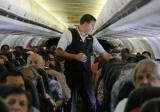
As airlines squeeze seats, passengers jostle for space

December 27, 2013

Airlines_squeeze_seatsDec 27: With air travellers increasingly feeling like packed sardines, flying has become a contact sport.

Flying airplanes can be a bruising experience these days. Rory Rowland said he was rudely rebuffed after he asked the person in front of him not to recline his seat on a red-eye flight. When he later got up to use the bathroom, and the other passenger had fallen asleep, “I hip-checked his seat like you wouldn’t believe,” Rowland, a speaker and consultant, said, then feigned innocence when the enraged passenger complained to a flight attendant. With air travellers increasingly feeling like packed sardines, flying has become a contact sport, nowhere more than over the reclined seat. Now, it’s only getting worse, as airlines re-examine every millimetre of the cabin.

Over the last two decades, the space between seats - hardly roomy before - has fallen about 10 per cent, from 34 inches to somewhere between 30 and 32 inches. Today, some airlines are pushing it even further, leaving only a knee-crunching 28 inches. To gain a little more space, airlines are turning to a new generation of seats that use lighter materials and less padding, moving the magazine pocket above the tray table and even reducing or eliminating the recline in seats. Some are even reducing the number of galleys and bathrooms.

Southwest, the nation’s largest domestic carrier, is installing seats with less cushion and thinner materials - a svelte model known in the business as “slim-line.” It also is reducing the maximum recline to 2 inches from 3. These new seats allow Southwest to add another row, or six seats, to every flight - and add $200 million a year in newfound revenue.

“In today’s environment, the goal is to fit as many seats in the cabin as possible,” said Tom Plant, the general manager for seating products at B/E Aerospace, one of the top airplane seat makers. “We would all like more space on an aircraft, but we all like a competitive ticket price.”

Some carriers are taking the smush to new heights. Spirit Airlines, for instance, uses seats on some flights with the backrest permanently set back 3 inches. Call it, as Spirit does, “prereclined.” The low-cost airline started installing the seats in 2010, squeezing passengers into an industry low of 28 inches. While the Airbus A320 typically accommodates 150 passengers in coach, Spirit can pack 178.

And that’s a good thing, Spirit says. “Customers appreciate the fact that there is no longer interference from the seat in front of you moving up and down throughout the flight,” said Misty Pinson, a spokeswoman for Spirit.

Rick Seaney, the chief executive of FareCompare.com, said the airline business had changed in recent years, after airlines parked older planes and started flying with fewer empty seats. In the past five years, he said, carriers had cut capacity - the number of seats they fly - about 12 per cent. “The flip side is they can’t afford not to fill up their seats,” Seaney said. “This is a massive sea change.”

With so little space to haggle over, passengers have developed their own techniques for handling the crowded conditions. “They jam their knee into the back of your seat as hard as they can and they’ll do it repeatedly to see if they can get a reaction,” said Mick Brekke, a businessman who flies for work a few times a month. “That’s happened to me more than once, and that usually settles down after they realize I’m not going to put it back up.”

The passengers Brekke has encountered are not even the most extreme: Some have taken to using seat-jamming devices, known as knee guards, that prevent a seat in front from reclining. Airlines ban them, but they work, users say.

Smaller seats are not the only reason passengers feel more constricted these days.

Travellers are also getting bigger. In the last four decades, the average American gained a little more than 20 pounds and his or her waist expanded about 2.5 inches, according to the Centres for Disease Control and Prevention. The dimensions of airplanes, however, have not changed and neither has the average width of a coach seat, which is 17 to 18 inches.

Lower costs

As the cabins grow more crowded, airlines say they are thinking only of their customers, trying to keep costs down. Jude Bricker, the senior vice president for planning at Allegiant, said the airline’s nonreclining seats have fewer moving parts and so require less maintenance, which means lower costs. This allows the airline to keep its fares low, he said. “We are continually reminded from customers and their behavior that what they want most is convenient service with a low fare,” Bricker said.

Several budget carriers in Europe have also adopted stiff seats, including Ryanair and EasyJet. Air France, for its domestic flights, which never take more than an hour, has installed nonreclining seats where the magazine pocket has been moved above the tray table to provide more space in the critical area around the knees.

For passengers willing to pay more, airlines offer more room. Business class remains an ultracompetitive market with constant innovation and comfortable amenities, like seats that recline fully. Airlines are also increasingly offering several rows of coach seats with more legroom - also at an extra price.

Still, the squeeze is on for most passengers in coach. On a flight from Washington to Frankfurt, Germany last year, Odysseas Papadimitriou, the chief executive of WalletHub.com, a personal finance social network, was challenged by a tall passenger seated behind him when he reclined his seat. “He was like, 'Hey, watch it, buddy. I don’t fit here with you reclining the seat,'” he said.

Papadimitriou called the flight attendant to mediate the dispute and eventually tilted his seat back, but the price he paid to recline was a fitful night’s sleep, as the other passenger grumbled and pushed against the back of his seat for the rest of the flight.

There are ways of resolving conflicts other than bumping into other passengers, as Rowland, the speaker and consultant, found. “I lean forward and tap them on the shoulder and say, 'I’ll buy you a drink if you don’t push your seat back,'” Rowland said. “It’s made flying very pleasant.”

Comments

Add new comment

  • Coastaldigest.com reserves the right to delete or block any comments.
  • Coastaldigset.com is not responsible for its readers’ comments.
  • Comments that are abusive, incendiary or irrelevant are strictly prohibited.
  • Please use a genuine email ID and provide your name to avoid reject.
News Network
February 11,2020

Aligarh, Feb 11: Paediatrician Dr Kafeel Khan, who was arrested from Mumbai on January 29 after he delivered a speech at Aligarh Muslim University (AMU) against communalism and politics of hate, will be released from jail on Tuesday after he was granted bail by an Aligarh court.

Khan will be released from Mathura jail on Tuesday after legal formalities are completed.

Chief judicial magistrate Karuna Singh granted bail to Khan on Monday on a bail bond of Rs 60,000. Two surety bonds of Rs 60,000 each would also be furnished by the guarantors.

Dr Khan's lawyer, Mohammad Irfan Gazi, told reporters, "The court was told that Khan was falsely implicated by police under political pressure. After hearing the arguments, the court granted him bail."

The suspended doctor was arrested by special task force (STF) of the UP police from Mumbai on January 29, when he reached the city to attend a protest against the Citizenship (Amendment) Act.

He was arrested in connection with a case registered against him in Aligarh under section 153-A (promoting enmity between different groups on ground of religion) of the Indian Penal Code at Civil Lines police station on December 13

The case was filed after his speech at Aligarh Muslim University (AMU).

According to the FIR, while addressing students, without naming anyone, Dr Kafeel Khan said that 'Mota Bhai' is teaching everyone to become Hindu or Muslim but not a human being. "This is a fight for our existence. We have to fight."

The FIR also said that Dr Kafeel Khan made an attempt to vitiate the peaceful atmosphere and disturb the communal harmony with his speech.

Dr Khan was in the news in 2017 when he was named as one of the nine accused in a case involving deaths of several children due to alleged disruption in supply of oxygen at the BRD Medical College in Gorakhpur. Though he was granted clean chit in a departmental inquiry, his suspension has not yet been revoked.

Comments

Add new comment

  • Coastaldigest.com reserves the right to delete or block any comments.
  • Coastaldigset.com is not responsible for its readers’ comments.
  • Comments that are abusive, incendiary or irrelevant are strictly prohibited.
  • Please use a genuine email ID and provide your name to avoid reject.
News Network
January 28,2020

New Delhi, Jan 28: Kolkata Metro Rail Corp expects to complete its East-West project, which runs partly under the city’s iconic Hooghly river, by March 2022 after a delay of several years doubled costs.

The authority is awaiting a final installment of Rs 20 crore ($2.8 million) over the next two years from the Indian Railway Board, said Manas Sarkar, managing director at KMRC. A soft loan of Rs 4,160 crore from Japan International Cooperation Agency helps fund 48.5% of the project.

India’s oldest metro, which started in 1984 with a North-South service, was due to expand by 2014 but faced problems including squatters on the planned route. These issues have contributed to the total project cost rising to about Rs 8,600 crore for some 17 kilometers from Rs 4,900 crore for 14 km.

“About 40% of total transport demand will be tackled by these two metro services,” Sarkar said in an interview at his office in Kolkata. “It will be a relief for environmental pollution and the city should be much more decongested.”

The new line is expected to carry about 900,000 people daily, -- roughly 20% of the city’s population -- and will take less than a minute to cross a 520-meter underwater tunnel. Depending on the time of day, it takes some 20 minutes to use the ferry and anywhere upward of an hour to cross the Howrah bridge.

KMRC will repay the JICA loan over 30 years after an initial six-year moratorium. The interest rate is between 1.2% to 1.6%. The East-West metro project is 74% owned by the railway ministry and 26% by the ministry of housing and urban affairs.

“We don’t anticipate any further cost escalation now,” Sarkar said.

Comments

Add new comment

  • Coastaldigest.com reserves the right to delete or block any comments.
  • Coastaldigset.com is not responsible for its readers’ comments.
  • Comments that are abusive, incendiary or irrelevant are strictly prohibited.
  • Please use a genuine email ID and provide your name to avoid reject.
Agencies
July 21,2020

New Delhi, Jul 21: The Supreme Court has asked the Ministry of Finance to look into a plea which claimed a loss of hundreds of crore every day, as the public sector banks are not invoking personal guarantees of big corporates who have defaulted on loans.

A bench comprising Justice R. F. Nariman and Navin Sinha asked the petitioners, Saurabh Jain and Rahul Sharma, who filed the PIL, to move the Finance Ministry with a representation within two weeks. The top court observed that the issue is important and the ministry should respond after the petitioner has made the representation before it. The matter had come up for hearing on Monday.

"We are of the view that at page 115 of the Writ Petition it has been made clear that the Ministry of Finance itself has, by a Circular, directed personal guarantees issued by promoters/managerial personnel to be invoked. According to the petitioners, despite this Circular, Public Sector Undertakings continue not to invoke such guarantees resulting in huge loss not only to the public exchequer but also to the common man", said the bench in its order.

Senior advocate Manan Mishra and advocate Durga Dutt, represented the petitioners.

Mishra contended before the bench that the statistics establish the public sector banks incurred a loss of approximately Rs 1.85 lakh crore in a financial year, and the banks did not take action to invoke personal guarantees of the biggest corporate defaulters.

The bench observed that since the petitioners claim the public sector undertakings are not complying with this circular, "We think you should first go to the ministry," said the bench.

Mishra argued before the bench that the loans from a common man are recovered through a mechanism where officials go through even the minutest detail, but promoters, chairpersons and other senior level functionaries of the big corporates find it convenient to get away by defaulting on loans.

The bench told the petitioner's counsel that the Finance Ministry has already issued a notification on this matter, and the petitioners should seek response from the ministry, and then move the top court. Mishra submitted before the bench to issue a direction to the Finance Ministry to give a response on their representation.

The bench said, "We allow the petitioners, at this stage, to withdraw this Writ Petition and approach the Ministry of Finance with a representation in this behalf. The representation will be made within a period of two weeks from today. The Ministry of Finance is directed to reply to the said representation within a period of four weeks after receiving such representation. With these observations, the petition is allowed to be withdrawn to do the needful."

Mishra contended before the bench seeking liberty to come back after a reply from the Finance Ministry. Justice Nariman said this option is open for petitioners after a decision has been taken by the ministry. "We will hear you", added Justice Nariman.

Comments

Add new comment

  • Coastaldigest.com reserves the right to delete or block any comments.
  • Coastaldigset.com is not responsible for its readers’ comments.
  • Comments that are abusive, incendiary or irrelevant are strictly prohibited.
  • Please use a genuine email ID and provide your name to avoid reject.