



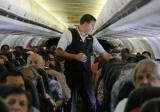
 Dec 27: With air travellers increasingly feeling like packed sardines, flying has become a contact sport.
Flying airplanes can be a bruising experience these days. Rory Rowland said he was rudely rebuffed after he asked the person in front of him not to recline his seat on a red-eye flight. When he later got up to use the bathroom, and the other passenger had fallen asleep, “I hip-checked his seat like you wouldn’t believe,” Rowland, a speaker and consultant, said, then feigned innocence when the enraged passenger complained to a flight attendant. With air travellers increasingly feeling like packed sardines, flying has become a contact sport, nowhere more than over the reclined seat. Now, it’s only getting worse, as airlines re-examine every millimetre of the cabin.
Over the last two decades, the space between seats - hardly roomy before - has fallen about 10 per cent, from 34 inches to somewhere between 30 and 32 inches. Today, some airlines are pushing it even further, leaving only a knee-crunching 28 inches. To gain a little more space, airlines are turning to a new generation of seats that use lighter materials and less padding, moving the magazine pocket above the tray table and even reducing or eliminating the recline in seats. Some are even reducing the number of galleys and bathrooms.
Southwest, the nation’s largest domestic carrier, is installing seats with less cushion and thinner materials - a svelte model known in the business as “slim-line.” It also is reducing the maximum recline to 2 inches from 3. These new seats allow Southwest to add another row, or six seats, to every flight - and add $200 million a year in newfound revenue.
“In today’s environment, the goal is to fit as many seats in the cabin as possible,” said Tom Plant, the general manager for seating products at B/E Aerospace, one of the top airplane seat makers. “We would all like more space on an aircraft, but we all like a competitive ticket price.”
Some carriers are taking the smush to new heights. Spirit Airlines, for instance, uses seats on some flights with the backrest permanently set back 3 inches. Call it, as Spirit does, “prereclined.” The low-cost airline started installing the seats in 2010, squeezing passengers into an industry low of 28 inches. While the Airbus A320 typically accommodates 150 passengers in coach, Spirit can pack 178.
And that’s a good thing, Spirit says. “Customers appreciate the fact that there is no longer interference from the seat in front of you moving up and down throughout the flight,” said Misty Pinson, a spokeswoman for Spirit.
Rick Seaney, the chief executive of FareCompare.com, said the airline business had changed in recent years, after airlines parked older planes and started flying with fewer empty seats. In the past five years, he said, carriers had cut capacity - the number of seats they fly - about 12 per cent. “The flip side is they can’t afford not to fill up their seats,” Seaney said. “This is a massive sea change.”
With so little space to haggle over, passengers have developed their own techniques for handling the crowded conditions. “They jam their knee into the back of your seat as hard as they can and they’ll do it repeatedly to see if they can get a reaction,” said Mick Brekke, a businessman who flies for work a few times a month. “That’s happened to me more than once, and that usually settles down after they realize I’m not going to put it back up.”
The passengers Brekke has encountered are not even the most extreme: Some have taken to using seat-jamming devices, known as knee guards, that prevent a seat in front from reclining. Airlines ban them, but they work, users say.
Smaller seats are not the only reason passengers feel more constricted these days.
Travellers are also getting bigger. In the last four decades, the average American gained a little more than 20 pounds and his or her waist expanded about 2.5 inches, according to the Centres for Disease Control and Prevention. The dimensions of airplanes, however, have not changed and neither has the average width of a coach seat, which is 17 to 18 inches.
Lower costs
As the cabins grow more crowded, airlines say they are thinking only of their customers, trying to keep costs down. Jude Bricker, the senior vice president for planning at Allegiant, said the airline’s nonreclining seats have fewer moving parts and so require less maintenance, which means lower costs. This allows the airline to keep its fares low, he said. “We are continually reminded from customers and their behavior that what they want most is convenient service with a low fare,” Bricker said.
Several budget carriers in Europe have also adopted stiff seats, including Ryanair and EasyJet. Air France, for its domestic flights, which never take more than an hour, has installed nonreclining seats where the magazine pocket has been moved above the tray table to provide more space in the critical area around the knees.
For passengers willing to pay more, airlines offer more room. Business class remains an ultracompetitive market with constant innovation and comfortable amenities, like seats that recline fully. Airlines are also increasingly offering several rows of coach seats with more legroom - also at an extra price.
Still, the squeeze is on for most passengers in coach. On a flight from Washington to Frankfurt, Germany last year, Odysseas Papadimitriou, the chief executive of WalletHub.com, a personal finance social network, was challenged by a tall passenger seated behind him when he reclined his seat. “He was like, 'Hey, watch it, buddy. I don’t fit here with you reclining the seat,'” he said.
Papadimitriou called the flight attendant to mediate the dispute and eventually tilted his seat back, but the price he paid to recline was a fitful night’s sleep, as the other passenger grumbled and pushed against the back of his seat for the rest of the flight.
There are ways of resolving conflicts other than bumping into other passengers, as Rowland, the speaker and consultant, found. “I lean forward and tap them on the shoulder and say, 'I’ll buy you a drink if you don’t push your seat back,'” Rowland said. “It’s made flying very pleasant.”



Comments
Add new comment