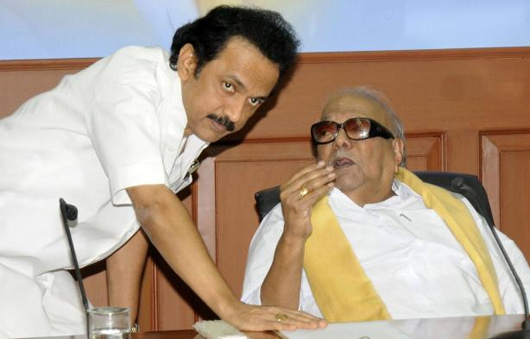
Alagiri told me Stalin would die in 3 months, says Karunanidhi

January 28, 2014

Stalin_Karunanidhi

New Delhi, Jan 28: DMK chief Karunanidhi on Tuesday said that expelled party leader and his older son Alagiri has told him that his younger brother Stalin will die within three months.

Alagiri, 62, MP from Madurai, has been involved in a prolonged tussle with his brother MK Stalin for control of the party.

“He used harsh language against Stalin, which I cannot tolerate. No father can tolerate such words against his own son,” said the DMK leader, who had okayed MK Alagiri’s expulsion from all party posts.

“I don’t know why Alagiri nurtures so much hatred against his brother,” TV reports quoted Karunanidhi as saying.

The DMK on Friday temporarily suspended MK Alagiri from the party’s primary membership and all posts for "indiscipline".

Read: MK Alagiri says there is no democracy in DMK after suspension from party

DMK general secretary K Anbazhagan had said in a statement that Alagiri was creating confusion by urging party cadres not to work and criticising the disciplinary action taken by the party against some members for their anti-party activities.

“His continuation in the party is not proper and would destroy the party discipline,” he said.

Alagiri had recently been given a veiled warning by his father after he opposed an alliance between DMK and the DMDK, a regional party headed by former actor Vijayakanth, who is also being wooed by the BJP.

He holds sway in the southern part of the state and five of his supporters in the disbanded Madurai unit of the party had been suspended for putting up his posters.

Alagiri had told Puthiya Thalaimurai, a Tamil news channel that except his father he would not accept anyone as the DMK chief. He had also said that a lot of decisions were taken by the DMK top brass without his congnisance.

Comments

Add new comment

  • Coastaldigest.com reserves the right to delete or block any comments.
  • Coastaldigset.com is not responsible for its readers’ comments.
  • Comments that are abusive, incendiary or irrelevant are strictly prohibited.
  • Please use a genuine email ID and provide your name to avoid reject.
News Network
March 27,2020

Mumbai, Mar 27: The Reserve Bank of India (RBI) on Friday lowered the key repo rate by 75 basis points to 4.4 per cent in a bid to arrest the economic slowdown amid coronavirus (COVID-19) outbreak.
The reverse repo rate now stands at 4 per cent, down by 90 basis points, said RBI Governor Shaktikanta Das adding this has been done to make it unattractive for banks to passively deposit funds with the central bank and instead lend it to the productive sectors.
The six-member monetary policy committee (MPC) met on March 24, 25 and 27 and voted 4:2 in favour of the repo rate reduction. The MPC also decided to continue with the accommodative stance as long as it is necessary to revive growth and mitigate the impact of COVID-19 on the economy while ensuring that inflation remains within the target.
"The need of the hour is to shield the economy from the pandemic," said Das. "We need to mitigate the impact of coronavirus, revive economic growth and provide financial stability."
Repo rate is the rate at which a country's central bank lends money to commercial banks, and the reverse repo rate is the rate at which it borrows from them.
The RBI Governor further said that the economic growth and inflation projection will be highly contingent depending on the duration, spread and intensity of the pandemic.
"Global economic activity has come to a near standstill as COVID-19 related lockdowns and social distancing are imposed across a widening swathe of affected countries. Expectations of a shallow recovery in 2020 from 2019's decade low in global growth have been dashed," said Das.
"The outlook is now heavily contingent upon the intensity, spread and duration of the pandemic. There is a rising probability that large parts of the global economy will slip into recession," he said.
However, the RBI has injected liquidity of Rs 2.8 lakh crore via various instruments equal to 1.4 per cent of GDP. "Along with today's measures, liquidity measures equal to 3.2 per cent of GDP. The RBI will take continuous measures to ensure liquidity in the system."
The RBI governor has said that all banking institutions can offer a three-month moratorium on all loans for a period of three months. The RBI has also allowed banks to restructure the working capital cycle for companies without worrying that these will have to be classified as a non-performing asset (NPA).
The three-month moratorium will permit banks to avoid a large onset of NPAs during the 21-day lockdown and keep their books healthy.
Das said banks and other financial institutions should do all they can to keep credit flowing to economic agents facing financial stress on account of the isolation that the virus has imposed.
"Market participants should work with regulators like the RBI and the Securities and Exchange Board of India (SEBI) to ensure the orderly functioning of markets in their role of price discovery and financial intermediation," he said.

Comments

Add new comment

  • Coastaldigest.com reserves the right to delete or block any comments.
  • Coastaldigset.com is not responsible for its readers’ comments.
  • Comments that are abusive, incendiary or irrelevant are strictly prohibited.
  • Please use a genuine email ID and provide your name to avoid reject.
News Network
March 28,2020

Amaravati, Mar 28: The state governments of Andhra Pradesh and Karnataka carried out a joint quarantine operation to help over a thousand migrant labourers from various districts of Andhra Pradesh.
The Andhra Pradesh administration received the information that 1,334 migrant labourers were trying to return to the state after obtaining passes from the Deputy Director of Fisheries in Mangalore, Karnataka.
The labourers, according to a press release by the Andhra Pradesh government, were headed towards the Nangili Toll Plaza in Kolar district, from where they would enter the state to return to their native places.
"The Chittoor Collector, Superintendent of Police and Sub-Collector rushed to the spot to coordinate with their counterparts from Kolar, Karnataka. The migrant workers were not permitted to enter AP due to the lockdown and the guidelines of the Union as well as state government," according to the release.
Instead, both the governments decided to initiate a joint quarantine operation in Kolar while taking precautionary measures to ensure that none of the labourers are carriers of the COVID-19 infection.
The Andhra government also reassured the Kolar administration that it will provide doctors, healthcare and all other facilities. It has also issued directions for logistical support, food, water, transport to take the labourers to quarantine facility, and medical team, consisting of 12 doctors, 22 supervisors and other staff, to be provided.
While the Prime Minister had imposed a nationwide lockdown, including the suspension of inter-state travel to prevent the spread of coronavirus, migrant workers and labourers around the country have started returning back to their native places fearing joblessness and cash crunch.
Andhra Pradesh as of Saturday 9:30 am, had 14 confirmed cases of coronavirus while Karnataka's count stood at 55, according to the Ministry of Health and Family Welfare.

Comments

Add new comment

  • Coastaldigest.com reserves the right to delete or block any comments.
  • Coastaldigset.com is not responsible for its readers’ comments.
  • Comments that are abusive, incendiary or irrelevant are strictly prohibited.
  • Please use a genuine email ID and provide your name to avoid reject.
News Network
May 7,2020

May 7: India is projected to record the highest number of births in the 9 months since COVID-19 was declared a pandemic in March, with more than 20 million babies expected to be born in the country between March and December, according to top UN body.

The United Nations Children's Fund (UNICEF) warned that pregnant mothers and babies born during the pandemic across the world were threatened by strained health systems and disruptions in services.

An estimated 116 million babies will be born under the shadow of COVID-19 pandemic, UNICEF said on Wednesday, ahead of Mother's Day, observed on May 10.

These babies are projected to be born up to 40 weeks after COVID-19 was recognised as a pandemic on March 11.

The highest numbers of births in the 9 months since the pandemic was declared are expected to occur in India, where 20.1 million babies are projected to be born between March 11 and December 16. Other countries with the expected highest numbers of births during this period are China (13.5 million), Nigeria (6.4 million), Pakistan (5 million) and Indonesia (4 million), it said.

"Most of these countries had high neonatal mortality rates even before the pandemic and may see these levels increase with COVID-19 conditions," UNICEF said.

It is estimated that there will be 24.1 million births in India for the January-December 2020 period.

UNICEF warned that COVID-19 containment measures can disrupt life-saving health services such as childbirth care, putting millions of pregnant mothers and their babies at great risk.

Even wealthier countries are affected by this crisis. In the US, the sixth-highest country in terms of the expected number of births, over 3.3 million babies are projected to be born between March 11 and December 16.

"New mothers and newborns will be greeted by harsh realities," UNICEF said, adding they include global containment measures such as lockdowns and curfews; health centres overwhelmed with response efforts; supply and equipment shortages; and a lack of sufficient skilled birth attendants as health workers, including midwives, are redeployed to treat COVID-19 patients.

"Millions of mothers all over the world embarked on a journey of parenthood in the world as it was. They now must prepare to bring a life into the world as it has become – a world where expecting mothers are afraid to go to health centres for fear of getting infected, or missing out on emergency care due to strained health services and lockdowns," UNICEF Executive Director Henrietta Fore said.

"It is hard to imagine how much the coronavirus pandemic has recast motherhood" Fore said.

UNICEF said its analysis was based on data from World Population Prospects 2019 of the UN Population Division.

An average full-term pregnancy typically lasts a complete 9 months, or 39 to 40 weeks. For the purposes of this estimate, the number of births for a 40-week period in 2020 was calculated.

The 40-week period of March 11 to December 16 is used in this estimate based upon the WHO's March 11 assessment that COVID-19 can be characterised as a pandemic.

UNICEF warned that although evidence suggests that pregnant mothers are not more affected by COVID-19 than others, countries need to ensure they still have access to antenatal, delivery and postnatal services.

Similarly, sick newborns need emergency services as they are at high risk of death. New families require support to start breastfeeding, and to get medicines, vaccines and nutrition to keep their babies healthy, it said.

"This is a particularly poignant Mother's Day, as many families have been forced apart during the coronavirus pandemic, but it is also a time for unity, a time to bring everyone together in solidarity. We can help save lives by making sure that every pregnant mother receives the support she needs to give birth safely in the months to come," Fore said.

Issuing an urgent appeal to governments and health care providers to save lives in the coming months, UNICEF said efforts must be made to help pregnant women receive antenatal checkups, skilled delivery care, postnatal care services, and care related to COVID-19 as needed.

Ensure health workers are provided with the necessary personal protective equipment and get priority testing and vaccination once a COVID-19 vaccine becomes available so that can deliver high quality care to all pregnant women and newborn babies during the pandemic, it said.

While it is not yet known whether the virus is transmitted from a mother to her baby during pregnancy and delivery, UNICEF advised all pregnant women to follow precautions to protect themselves from exposure to the virus.

Closely monitor themselves for symptoms of COVID-19 and seek advice from the nearest designated facility if they have concerns or experience symptoms. Pregnant women should also take the same precautions to avoid COVID -19 infection as other people: practice physical distancing, avoid physical gatherings and use online health services, it said.

UNICEF said even before COVID-19 pandemic, an estimated 2.8 million pregnant women and newborns died every year, or 1 every 11 seconds, mostly of preventable causes.

The agency called for immediate investment in health workers with the right training, who are equipped with the right medicines to ensure every mother and newborn is cared for by a safe pair of hands to prevent and treat complications during pregnancy, delivery and birth.


Comments

Add new comment

  • Coastaldigest.com reserves the right to delete or block any comments.
  • Coastaldigset.com is not responsible for its readers’ comments.
  • Comments that are abusive, incendiary or irrelevant are strictly prohibited.
  • Please use a genuine email ID and provide your name to avoid reject.