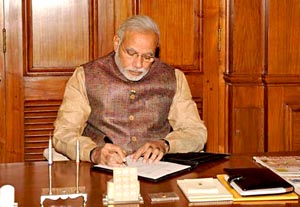
All GOMs, EGOMs abolished

May 31, 2014

New Delhi, May 31: Prime Minister Narendra Modi Saturday decided to abolish all the 30 ministerial groups to bring more accountability and faster decision making among his colleagues who head the various ministries and departments.Narendra Modi office 31

There are currently nine empowered groups of ministers (EGOMs) and 21 groups of ministers (GOMs), which were set up to take decisions on various matters before bringing them for the cabinet's consideration.

"This would expedite the process of decision making and usher in greater accountability in the system," an official statement from the Prime Minister's Office said.

"The ministries and departments will now process the issues pending before the EGOMs and GOMs and take appropriate decisions at the level of ministries and departments itself."

Comments

Add new comment

  • Coastaldigest.com reserves the right to delete or block any comments.
  • Coastaldigset.com is not responsible for its readers’ comments.
  • Comments that are abusive, incendiary or irrelevant are strictly prohibited.
  • Please use a genuine email ID and provide your name to avoid reject.
Agencies
June 14,2020

New Delhi, Jun 14: Petrol price on Sunday was hiked by a record 62 paise per litre and that of diesel by 64 paise as oil companies for the eighth day in a row adjusted retail rates in line with cost since ending an 82-day hiatus in rate revision.

Petrol price in Delhi was hiked to Rs 75.78 per litre from Rs 75.16 while diesel rates were increased to Rs 74.03 a litre from Rs 73.39, according to a price notification of state oil marketing companies.

Rates have been increased across the country and vary from state to state depending on the incidence of local sales tax or VAT.

The 62 paise a litre increase in petrol and 64 paise hike in diesel price is the highest surge in rates since the daily price revision was started in June 2017.

This is the eighth daily increase in rates in a row since oil companies on June 7 restarted revising prices in line with costs, after ending an 82-day hiatus.

In eight hikes, petrol price has gone up by Rs 4.52 per litre and diesel by Rs 4.64 -- a record increase in rates in any eight days since the daily price revision was introduced.

The freeze in rates was imposed in mid-March soon after the government hiked excise duty on petrol and diesel to shore up additional finances.

Oil PSUs Indian Oil Corp (IOC), Bharat Petroleum Corp Ltd (BPCL) and Hindustan Petroleum Corp Ltd (HPCL), instead of passing on the excise duty hikes to customers, adjusted them against the fall in the retail rates that was warranted because of international oil prices falling to two-decade lows.

The government had first raised excise duty on petrol and diesel by Rs 3 per litre each on March 14 and then again on May 5 by a record Rs 10 per litre in case of petrol and Rs 13 on diesel. The two hikes gave the government Rs 2 lakh crore in additional tax revenues.

State-owned fuel retailers IOC, BPCL and HPCL had frozen petrol and diesel prices since March 16, as if anticipating the government move and set off gains they accrued from continuing drop in international oil prices against the excise duty hike.

They, however, promptly passed the increase in local sales tax or VAT by state governments such as Rs 1.67 increase in VAT on petrol and Rs 7.10 in diesel by the Delhi government on May 4.

The total incidence of excise duty on petrol has risen to Rs 32.98 per litre and that on diesel to Rs 31.83. The excise tax on petrol was Rs 9.48 per litre when the Narendra Modi government took office in 2014 and that on diesel was Rs 3.56 a litre.

The government had between November 2014 and January 2016 raised excise duty on petrol and diesel on nine occasions to take away gains arising from plummeting global oil prices.

In all, duty on petrol rate was hiked by Rs 11.77 per litre and that on diesel by 13.47 a litre in those 15 months that helped government's excise mop up more than double to Rs 2,42,000 crore in 2016-17 from Rs 99,000 crore in 2014-15.

It cut excise duty by Rs 2 in October 2017 and by Rs 1.50 a year later. But it raised excise duty by Rs 2 per litre in July 2019.

It again raised excise duty on March 14 by Rs 3 per litre.

Comments

Add new comment

  • Coastaldigest.com reserves the right to delete or block any comments.
  • Coastaldigset.com is not responsible for its readers’ comments.
  • Comments that are abusive, incendiary or irrelevant are strictly prohibited.
  • Please use a genuine email ID and provide your name to avoid reject.
News Network
April 9,2020

New Delhi, Apr 9: Kerala opposition coalition United Democratic Front on Thursday submitted a roadmap to Prime Minister Narendra Modi for staggered lifting of ongoing lockdown due to COVID-19 pandemic.

The coalition led by leader of opposition Ramesh Chennithala has given a set of recommendations to Modi in this regard, which include those made by an expert committee headed by deputy leader of opposition M K Muneer.

The committee was set up to suggest measures to be taken by the government for smooth transition from lockdown to normalcy.

It listed an eight-point exit strategy for removing lockdown in a staggered approach at a district level, with emphasis on hotspots to avoid further spread of virus and ensure smooth restart of economy.

This approach is tuned to the unique needs of each district and all the districts should also be categorised as per their risk levels, the report said.

The report has also been submitted to chief ministers of all states, former prime minister Manmohan Singh, Congress president Sonia Gandhi, senior Congress leader Rahul Gandhi among others.

The committee recommended that COVID-19 rapid testing must be enhanced across the country and the testing target be widened to 500 tests per one lakh population.

"A step-by-step approach is necessary for each sector along with conditions that need to be considered for each sector," the report said.

"There is a need for a comprehensive economic stimulus package in addition to the ones already announced after considering all the industries," it added.

Comments

Add new comment

  • Coastaldigest.com reserves the right to delete or block any comments.
  • Coastaldigset.com is not responsible for its readers’ comments.
  • Comments that are abusive, incendiary or irrelevant are strictly prohibited.
  • Please use a genuine email ID and provide your name to avoid reject.
Agencies
May 30,2020

New Delhi, May 30: The COVID-19 pandemic has left the Indian private healthcare sector in acute financial distress, a new survey said on Friday adding that the healthcare facilities in the country have witnessed at least 80 per cent fall in average revenue.

Post the lockdown from March 24, Indian hospitals have seen a large impact, especially among small and medium-sized hospitals, which are now facing existential challenges.

The survey by healthcare industry body NATHEALTH was conducted in 251 healthcare facilities across nine states and 69 cities to assess the impact of COVID-19 on the domestic healthcare industry.

The findings showed that 90 per cent of the surveyed healthcare facilities are facing financial challenges with 21 per cent facilities facing an existential threat.

"There is a need for a stimulus package to revive the Indian healthcare industry which will be crucial to provide much-needed relief to the healthcare sector which is the frontline defence in this fight against COVID-19," said Dr Sudarshan Ballal, President NATHEALTH.

According to the survey, hospitals in tier 1 and tier 2 cities are experiencing a 78 per cent reduction in OPD footfalls, and a drop of 79 per cent in in-patient admissions.

The study found that 90 per cent of organisations require some form of financial assistance.

The findings indicated that even after the lockdown lift, the situation will remain difficult for the hospitals and nursing homes as patients will hesitate from visiting hospitals.

Comments

Add new comment

  • Coastaldigest.com reserves the right to delete or block any comments.
  • Coastaldigset.com is not responsible for its readers’ comments.
  • Comments that are abusive, incendiary or irrelevant are strictly prohibited.
  • Please use a genuine email ID and provide your name to avoid reject.