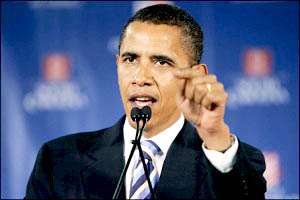
Americans facing competition from India, China: Obama

April 8, 2014

Washington, Apr 8: US President Barack Obama has said that Americans are facing competition from India and China and exuded confidence that young Americans can match or exceed anything that they do.

Americans_Obama"You guys are all coming up in an age where you're not going to be able to compete with people across town for good jobs -- you're going to be competing with the rest of the world. Young people in India and China, they're all interested in trying to figure out how they get a foothold in this world economy," Obama said while addressing students in Maryland yesterday.

"That's who you're competing against. Now, I'm confident you can match or exceed anything they do, but we don't do it by just resting on what we've done before. We've got to out-work and out-innovate and out-hustle everybody else. We've got to think about new ways of doing things," said the US President.

Obama said he wants to make sure every student in America has a chance to get that moment.

"you're also going to be leading this country. That's the chance that this country gave to me and Michelle. And that's the chance I want for every single one of you," he said.

"From preschool for every four-year-old in America, to higher education for everybody who wants to go, every young person deserves a fair shot. I'm going to keep on doing everything I can to make sure you get that shot and to keep America a place where you can make it if you try," he said.

Obama announced to launch a new competition, backed by America's Departments of Education and Labor, to start redesigning some of high schools.

"We call it Youth CareerConnect. And we're offering USD 100 million in new grants to help schools and local partners develop and test new curricula and models for success. We want to invest in your future," he said.

Comments

Add new comment

  • Coastaldigest.com reserves the right to delete or block any comments.
  • Coastaldigset.com is not responsible for its readers’ comments.
  • Comments that are abusive, incendiary or irrelevant are strictly prohibited.
  • Please use a genuine email ID and provide your name to avoid reject.
News Network
February 28,2020

Tehran, Feb 28: The coronavirus epidemic in Iran has cost 26 lives, the health ministry announced Thursday, with a vice president becoming the latest top official to be infected as the spread appeared to accelerate.

Health ministry spokesman Kianoush Jahanpour told a news conference that the tally of infections had risen to 245 with 106 more cases confirmed -- the highest number for a single day since Iran announced its first infections on February 19.

The Islamic republic has the highest death toll from the virus outside China, where COVID-19 first emerged.

Among the latest coronavirus sufferers is one of Iran's seven vice presidents, Massoumeh Ebtekar, who oversees women's affairs.

Ebtekar, a former spokeswoman for students who took 52 Americans hostage at the US embassy in Tehran in 1979, is being treated at home and members of her team have been tested, state news agency IRNA reported.

Mojtaba Zolnour, head of parliament's national security and foreign affairs committee, also contracted the virus, appearing in a video posted by Fars news agency saying he was in self-quarantine.

The cleric is a deputy for the Shiite holy city of Qom in central Iran where the country's first cases were detected.

According to media reports, among the deceased in Qom on Thursday was theologian Hadi Khroroshahi, who in 1981 was named Iran's first ambassador to the Vatican.

The announcement by Zolnour comes two days after another top official, deputy health minister Iraj Harirchi, head of the government's coronavirus task force, said he too had contracted the virus.

On Wednesday, Iranian authorities announced domestic travel restrictions for people with confirmed or suspected infections.

They also placed curbs on access to major Shiite pilgrimage sites, including the Imam Reza shrine in second city Mashhad and the Fatima Masumeh shrine in Qom.

Visitors to the shrines will be allowed to visit on condition they are provided "with hand-washing liquids, proper (health) information, masks", Health Minister Saeed Namaki said.

They must "not gather together in groups but just pray and leave", he said.

In a rare move, authorities announced the cancellation of the main Friday weekly prayers in Tehran, Qom and Mashhad as well as in the capitals of 22 of Iran's 31 provinces and other infected areas.

"All of these decisions are temporary and if the situation changes, we might intensify or ease them," Namaki said.

Comments

Add new comment

  • Coastaldigest.com reserves the right to delete or block any comments.
  • Coastaldigset.com is not responsible for its readers’ comments.
  • Comments that are abusive, incendiary or irrelevant are strictly prohibited.
  • Please use a genuine email ID and provide your name to avoid reject.
News Network
June 9,2020

Washington, Jun 9: When epidemiologists talked about "flattening the curve," they probably didn't mean it this way: the US hit its peak coronavirus caseload in April, but since that time the graph has been on a seemingly unending plateau.

That's unlike several other hard-hit countries which have successfully pushed down their numbers of new cases, including Spain and Italy, which now have bell-shaped curves.

Experts say the prolonged nature of the US epidemic is the result of the cumulative impact of regional outbreaks, as the virus that started out primarily on the coasts and in major cities moves inward.

Layered on top of that are the effects of lifting lockdowns in parts of the country that are experiencing rising cases, as well as a lapse in compliance with social distancing guidelines because of economic hardship, and in some cases a belief that the threat is overstated.

"The US is a large country both in geography and population, and the virus is at very different stages in different parts of the country," Tom Frieden, a former director of the Centers for Disease Control and Prevention told AFP.

The US saw more than 35,000 new cases for several days in April. While that figure has declined, it has still been exceeding 20,000 regularly in recent days.

By contrast, Italy was regularly hitting more than 5,000 cases per day in March but is currently experiencing figures in the low hundreds.

"We did not act quickly and robustly enough to stop the virus spreading initially, and data indicate that it travelled from initial hotspots along major transport routes into other urban and rural areas," added Frieden, now CEO of the non-profit Resolve to Save Lives.

To wit: the East Coast states of New York, New Jersey and Massachusetts accounted for about 50 percent of all cases until about a month or so ago -- but now the geographic footprint of the US epidemic has shifted to the Midwest and southeast, including Florida.

Another key problem, said Jennifer Nuzzo, an epidemiologist at Johns Hopkins, is that the United States is still not doing enough testing, contact tracing and isolation.

After coming late to the testing party -- for reasons ranging from technical issues to regulatory hurdles -- the US has now conducted more COVID-19 tests than any other country.

It even has one of the highest per capita rates per country of 62 per 1,000 people, according to the website ourworldindata.org -- better than Germany (52 per 1,000) and South Korea (20 per 1,000).

But according to Nuzzo, these numbers are misleading, because "the amount of testing that a country should do should be scaled to the size of its epidemic.

"The United States has the largest epidemic in the world so obviously we need to do a lot more testing than any other country."

For Johns Hopkins, the more important metric is the positivity rate -- that is, out of all tests conducted, how many came back positive for COVID-19.

As of June 7, the United States had an average daily positivity rate of 14 percent, well above the World Health Organization guideline of 5 percent over two weeks before social distancing guidelines should be relaxed.

By contrast, Germany, which has tested far fewer people in relation to its population, has a positivity rate of 5 percent.

Even if testing were scaled up, carrying out tests in of itself does very little good without the next steps -- finding out who was exposed and then asking them to isolate.

Here also, too many US states are lagging woefully behind.

Texas, which is experiencing a surge in cases after relaxing its lockdown, is a case in point. The state targeted hiring a modest 4,000 tracers by June, but according to local reports is still more than a thousand shy of even that goal.

Opt-in app based efforts have also been slow to get off the ground.

Then there is the fact that some people are growing tired of lockdowns, while others don't have the economic luxury of being able to stay home for prolonged periods.

The government sent some 160 million Americans a single stimulus check of up to $1,200 back in April but it's not clear whether more will be forthcoming.

Still others, particularly in so-called red states under Republican leadership, have chafed under restrictions and mask-wearing guidelines that they see as an affront to their personal freedom.

"The US is kind of on the extreme of the individual liberty side," Sten Vermund, dean of the Yale School of Public Health, told AFP.

Part of this has to do with mixed messaging from Republican leaders, including President Donald Trump, said Nuzzo.

"We have had at the highest political level an assertion that this is a situation that's been overblown, and that maybe certain protective behaviors are not necessary," she said.

More recently, tens of thousands of people across the country have taken to the streets to protest the killing on an unarmed black man by police, risking coronavirus infection to demonstrate against the public health threat of racialized state violence.


Comments

Add new comment

  • Coastaldigest.com reserves the right to delete or block any comments.
  • Coastaldigset.com is not responsible for its readers’ comments.
  • Comments that are abusive, incendiary or irrelevant are strictly prohibited.
  • Please use a genuine email ID and provide your name to avoid reject.
Agencies
June 29,2020

Tehran, Jun 29: Iran has issued an arrest warrant and asked Interpol for help in detaining President Donald Trump and dozens of others it believes carried out the drone strike that killed a top Iranian general in Baghdad, a local prosecutor reportedly said Monday.

While Trump faces no danger of arrest, the charges underscore the heightened tensions between Iran and the United States since Trump unilaterally withdrew America from Tehran’s nuclear deal with world powers.

Tehran prosecutor Ali Alqasimehr said Trump and more than 30 others whom Iran accuses of involvement in the Jan. 3 strike that killed Gen. Qassem Soleimani in Baghdad face “murder and terrorism charges,” the semiofficial ISNA news agency reported.

Alqasimehr did not identify anyone else sought other than Trump, but stressed that Iran would continue to pursue his prosecution even after his presidency ends.

Interpol, based in Lyon, France, did not immediately respond to a request for comment.

Alqasimehr also was quoted as saying that Iran requested a “red notice” be put out for Trump and the others, which represents the highest level arrest request issued by Interpol. Local authorities end up making the arrests on behalf of the country that request it. The notices cannot force countries to arrest or extradite suspects, but can put government leaders on the spot and limit suspects’ travel.

After receiving a request, Interpol meets by committee and discusses whether or not to share the information with its member states. Interpol has no requirement for making any of the notices public, though some do get published on its website.

It is unlikely Interpol would grant Iran’s request as its guideline for notices forbids it from “undertaking any intervention or activities of a political” nature.

The U.S. killed Soleimani, who oversaw the Revolutionary Guard’s expeditionary Quds Force, and others in the January strike near Baghdad International Airport. It came after months of incidents raising tensions between the two countries and ultimately saw Iran retaliate with a ballistic missile strike targeting American troops in Iraq.

Comments

Add new comment

  • Coastaldigest.com reserves the right to delete or block any comments.
  • Coastaldigset.com is not responsible for its readers’ comments.
  • Comments that are abusive, incendiary or irrelevant are strictly prohibited.
  • Please use a genuine email ID and provide your name to avoid reject.