


Americans vote to elect president after ugliest campaign

November 8, 2016

Washington, Nov 8: Millions of Americans today lined up at polling stations to elect either the country's first woman president in its 240-year history or a political outsider in the White House as the race between Hillary Clinton and his rival Donald Trump remain too close to call.trump-clinton
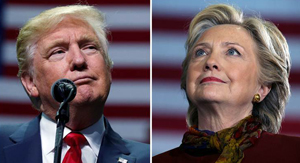
Fighting for every single vote at stake, Democratic nominee Clinton and her Republican rival Trump made their last minute forceful argument before the American people with their own vision for the world's largest economy, ending the ugliest presidential campaign in US history.

Clinton, 69, was joined by husband Bill as she addressed a massive rally in Raleigh in the key battle ground state of North Carolina, which was entertained by Lady Gaga.

Trump, 70, made a last minute scheduled stop in Michigan to address thousands of his supporters hoping that he might be able to swing this state from the Democrats.

The two rallies ended around 1 AM (local time), just six hours before opening of the polling booths in the East Coast.

The first ballots were cast in a sleepy hamlet in New Hampshire, traditionally the first in the nation to vote on Election Day, with Clinton winning the contest.

Clinton registered her first 'win' in the 2016 elections by four votes to two against Trump soon after midnight in the remote Dixville Notch, New Hampshire.

While Clinton is close to victory mark, Trump must win most of the battleground states to clinch the magic figure of 270 Electoral College votes.

Arizona (11), Florida (29), Nevada (6), Nebraska 2nd Congressional District (1), New Hampshire (4) and North Carolina (15) are key battleground states.

An estimated 200 million people are eligible to cast their votes to elect the country's 45th president along with hundreds of Congressmen and members of state legislatures and local civic bodies.

A record 42 million have already voted using the "early voting" provision of the American electoral system, surpassing the 2012 record when 32.3 million people had voted in advance.

Clinton and Trump crisscrossed several stops in key battleground states on the final day of campaigning which the US media has termed as the ugliest and the most divisive.

"This election is basically between division and unity in our country. It's between strong and steady leadership or a loose cannon who could put everything at risk. It is between an economy that works for everyone or one that is even more stacked for those at the top," Clinton told a cheering crowd in Raleigh, North Carolina.

"None of us, none of us, want to wake up on Wednesday morning and wish we had done more," she said, which she repeated in her other election rallies including the one in Philadelphia, which was also addressed by US President Barack Obama and First Lady Michelle.

Latest poll indicated that while the election seems to have tightened in the last few days, Clinton maintains a slight lead over Trump. Almost all major polls are predicting a victory for Clinton, but Trump appeared confident of winning some of the key battleground states and thus wrest the White House from the Democrats after a gap of eight years.
 
"Do you want America to be ruled by the corrupt political class. Or do you want to be ruled by you, the people," Trump said in Michigan.

"Political establishment has brought distraction of factories and jobs," Trump said.

"Tomorrow the working class will strike back," he said in New Hampshire and in Michigan he declared "today is the Independence Day".

Trump kicked off his Monday engagements with a rally in Florida.

"We're going to be one country. We're not going to be a divided nation anymore, we're a divided nation. We are a divided nation. We will also cancel billions and billions of dollars in global warming payments to the United Nations where those payments disappear. And we're going to use all that money to invest in the infrastructure and we could even say the environmental infrastructure of our country," Trump said.

Trump would be spending the election day in New York. His 'victory rally' has been schedule at a hotel in New York, a few kilometres away from the 'victory rally' of Clinton.

The Republican presidential nominee's election journey has been sensational as from a rank political outsider he has come close to becoming the US President.

This year, the Republican field began with a long list of 17 candidates, including Indian-origin Louisiana governor Bobby Jindal, New Jersey Governor Chris Christie and former Florida governor Jeb Bush. The Democratic field, on the other hand, was not as crowded, with just Hillary Clinton and Senator Bernie Sanders in the race.

Unlike India, in the US campaigning can be done even as voting continues.

Every state would start counting the votes as polling concludes.

One of the main highlight of the last few weeks has been the electioneering blitz by Obama.
In the last 10 days, he addressed as many as 17 rallies -- rare for an outgoing President.

In the last phase of the campaign, the Clinton campaign also brought in popular singers, which Trump alleged was a move to attract crowd.

The two campaigns have different theme. While 'Make America Great Again' is the theme of Trump, 'Stronger Together' is Clinton's slogan.

Both the candidates have said they would accept the results of the elections, but reserve the right to challenge in case of close results. The new president would be sworn in on January 20.

Till then the winner would be called president-elect and would have a transition team in place working from Washington. 

Comments

Add new comment

  • Coastaldigest.com reserves the right to delete or block any comments.
  • Coastaldigset.com is not responsible for its readers’ comments.
  • Comments that are abusive, incendiary or irrelevant are strictly prohibited.
  • Please use a genuine email ID and provide your name to avoid reject.
News Network
March 19,2020

Rome, Mar 19: Italy on Wednesday reported 475 new deaths from the novel coronavirus, the highest one-day official toll of any nation since the first case was detected in China late last year.

The total number of deaths in Italy has reached 2,978, more than half of all the cases recorded outside China, while the number of infections stood at 35,713.

The previous record high of 368 deaths was also recorded in Italy, on Sunday. The nation of 60 million has now recorded 34.2 percent of all the deaths officially attributed to COVID-19 across the world.

With the death rate still climbing despite the Mediterranean country entering a second week under an effective lockdown, officials urged Italians to have faith and to stay strong.

"They main thing is, do not give up," Italian National Institute of Health chief Silvio Brusaferro said in a nationally televised press conference.

"It will take a few days before we see the benefits" of containment measures, said Brusaferro. "We must maintain these measures to see their effect, and above all to protect the most vulnerable."

Imposed nationally on March 12, the shutdown of most Italian businesses and a ban on public gatherings are due to expire on March 25.

But school closures and other measures, such as a ban fan attendance at sporting events, are due to run on until April 3.

A top government minister hinted Wednesday that the school closure would be extended well into next month, if not longer.

The rates within Italy itself remained stable, with two-thirds of the deaths -- 1,959 in all -- reported in the northern Lombardy region around Milan, the Italian financial and fashion capital.

Comments

Add new comment

  • Coastaldigest.com reserves the right to delete or block any comments.
  • Coastaldigset.com is not responsible for its readers’ comments.
  • Comments that are abusive, incendiary or irrelevant are strictly prohibited.
  • Please use a genuine email ID and provide your name to avoid reject.
News Network
July 4,2020

Geneva, Jul 4: The World Health Organization has updated its account of the early stages of the COVID crisis to say it was alerted by its own office in China, and not by China itself, to the first pneumonia cases in Wuhan.

The UN health body has been accused by US President Donald Trump of failing to provide the information needed to stem the pandemic and of being complacent towards Beijing, charges it denies.

On April 9, WHO published an initial timeline of its communications, partly in response to criticism of its early response to the outbreak that has now claimed more than 521,000 lives worldwide.

In that chronology, WHO had said only that the Wuhan municipal health commission in the province of Hubei had on December 31 reported cases of pneumonia. The UN health agency did not however specify who had notified it.

WHO director Tedros Adhanom Ghebreyesus told a press conference on April 20 the first report had come from China, without specifying whether the report had been sent by Chinese authorities or another source.

But a new chronology, published this week by the Geneva-based institution, offers a more detailed version of events.

It indicates that it was the WHO office in China that on December 31 notified its regional point of contact of a case of "viral pneumonia" after having found a declaration for the media on a Wuhan health commission website on the issue.

The same day, WHO's epidemic information service picked up another news report transmitted by the international epidemiological surveillance network ProMed -- based in the United States -- about the same group of cases of pneumonia from unknown causes in Wuhan.

After which, WHO asked the Chinese authorities on two occasions, on January 1 and January 2, for information about these cases, which they provided on January 3.

WHO emergencies director Michael Ryan told a press conference on Friday that countries have 24-48 hours to officially verify an event and provide the agency with additional information about the nature or cause of an event.

Ryan added that the Chinese authorities immediately contacted WHO's as soon as the agency asked to verify the report.

US President Donald Trump has announced that his country, the main financial contributor to WHO, will cut its bridges with the institution, which he accuses of being too close to China and of having poorly managed the pandemic.

The WHO denies any complacency toward China.

Comments

Add new comment

  • Coastaldigest.com reserves the right to delete or block any comments.
  • Coastaldigset.com is not responsible for its readers’ comments.
  • Comments that are abusive, incendiary or irrelevant are strictly prohibited.
  • Please use a genuine email ID and provide your name to avoid reject.
Agencies
July 1,2020

The ILO has warned that if another Covid-19 wave hits in the second half of 2020, there would be global working-hour loss of 11.9 percent - equivalent to the loss of 340 million full-time jobs.

According to the 5th edition of International Labour Organisation (ILO) Monitor: Covid-19 and the world of work, the recovery in the global labour market for the rest of the year will be uncertain and incomplete.

The report said that there was a 14 percent drop in global working hours during the second quarter of 2020, equivalent to the loss of 400 million full-time jobs.

The number of working hours lost across the world in the first half of 2020 was significantly worse than previously estimated. The highly uncertain recovery in the second half of the year will not be enough to go back to pre-pandemic levels even in the best scenario, the agency warned.

The baseline model – which assumes a rebound in economic activity in line with existing forecasts, the lifting of workplace restrictions and a recovery in consumption and investment – projects a decrease in working hours of 4.9 percent (equivalent to 140 million full-time jobs) compared to last quarter of 2019.

It says that in the pessimistic scenario, the situation in the second half of 2020 would remain almost as challenging as in the second quarter.

“Even if one assumes better-tailored policy responses – thanks to the lessons learned throughout the first half of the year – there would still be a global working-hour loss of 11.9 per cent at the end of 2020, or 340 million full-time jobs, relative to the fourth quarter of 2019,” it said.

The pessimistic scenario assumes a second pandemic wave and the return of restrictions that would significantly slow recovery. The optimistic scenario assumes that workers’ activities resume quickly, significantly boosting aggregate demand and job creation. With this exceptionally fast recovery, the global loss of working hours would fall to 1.2 per cent (34 million full-time jobs).

The agency said that under the three possible scenarios for recovery in the next six months, “none” sees the global job situation in better shape than it was before lockdown measures began.

“This is why we talk of an uncertain but incomplete recovery even in the best of scenarios for the second half of this year. So there is not going to be a simple or quick recovery,” ILO Director-General Guy Ryder said.

The new figures reflect the worsening situation in many regions over the past weeks, especially in developing economies. Regionally, working time losses for the second quarter were: Americas (18.3 percent), Europe and Central Asia (13.9 percent), Asia and the Pacific (13.5 percent), Arab States (13.2 percent), and Africa (12.1 percent).

The vast majority of the world’s workers (93 per cent) continue to live in countries with some sort of workplace closures, with the Americas experiencing the greatest restrictions.

During the first quarter of the year, an estimated 5.4 percent of global working hours (equivalent to 155 million full-time jobs) were lost relative to the fourth quarter of 2019. Working- hour losses for the second quarter of 2020 relative to the last quarter of 2019 are estimated to reach 14 per cent worldwide (equivalent to 400 million full-time jobs), with the largest reduction (18.3 per cent) occurring in the Americas.

The ILO Monitor also found that women workers have been disproportionately affected by the pandemic, creating a risk that some of the modest progress on gender equality made in recent decades will be lost, and that work-related gender inequality will be exacerbated.

The severe impact of Covid-19 on women workers relates to their over-representation in some of the economic sectors worst affected by the crisis, such as accommodation, food, sales and manufacturing.

Globally, almost 510 million or 40 percent of all employed women work in the four most affected sectors, compared to 36.6 percent of men, it said.

The report said that women also dominate in the domestic work and health and social care work sectors, where they are at greater risk of losing their income and of infection and transmission and are also less likely to have social protection.

The pre-pandemic unequal distribution of unpaid care work has also worsened during the crisis, exacerbated by the closure of schools and care services.

Even as countries have adopted policy measures with unprecedented speed and scope, the ILO Monitor highlights some key challenges ahead, including finding the right balance and sequencing of health, economic and social and policy interventions to produce optimal sustainable labour market outcomes; implementing and sustaining policy interventions at the necessary scale when resources are likely to be increasingly constrained and protecting and promoting the conditions of vulnerable, disadvantaged and hard-hit groups to make labour markets fairer and more equitable.

“The decisions we adopt now will echo in the years to come and beyond 2030. Although countries are at different stages of the pandemic and a lot has been done, we need to redouble our efforts if we want to come out of this crisis in a better shape than when it started,” Ryder said. 

Comments

Add new comment

  • Coastaldigest.com reserves the right to delete or block any comments.
  • Coastaldigset.com is not responsible for its readers’ comments.
  • Comments that are abusive, incendiary or irrelevant are strictly prohibited.
  • Please use a genuine email ID and provide your name to avoid reject.