


Amid Recount Effort, Donald Trump Eyes Foreign Policy, Defense Jobs

November 27, 2016

West Palm Beach, Nov 27: His inauguration less than eight weeks away, President-elect Donald Trump was confronted by new developments Saturday in recount efforts in three states pivotal to his Nov. 8 victory, even as he worked to fill foreign policy and national defense jobs in his incoming administration.
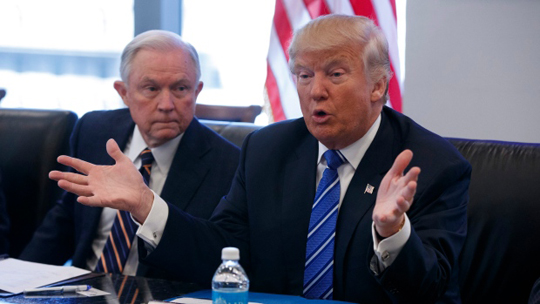
Donald

The New York billionaire, whose defeat of Democrat Hillary Clinton surprised even some loyalists, has scrambled to fill his Cabinet as the Jan. 20 inauguration approaches. Still, in many ways, he has barely scratched the surface of creating the massive team needed to run the government.

Experts say presidential transitions are periods of great vulnerability for the nation, and among the vacancies on the Trump team are leaders of the departments of State, Defense and Homeland Security.

Trump, who has virtually no experience in foreign affairs, offered a one-line tweet Saturday morning in reaction to the death of Cuban leader Fidel Castro - "Fidel Castro is dead!" - before issuing a more detailed statement.

"While Cuba remains a totalitarian island, it is my hope that today marks a move away from the horrors endured for too long, and toward a future in which the wonderful Cuban people finally live in the freedom they so richly deserve," Trump said.

His transition team did not immediately respond to requests to clarify his Cuba policy, which was inconsistent during the campaign.

Also Saturday, Clinton's camp said it was supporting Green Party candidate Jill Stein's push to force recounts in Wisconsin, Pennsylvania in Michigan. Trump narrowly carried those Democratic strongholds.

Clinton leads the national popular vote by close to 2 million votes, but Trump won 290 electoral votes to Clinton's 232, with Michigan still too close to call. It takes 270 to win the presidency.

Wisconsin officials are moving forward with the first presidential recount in state history following Stein's formal request. Stein, who drew 1 percent of the vote nationally, is raising millions of dollars to pay for the effort.

"Because we had not uncovered any actionable evidence of hacking or outside attempts to alter the voting technology, we had not planned to exercise this option ourselves," Clinton campaign attorney Marc Elias wrote Saturday in blog post. "But now that a recount has been initiated in Wisconsin, we intend to participate in order to ensure the process proceeds in a manner that is fair to all sides."

Elias said Clinton would take the same approach in Pennsylvania and Michigan if Stein were to follow through with recount requests those states, even though that was highly unlikely to change the election outcome.

"Regardless of the potential to change the outcome in any of the states, we feel it is important, on principle, to ensure our campaign is legally represented in any court proceedings and represented on the ground in order to monitor the recount process itself," Elias wrote.

Trump was spending the Thanksgiving holiday weekend with family at his Palm Beach estate, Mar-a-Lago. On Friday, he named Fox News analyst Kathleen Troia "KT" McFarland as deputy national security adviser and appointed campaign attorney Donald McGahn as White House counsel.

McFarland has worked for three presidents, although none since Ronald Reagan. Fox News said Saturday that her contract has been terminated in light of the appointment.

Trump planned to return to his New York home on Sunday ahead of a series of Monday meetings with prospective administration hires, including Sheriff David Clarke of Milwaukee County, Wisconsin. He's seen as a possible Homeland Security pick. Clarke's vocal opposition to the "Black Lives Matter" movement has made him popular with many conservatives.

Trump and Vice President-elect Mike Pence also have Monday meetings scheduled with Oklahoma Attorney General Scott Pruitt, Rep. Lou Barletta, R-Pa., former Security and Exchange Commission commissioner Paul Atkins, World Wide Technology chairman David Steward and General Growth Properties CEO Sandeep Mathrani.

Internal divisions over his choice for secretary of state have delayed that critical decision. The options include former New York City Mayor Rudy Giuliani, who lacks foreign policy experience, but was intensely loyal to Trump, and 2012 Republican presidential nominee Mitt Romney, who aggressively opposed Trump's candidacy but is largely regarded as more qualified. Tennessee Sen. Bob Corker is also a possibility.

With the world's attention on Cuba on Saturday, Trump indicated his administration would do "all it can to ensure the Cuban people can finally begin their journey toward prosperity and liberty."

During the campaign, Trump initially suggested he supported President Barack Obama's moves to loosen the US trade embargo.

Trump reversed himself less than a month before the election, and said he would reverse Obama unless Cuba met demands including "religious and political freedom for the Cuban people and the freeing of political prisoners."

His Saturday statement offered no more clarity.

Comments

Add new comment

  • Coastaldigest.com reserves the right to delete or block any comments.
  • Coastaldigset.com is not responsible for its readers’ comments.
  • Comments that are abusive, incendiary or irrelevant are strictly prohibited.
  • Please use a genuine email ID and provide your name to avoid reject.
News Network
March 3,2020

Mar 3: Just hours after the ending of a week-long “reduction” in violence that was crucial for Donald Trump’s peace deal in Afghanistan, the Taliban struck again: On Monday, they killed three people and injured about a dozen at a football match in Khost province. This resumption of violence will not surprise anyone actually invested in peace for that troubled country. The point of the U.S.-Taliban deal was never peace. It was to try and cover up an ignominious exit for the U.S., driven by an election-bound president who feels no responsibility toward that country or to the broader region.

Seen from South Asia, every point we know about in the agreement is a concession by Trump to the Taliban. Most importantly, it completes a long-term effort by the U.S. to delegitimize the elected government in Kabul — and, by extension, Afghanistan’s constitution. Afghanistan’s president is already balking at releasing 5,000 Taliban prisoners before intra-Afghan talks can begin — a provision that his government did not approve.

One particularly cringe-worthy aspect: The agreement refers to the Taliban throughout  as “the Islamic Emirate of Afghanistan that is not recognized by the United States as a state and is known as the Taliban.” This unwieldy nomenclature validates the Taliban’s claim to be a government equivalent to the one in Kabul, just not the one recognised at the moment by the U.S. When read together with the second part of the agreement, which binds the U.S. to not “intervene in [Afghanistan’s] domestic affairs,” the point is obvious: The Taliban is not interested in peace, but in ensuring that support for its rivals is forbidden, and its path to Kabul is cleared.

All that the U.S. has effectively gotten in return is the Taliban’s assurance that it will not allow the soil of Afghanistan to be used against the “U.S. and its allies.” True, the U.S. under Trump has shown a disturbing willingness to trust solemn assurances from autocrats; but its apparent belief in promises made by a murderous theocratic movement is even more ridiculous. Especially as the Taliban made much the same promise to an Assistant Secretary of State about Osama bin Laden while he was in the country plotting 9/11.

Nobody in the region is pleased with this agreement except for the Taliban and their backers in the Pakistani military. India has consistently held that the legitimate government in Kabul must be the basic anchor of any peace plan. Ordinary Afghans, unsurprisingly, long for peace — but they are, by all accounts, deeply skeptical about how this deal will get them there. The brave activists of the Afghan Women’s Network are worried that intra-Afghan talks will take place without adequate representation of the country’s women — who have, after all, the most to lose from a return to Taliban rule.

But the Pakistani military establishment is not hiding its glee. One retired general tweeted: “Big victory for Afghan Taliban as historic accord signed… Forced Americans to negotiate an accord from the position of parity. Setback for India.” Pakistan’s army, the Taliban’s biggest backer, longs to re-install a friendly Islamist regime in Kabul — and it has correctly estimated that, after being abandoned by Trump, the Afghan government will have sharply reduced bargaining power in any intra-Afghan peace talks. A deal with the Taliban that fails also to include its backers in the Pakistani military is meaningless.

India, meanwhile, will not see this deal as a positive for regional peace or its relationship with the U.S. It comes barely a week after Trump’s India visit, which made it painfully clear that shared strategic concerns are the only thing keeping the countries together. New Delhi remembers that India is not, on paper, a U.S. “ally.” In that respect, an intensification of terrorism targeting India, as happened the last time the U.S. withdrew from the region, would not even be a violation of Trump’s agreement. One possible outcome: Over time the government in New Delhi, which has resolutely sought to keep its ties with Kabul primarily political, may have to step up security cooperation. Nobody knows where that would lead.

The irresponsible concessions made by the U.S. in this agreement will likely disrupt South Asia for years to come, and endanger its own relationship with India going forward. But worst of all, this deal abandons those in Afghanistan who, under the shadow of war, tried to develop, for the first time, institutions that work for all Afghans. No amount of sanctimony about “ending America’s longest war” should obscure the danger and immorality of this sort of exit.

Comments

Add new comment

  • Coastaldigest.com reserves the right to delete or block any comments.
  • Coastaldigset.com is not responsible for its readers’ comments.
  • Comments that are abusive, incendiary or irrelevant are strictly prohibited.
  • Please use a genuine email ID and provide your name to avoid reject.
Agencies
March 14,2020

San Francisco, Mar 14: Microsoft on friday announced that co-founder Bill Gates has left its board of directors to devote more time to philanthropy.

The 64-year-old stopped being involved in day-to-day operations at the firm more than a decade ago, turning his attention to the foundation he launched with his wife, Melinda.

Gates served as chairman of Microsoft's board of directors until early in 2014 and has now stepped away entirely, according to the Redmond-based technology giant.

“It's been a tremendous honor and privilege to have worked with and learned from Bill over the years,” Microsoft chief executive and company veteran Satya Nadella said in a release.

Nadella said Microsoft would continue to benefit from Gates' “technical passion and advice” in his continuing role as a technical advisor.
“I am grateful for Bill's friendship and look forward to continuing to work alongside him,” he added.

Gates left his CEO position in 2000, handing the company reins to Steve Ballmer to devote more time to his charitable foundation.

He gave up the role of chairman at the same time Nadella became Microsoft's third CEO in 2014.

Regularly listed among the world's richest people, William H. Gates was a geeky-looking young man when he and Paul Allen co-founded Microsoft in 1975.

Gates went on to turn his attention from software to fighting disease and other humanitarian challenges with his wife, under the auspices of the Bill and Melinda Gates Foundation.

Comments

Add new comment

  • Coastaldigest.com reserves the right to delete or block any comments.
  • Coastaldigset.com is not responsible for its readers’ comments.
  • Comments that are abusive, incendiary or irrelevant are strictly prohibited.
  • Please use a genuine email ID and provide your name to avoid reject.
News Network
May 29,2020

Washington, May 29: Reiterating his offer to mediate on the border dispute between India and China, US President Donald Trump has said that he spoke with Narendra Modi about the "big conflict" and asserted that the Indian Prime Minister is not in a "good mood" over the latest flare-ups between the two countries.

Speaking with the reporters in the Oval Office of the White House on Thursday, Trump said a "big conflict" was going on between India and China.

"I like your prime minister a lot. He is a great gentleman," the president said.

"Have a big conflict …India and China. Two countries with 1.4 billion people (each). Two countries with very powerful militaries. India is not happy and probably China is not happy," he said when asked if he was worried about the border situation between India and China.

"I can tell you; I did speak to Prime Minister Modi. He is not in a good mood about what is going on with China," Trump said.

A day earlier, the president offered to mediate between India and China.

Trump on Wednesday said in a tweet that he was "ready, willing and able to mediate" between the two countries.

Responding to a question on his tweet, Trump reiterated his offer, saying if called for help, "I would do that (mediate). If they thought it would help" about "mediate or arbitrate, I would do that," he said.

India on Wednesday said it was engaged with China to peacefully resolve the border row, in a carefully crafted reaction to Trump's offer to arbitrate between the two Asian giants to settle their decades-old dispute.

"We are engaged with the Chinese side to peacefully resolve it," External Affairs Ministry Spokesperson Anurag Srivastava said, replying to a volley of questions at an online media briefing.

While the Chinese Foreign Ministry is yet to react to Trump's tweet which appears to have caught Beijing by surprise, an op-ed in the state-run Global Times said both countries did not need such a help from the US President.

"The latest dispute can be solved bilaterally by China and India. The two countries should keep alert on the US, which exploits every chance to create waves that jeopardise regional peace and order," it said.

In Beijing, Chinese Foreign Ministry spokesman Zhao Lijian said on Wednesday that both China and India have proper mechanisms and communication channels to resolve the issues through dialogue and consultations.

Trump previously offered to mediate between India and Pakistan on the Kashmir issue, a proposal which was rejected by New Delhi.

The situation in eastern Ladakh deteriorated after around 250 Chinese and Indian soldiers were engaged in a violent face-off on the evening of May 5 which spilled over to the next day before the two sides agreed to "disengage" following a meeting at the level of local commanders.

Over 100 Indian and Chinese soldiers were injured in the violence.

The incident in Pangong Tso was followed by a similar incident in north Sikkim on May 9.

Comments

Add new comment

  • Coastaldigest.com reserves the right to delete or block any comments.
  • Coastaldigset.com is not responsible for its readers’ comments.
  • Comments that are abusive, incendiary or irrelevant are strictly prohibited.
  • Please use a genuine email ID and provide your name to avoid reject.