


Amid Recount Effort, Donald Trump Eyes Foreign Policy, Defense Jobs

November 27, 2016

West Palm Beach, Nov 27: His inauguration less than eight weeks away, President-elect Donald Trump was confronted by new developments Saturday in recount efforts in three states pivotal to his Nov. 8 victory, even as he worked to fill foreign policy and national defense jobs in his incoming administration.
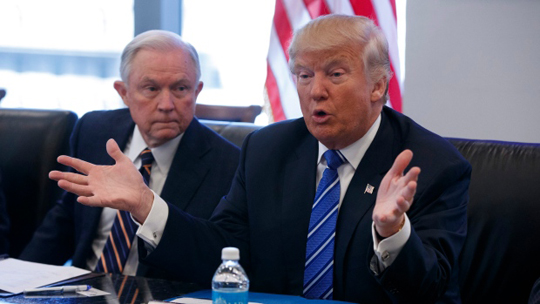
Donald

The New York billionaire, whose defeat of Democrat Hillary Clinton surprised even some loyalists, has scrambled to fill his Cabinet as the Jan. 20 inauguration approaches. Still, in many ways, he has barely scratched the surface of creating the massive team needed to run the government.

Experts say presidential transitions are periods of great vulnerability for the nation, and among the vacancies on the Trump team are leaders of the departments of State, Defense and Homeland Security.

Trump, who has virtually no experience in foreign affairs, offered a one-line tweet Saturday morning in reaction to the death of Cuban leader Fidel Castro - "Fidel Castro is dead!" - before issuing a more detailed statement.

"While Cuba remains a totalitarian island, it is my hope that today marks a move away from the horrors endured for too long, and toward a future in which the wonderful Cuban people finally live in the freedom they so richly deserve," Trump said.

His transition team did not immediately respond to requests to clarify his Cuba policy, which was inconsistent during the campaign.

Also Saturday, Clinton's camp said it was supporting Green Party candidate Jill Stein's push to force recounts in Wisconsin, Pennsylvania in Michigan. Trump narrowly carried those Democratic strongholds.

Clinton leads the national popular vote by close to 2 million votes, but Trump won 290 electoral votes to Clinton's 232, with Michigan still too close to call. It takes 270 to win the presidency.

Wisconsin officials are moving forward with the first presidential recount in state history following Stein's formal request. Stein, who drew 1 percent of the vote nationally, is raising millions of dollars to pay for the effort.

"Because we had not uncovered any actionable evidence of hacking or outside attempts to alter the voting technology, we had not planned to exercise this option ourselves," Clinton campaign attorney Marc Elias wrote Saturday in blog post. "But now that a recount has been initiated in Wisconsin, we intend to participate in order to ensure the process proceeds in a manner that is fair to all sides."

Elias said Clinton would take the same approach in Pennsylvania and Michigan if Stein were to follow through with recount requests those states, even though that was highly unlikely to change the election outcome.

"Regardless of the potential to change the outcome in any of the states, we feel it is important, on principle, to ensure our campaign is legally represented in any court proceedings and represented on the ground in order to monitor the recount process itself," Elias wrote.

Trump was spending the Thanksgiving holiday weekend with family at his Palm Beach estate, Mar-a-Lago. On Friday, he named Fox News analyst Kathleen Troia "KT" McFarland as deputy national security adviser and appointed campaign attorney Donald McGahn as White House counsel.

McFarland has worked for three presidents, although none since Ronald Reagan. Fox News said Saturday that her contract has been terminated in light of the appointment.

Trump planned to return to his New York home on Sunday ahead of a series of Monday meetings with prospective administration hires, including Sheriff David Clarke of Milwaukee County, Wisconsin. He's seen as a possible Homeland Security pick. Clarke's vocal opposition to the "Black Lives Matter" movement has made him popular with many conservatives.

Trump and Vice President-elect Mike Pence also have Monday meetings scheduled with Oklahoma Attorney General Scott Pruitt, Rep. Lou Barletta, R-Pa., former Security and Exchange Commission commissioner Paul Atkins, World Wide Technology chairman David Steward and General Growth Properties CEO Sandeep Mathrani.

Internal divisions over his choice for secretary of state have delayed that critical decision. The options include former New York City Mayor Rudy Giuliani, who lacks foreign policy experience, but was intensely loyal to Trump, and 2012 Republican presidential nominee Mitt Romney, who aggressively opposed Trump's candidacy but is largely regarded as more qualified. Tennessee Sen. Bob Corker is also a possibility.

With the world's attention on Cuba on Saturday, Trump indicated his administration would do "all it can to ensure the Cuban people can finally begin their journey toward prosperity and liberty."

During the campaign, Trump initially suggested he supported President Barack Obama's moves to loosen the US trade embargo.

Trump reversed himself less than a month before the election, and said he would reverse Obama unless Cuba met demands including "religious and political freedom for the Cuban people and the freeing of political prisoners."

His Saturday statement offered no more clarity.

Comments

Add new comment

  • Coastaldigest.com reserves the right to delete or block any comments.
  • Coastaldigset.com is not responsible for its readers’ comments.
  • Comments that are abusive, incendiary or irrelevant are strictly prohibited.
  • Please use a genuine email ID and provide your name to avoid reject.
News Network
June 4,2020

Jun 4: A malaria drug President Donald Trump took to try to prevent COVID-19 proved ineffective for that in the first large, high-quality study to test it in people in close contact with someone with the disease.

Results published Wednesday by the New England Journal of Medicine show that hydroxychloroquine was no better than placebo pills at preventing illness from the coronavirus.

The drug did not seem to cause serious harm, though -- about 40% on it had side effects, mostly mild stomach problems.

 “We were disappointed. We would have liked for this to work,” said the study leader, Dr. David Boulware, an infectious disease specialist at the University of Minnesota.

“But our objective was to answer the question and to conduct a high-quality study,” because the evidence on the drug so far has been inconclusive, he said.

Hydroxychloroquine and a similar drug, chloroquine, have been the subject of much debate since Trump started promoting them in March.

Hydroxychloroquine has long been used for malaria, lupus, and rheumatoid arthritis, but no large studies have shown it or chloroquine to be safe or effective for much sicker patients with coronavirus, and some studies have suggested the drugs may do harm.

Trump took a two-week course of hydroxychloroquine, along with zinc and Vitamin D, after two staffers tested positive for COVID-19, and had no ill effects, according to results of his latest physical released by his doctor Wednesday.

Federal regulators have warned against hydroxychloroquine's use except in hospitals and formal studies because of the risk of side effects, especially heart rhythm problems.

Boulware's study involved 821 people in the United States and Canada living with someone diagnosed with COVID-19 or at high risk of getting it because of their job -- doctors, nurses, ambulance workers who had significant exposure to a sick patient while not wearing full protective gear.

They were randomly assigned to get either the nutrient folate as a placebo or hydroxychloroquine for five days, starting within four days of their exposure. Neither they nor others involved in the research knew who was getting which pills.

After 14 days in the study, 12 per cent on the drug developed COVID-19 symptoms versus 14 per cent in the placebo group, but the difference is so small it could have occurred by chance, Boulware said.

“There's basically no effect. It does not prevent infection,” he said of the drug. Even if it were to give some slim advantage, “we'd want a much larger effect” to justify its use and risk of side effects for preventing illness, he said.

Results were no different among a subgroup of participants who were taking zinc or vitamin C, which some people believe might help make hydroxychloroquine more effective or fight the coronavirus.

There are some big caveats: The study enrolled people through the Internet and social media, relying on them to report their own symptoms rather than having them tracked in a formal way by doctors.

Participants were not all tested for the coronavirus but were diagnosed as COVID-19 cases based on symptoms in many cases. And not all took their medicines as directed.

The results “are more provocative than definitive,” and the drug may yet have prevention benefits if tried sooner or in a different way, Dr. Myron Cohen of the University of North Carolina at Chapel Hill wrote in a commentary in the journal.

Others were glad to see a study that had a comparison group and good scientific methods after so many weaker reports on hydroxychloroquine.

“This fits with everything else we've seen so far which suggests that it's not beneficial," said Dr. Peter Bach, director of a health policy center at Memorial Sloan Kettering Cancer Center in New York.

This study was in younger relatively healthy people, but the results “would make me very discouraged about trying to use this in older people” who are most vulnerable to serious illness from the coronavirus, Bach said.

“If it does work, it doesn't work very well.” Dr. Dan Culver, a lung specialist at the Cleveland Clinic, said there's still a chance that giving the drug sooner than four days after someone's exposure to the virus may help prevent illness.

But the study “takes 'home run' off the table” as far as hopes for the drug, he said.

The study was mostly funded by David Baszucki, founder of Roblox, a California-based game software company, and other private donors and the Minnesota university.

Boulware also is leading a study testing hydroxychloroquine for treating COVID-19. The study is finished and results are being analyzed now.

On Tuesday, the journal Lancet posted an “expression of concern” about a study it published earlier this month of nearly 15,000 COVID-19 patients on the malaria drugs that tied their use to a higher risk of dying in the hospital or developing a heartbeat problem.

Scientists have raised serious questions about the database used for that study, and its authors have launched an independent audit.

That work had a big impact: the World Health Organization suspended use of hydroxychloroquine in a study it is leading, and French officials stopped the drug's use in hospitals. On Wednesday, the WHO said experts who reviewed safety information decided that its study could resume.

Comments

Add new comment

  • Coastaldigest.com reserves the right to delete or block any comments.
  • Coastaldigset.com is not responsible for its readers’ comments.
  • Comments that are abusive, incendiary or irrelevant are strictly prohibited.
  • Please use a genuine email ID and provide your name to avoid reject.
News Network
February 9,2020

Beijing, Feb 9: After making sure everyone's face mask is on and sanitizer is to hand, the Qiao family heads out to Jingshan Park, a former royal sanctuary beside the Forbidden City in China's capital Beijing.

Snow has fallen for a second day, a rare event in the city of 21.5 million that would normally bring hundreds of thousands of people out to take photos and play. But the streets are empty and the parks are so quiet the only sound is of birds chirping.

It's not just Beijing. Shanghai, China's financial hub, and other cities in the world's most populous nation have turned into ghost towns after the government extended a holiday and asked residents not to go out because of the coronavirus.

"We know the situation of the coronavirus is severe. But the epicentre is far away, so we think it should be fine here ... It's a God-given chance to enjoy this family moment with snow and without work," said Mr Qiao, who has an 11-year-old daughter.

The epidemic has killed 722 people and infected nearly 32,000 in China as of February 8. More than three-quarters of the cases are in the central Hubei province where the virus originated - more than 1,000 km (620 miles) from Beijing.

Only a few people are brave enough to come out. A security guard at Jingshan Park said there were less than a third of the number of tourists than usual, even with the rare snowfall.

Even at one of the best spots for snapping photos of snowy Beijing just outside the Forbidden City, there's barely a crowd, while the usual tour buses and groups of people speaking different dialects are nowhere to be seen.

"Last year when it snowed, I took a few hours off work to come down here to take a picture and the crowd was several layers deep," said a man in his 30s who gave his surname as Yang. "But this year, I am not at all worried about finding a space to take a photo. The virus is keeping people indoors."

Security guards along Wangfujing street, a popular pedestrianised shopping area in downtown Beijing, said it was normally so crowded during the holiday period that it was hard to move around.

"Look at it now, there are more security guards and street cleaners than tourists!" said one of the guards.

Businesses, including shops, bars and restaurants, have been severely hit by the epidemic as the government has banned mass gatherings and even group meals in an effort to curb the spread of the coronavirus.

"You would have to wait outside for a table on a normal day," said a waitress at a restaurant with more than 50 tables. Just five were taken at the peak lunch hour.

Only a handful of the more than 100 restaurants along Beijing's famous food street, Guijie, were open, and the remaining outlets were wondering how long they can hold out.

Comments

Add new comment

  • Coastaldigest.com reserves the right to delete or block any comments.
  • Coastaldigset.com is not responsible for its readers’ comments.
  • Comments that are abusive, incendiary or irrelevant are strictly prohibited.
  • Please use a genuine email ID and provide your name to avoid reject.
News Network
February 2,2020

Feb 2: The Philippines on Sunday reported the first death from a new virus outside of China, where authorities delayed the opening of schools in the worst-hit province and tightened quarantine measures in a city that allow only one family member to venture out to buy supplies.

The Philippine Department of Health said a 44-year-old Chinese man from Wuhan was admitted on Jan. 25 after experiencing a fever, cough, and sore throat. He developed severe pneumonia, and in his last few days, “the patient was stable and showed signs of improvement, however, the condition of the patient deteriorated within his last 24 hours resulting in his demise.”

The man’s 38-year-old female companion, also from Wuhan, also tested positive for the virus and remains in hospital isolation in Manila.

President Rodrigo Duterte approved a temporary ban on all travelers, except Filipinos, from China and its autonomous regions. The U.S., Japan, Singapore and Australia have imposed similar restrictions despite criticism from China and an assessment from the World Health Organization that they were unnecessarily hurting trade and travel.

The death toll in China climbed by 45 to 304 and the number of cases by 2,590 to 14,380, according to the National Health Commission, well above the number of those infected in in the 2002-03 outbreak of SARS, or severe acute respiratory syndrome, which broke out in southern China and spread worldwide.

Meanwhile, six officials in the city of Huanggang, neighboring the epicenter of Wuhan in Hubei province, have been fired over “poor performance” in handling the outbreak, the official Xinhua News Agency reported.

It cited the mayor as saying the city’s “capabilities to treat the patients remained inadequate and there is a severe shortage in medical supplies such as protective suits and medical masks.”

After Huanggang, the trading center of Wenzhou in coastal Zhejiang province also confined people to homes, allowing only one family member to venture out every other day to buy necessary supplies.

With the outbreak showing little sign of abating, authorities in Hubei and elsewhere have extended the Lunar New Year holiday, due to end this week, well into February. The annual travel crunch of millions of people returning from their hometowns to the cities is thought to pose a major threat of secondary infection at a time when authorities are encouraging people to avoid public gatherings.

All Hubei schools will postpone the opening of the new semester until further notice and students from elsewhere who visited over the holiday will also be excused from classes.

Far away on China’s southeast coast, the manufacturing hub of Wenzhou put off the opening of government offices until Feb. 9, private businesses until Feb. 17 and schools until March 1.

With nearly 10 million people, Wenzhou has reported 241 confirmed cases of the virus, one of the highest levels outside Hubei. Similar measures have been announced in the provinces and cities of Heilongjiang, Shandong, Guizhou, Hebei and Hunan, while the major cities of Shanghai and Beijing were on indefinite leave pending developments.

Despite imposing drastic travel restrictions at home, China has chafed at those imposed by foreign governments, criticizing Washington’s order barring entry to most non-citizens who visited China in the past two weeks. Apart from dinging China’s international reputation, such steps could worsen a domestic economy already growing at its lowest rate in decades.

The crisis is the latest to confront Chinese leader Xi Jinping, who has been beset by months of anti-government protests in the semi-autonomous Chinese city of Hong Kong, the reelection of Taiwan’s pro-independence president and criticism over human rights violations in the traditionally Muslim northwestern territory of Xinjiang. Economically, Xi faces lagging demand and dramatically slower growth at home while the tariff war with the U.S. remains largely unresolved.

Among a growing number of airlines suspending flights to mainland China was Qatar Airways. The Doha-based carrier said on its website that its flights would stop Monday. It blamed “significant operational challenges caused by entry restrictions imposed by a number of countries” for the suspension of flights.

Oman also halted flights to China, as did Saudi Arabia’s flagship national carrier, Saudia.

Saudi Arabia’s state-run TV reported that 10 Saudi students were evacuated from Wuhan on a special flight. It said the students would be screened upon arrival, but did not say whether they would be quarantined for 14 days.

This weekend, South Korea and India flew hundreds of their citizens out of Wuhan. They went into a two-week quarantine.

On Sunday, South Korea reported three more cases for a total of 15. They include an evacuee, a Chinese relative of a man who tested positive and a man who returned from Wuhan. India reported a second case, also in southern Kerala state.

South Korea also barred foreigners who have stayed or traveled to Hubei province within the last 14 days from entering the country.

Indonesia flew back 241 nationals from Wuhan on Sunday and quarantined them on the remote Natuna Islands for two weeks. Several hundred residents protested the move, with one saying, “This is not because we do not have a sense of solidarity with fellow nationals. But because we fear they could infect us with the deadly virus from China.”

A Turkish military transport plane carrying 42 people arrived in Ankara from Wutan Saturday night. The 32 Turkish, six Azerbaijani, three Georgian nationals and an Albanian will remain under observation for 14 days, together with 20 personnel who participated in the evacuation, Health Minister Fahrettin Koca said.

Vietnam counted its seventh case, a Vietnamese-American man who had a two-hour layover in Wuhan on his way from the U.S. to Ho Chi Minh City.

The virus’ rapid spread in two months prompted the WHO on Thursday to declare it a global emergency.

That declaration “flipped the switch” from a cautious attitude to recommending governments prepare for the possibility the virus might spread, said the WHO representative in Beijing, Gauden Galea. Most cases reported so far have been people who visited China or their family members.

WHO said it was especially concerned that some cases abroad involved human-to-human transmission.

“Countries need to get ready for possible importation in order to identify cases as early as possible and in order to be ready for a domestic outbreak control, if that happens,” Galea told The Associated Press.

Both the new virus and SARS are from the coronavirus family, which also includes those that cause the common cold.

The death rate in China is falling, but the number of confirmed cases will keep growing because thousands of specimens from suspected cases have yet to be tested, Galea said.

“The case fatality ratio is settling out at a much lower level than we were reporting three, now four, weeks ago,” he said.

Although scientists expect to see limited transmission of the virus between people with family or other close contact, they are concerned about cases of infection spreading to people who might have less exposure.

Comments

Add new comment

  • Coastaldigest.com reserves the right to delete or block any comments.
  • Coastaldigset.com is not responsible for its readers’ comments.
  • Comments that are abusive, incendiary or irrelevant are strictly prohibited.
  • Please use a genuine email ID and provide your name to avoid reject.