


Amid Recount Effort, Donald Trump Eyes Foreign Policy, Defense Jobs

November 27, 2016

West Palm Beach, Nov 27: His inauguration less than eight weeks away, President-elect Donald Trump was confronted by new developments Saturday in recount efforts in three states pivotal to his Nov. 8 victory, even as he worked to fill foreign policy and national defense jobs in his incoming administration.
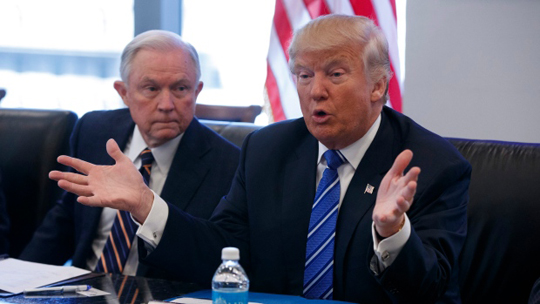
Donald

The New York billionaire, whose defeat of Democrat Hillary Clinton surprised even some loyalists, has scrambled to fill his Cabinet as the Jan. 20 inauguration approaches. Still, in many ways, he has barely scratched the surface of creating the massive team needed to run the government.

Experts say presidential transitions are periods of great vulnerability for the nation, and among the vacancies on the Trump team are leaders of the departments of State, Defense and Homeland Security.

Trump, who has virtually no experience in foreign affairs, offered a one-line tweet Saturday morning in reaction to the death of Cuban leader Fidel Castro - "Fidel Castro is dead!" - before issuing a more detailed statement.

"While Cuba remains a totalitarian island, it is my hope that today marks a move away from the horrors endured for too long, and toward a future in which the wonderful Cuban people finally live in the freedom they so richly deserve," Trump said.

His transition team did not immediately respond to requests to clarify his Cuba policy, which was inconsistent during the campaign.

Also Saturday, Clinton's camp said it was supporting Green Party candidate Jill Stein's push to force recounts in Wisconsin, Pennsylvania in Michigan. Trump narrowly carried those Democratic strongholds.

Clinton leads the national popular vote by close to 2 million votes, but Trump won 290 electoral votes to Clinton's 232, with Michigan still too close to call. It takes 270 to win the presidency.

Wisconsin officials are moving forward with the first presidential recount in state history following Stein's formal request. Stein, who drew 1 percent of the vote nationally, is raising millions of dollars to pay for the effort.

"Because we had not uncovered any actionable evidence of hacking or outside attempts to alter the voting technology, we had not planned to exercise this option ourselves," Clinton campaign attorney Marc Elias wrote Saturday in blog post. "But now that a recount has been initiated in Wisconsin, we intend to participate in order to ensure the process proceeds in a manner that is fair to all sides."

Elias said Clinton would take the same approach in Pennsylvania and Michigan if Stein were to follow through with recount requests those states, even though that was highly unlikely to change the election outcome.

"Regardless of the potential to change the outcome in any of the states, we feel it is important, on principle, to ensure our campaign is legally represented in any court proceedings and represented on the ground in order to monitor the recount process itself," Elias wrote.

Trump was spending the Thanksgiving holiday weekend with family at his Palm Beach estate, Mar-a-Lago. On Friday, he named Fox News analyst Kathleen Troia "KT" McFarland as deputy national security adviser and appointed campaign attorney Donald McGahn as White House counsel.

McFarland has worked for three presidents, although none since Ronald Reagan. Fox News said Saturday that her contract has been terminated in light of the appointment.

Trump planned to return to his New York home on Sunday ahead of a series of Monday meetings with prospective administration hires, including Sheriff David Clarke of Milwaukee County, Wisconsin. He's seen as a possible Homeland Security pick. Clarke's vocal opposition to the "Black Lives Matter" movement has made him popular with many conservatives.

Trump and Vice President-elect Mike Pence also have Monday meetings scheduled with Oklahoma Attorney General Scott Pruitt, Rep. Lou Barletta, R-Pa., former Security and Exchange Commission commissioner Paul Atkins, World Wide Technology chairman David Steward and General Growth Properties CEO Sandeep Mathrani.

Internal divisions over his choice for secretary of state have delayed that critical decision. The options include former New York City Mayor Rudy Giuliani, who lacks foreign policy experience, but was intensely loyal to Trump, and 2012 Republican presidential nominee Mitt Romney, who aggressively opposed Trump's candidacy but is largely regarded as more qualified. Tennessee Sen. Bob Corker is also a possibility.

With the world's attention on Cuba on Saturday, Trump indicated his administration would do "all it can to ensure the Cuban people can finally begin their journey toward prosperity and liberty."

During the campaign, Trump initially suggested he supported President Barack Obama's moves to loosen the US trade embargo.

Trump reversed himself less than a month before the election, and said he would reverse Obama unless Cuba met demands including "religious and political freedom for the Cuban people and the freeing of political prisoners."

His Saturday statement offered no more clarity.

Comments

Add new comment

  • Coastaldigest.com reserves the right to delete or block any comments.
  • Coastaldigset.com is not responsible for its readers’ comments.
  • Comments that are abusive, incendiary or irrelevant are strictly prohibited.
  • Please use a genuine email ID and provide your name to avoid reject.
Agencies
April 20,2020

Hong Kong, Apr 20: Oil prices collapsed to more than two-decade lows Monday as traders grow concerned that storage facilities are reaching their limits, while equities were mixed, with some support coming from signs that the coronavirus may have peaked in Europe and the United States.

US crude benchmark West Texas Intermediate briefly plunged almost 20 percent to below 15 -- its lowest since 1999 -- as stockpiles continue to build owing to a crash in demand caused by the COVID-19 pandemic.

Analysts said this month's agreement between top producers to slash output by 10 million barrels a day was having little impact on the oil crisis because of lockdowns and travel restrictions that are keeping billions of people at home.

WTI was hit particularly hard as its main US storage facilities in Cushing, Oklahoma, were filling up.

ANZ said "crude oil prices remained under pressure, as projections of weaker demand weigh on sentiment".

"Despite the OPEC+ alliance agreeing to an unprecedented cut in output, the physical market is awash with oil," it said, referring to the Organization of the Petroleum Exporting Countries and non-OPEC partners.

And AxiCorp's Stephen Innes added: "It's a dump at all cost as no one... wants delivery of oil, with Cushing storage facilities filling by the minute.

"It hasn't taken long for the market to recognise that the OPEC+ deal will not, in its present form, be enough to balance oil markets." Stock traders were in slightly more buoyant mood as governments start to consider how and when to ease lockdowns that have crippled the global economy.

Italy, Spain, France and Britain reported drops in daily death tolls and slowing infection rates.

"We are scoring points against the epidemic," said Prime Minister Edouard Philippe, while insisting "we are not out of the health crisis yet".

Meanwhile, in the US, Andrew Cuomo, governor of badly hit New York state, said the disease was "on the descent", though he cautioned it was "no time to get cocky".

Mounting evidence suggests that the lockdowns and social distancing are slowing the spread of the virus.

That has intensified planning in many countries to begin loosening curbs on movement and easing the crushing pressure on national economies.

Adding to the sense of hope was a report indicating promising research on a drug to treat coronavirus.

Hong Kong, Shanghai and Seoul were each up 0.1 percent, while Wellington added 0.4 percent.

However, Tokyo went into the break 0.9 percent lower, while Sydney and Manila dropped one percent apiece. There were also losses in Taipei, Singapore and Jakarta.

"The longer investors have to contemplate future economic issues while they wait for more countries to be on the downward slope of the pandemic curve, the more scope there is of risk assets pricing in a difficult future," Chris Iggo, of AXA Investment Managers UK, said.

Investors are keeping an eye on Washington, where Congress and the White House are working towards a 450 billion economic relief plan for small business to add to the trillions already pledged to support the economy.

Big-name companies including IBM, Netflix and Coca-Cola are due to deliver their earnings reports.

Comments

Add new comment

  • Coastaldigest.com reserves the right to delete or block any comments.
  • Coastaldigset.com is not responsible for its readers’ comments.
  • Comments that are abusive, incendiary or irrelevant are strictly prohibited.
  • Please use a genuine email ID and provide your name to avoid reject.
News Network
April 15,2020

Wuhan, Apr 15: In the six days after top Chinese officials secretly determined they likely were facing a pandemic from a new coronavirus, the city of Wuhan at the epicenter of the disease hosted a mass banquet for tens of thousands of people; millions began traveling through for Lunar New Year celebrations.

President Xi Jinping warned the public on the seventh day, Janaury 20. But by that time, more than 3,000 people had been infected during almost a week of public silence, according to internal documents obtained by The Associated Press and expert estimates based on retrospective infection data.

That delay from Jan 14 to Jan. 20 was neither the first mistake made by Chinese officials at all levels in confronting the outbreak, nor the longest lag, as governments around the world have dragged their feet for weeks and even months in addressing the virus.

But the delay by the first country to face the new coronavirus came at a critical time — the beginning of the outbreak. China's attempt to walk a line between alerting the public and avoiding panic set the stage for a pandemic that has infected almost 2 million people and taken more than 126,000 lives.

A This is tremendous, a said Zuo-Feng Zhang, an epidemiologist at the University of California, Los Angeles. If they took action six days earlier, there would have been much fewer patients and medical facilities would have been sufficient. We might have avoided the collapse of Wuhan's medical system.

Other experts noted that the Chinese government may have waited on warning the public to stave off hysteria, and that it did act quickly in private during that time.

But the six-day delay by China's leaders in Beijing came on top of almost two weeks during which the national Center for Disease Control did not register any cases from local officials, internal bulletins obtained by the AP confirm. Yet during that time, from Jan 5 to Jan 17, hundreds of patients were appearing in hospitals not just in Wuhan but across the country.

It's uncertain whether it was local officials who failed to report cases or national officials who failed to record them. It's also not clear exactly what officials knew at the time in Wuhan, which only opened back up last week with restrictions after its quarantine.

But what is clear, experts say, is that China's rigid controls on information, bureaucratic hurdles and a reluctance to send bad news up the chain of command muffled early warnings. The punishment of eight doctors for rumor-mongering, broadcast on national television on Jan. 2, sent a chill through the city's hospitals.

Doctors in Wuhan were afraid, said Dali Yang, a professor of Chinese politics at the University of Chicago. It was truly intimidation of an entire profession. Without these internal reports, it took the first case outside China, in Thailand on Jan 13, to galvanize leaders in Beijing into recognising the possible pandemic before them. It was only then that they launched a nationwide plan to find cases distributing CDC-sanctioned test kits, easing the criteria for confirming cases and ordering health officials to screen patients, all without telling the public.

The Chinese government has repeatedly denied suppressing information in the early days, saying it immediately reported the outbreak to the World Health Organization.

Allegations of a cover-up or lack of transparency in China are groundless, said foreign ministry spokesman Zhao Lijian at a Thursday press conference.

The documents show that the head of China's National Health Commission, Ma Xiaowei, laid out a grim assessment of the situation on Jan. 14 in a confidential teleconference with provincial health officials.

A memo states that the teleconference was held to convey instructions on the coronavirus from President Xi Jinping, Premier Li Keqiang and Vice Premier Sun Chunlan, but does not specify what those instructions were.

The epidemic situation is still severe and complex, the most severe challenge since SARS in 2003, and is likely to develop into a major public health event, the memo cites Ma as saying.

The National Health Commission is the top medical agency in the country. In a faxed statement, the Commission said it had organised the teleconference because of the case reported in Thailand and the possibility of the virus spreading during New Year travel. It added that China had published information on the outbreak in an open, transparent, responsible and timely manner," in accordance with important instructions repeatedly issued by President Xi.

The documents come from an anonymous source in the medical field who did not want to be named for fear of retribution. The AP confirmed the contents with two other sources in public health familiar with the teleconference. Some of the memo's contents also appeared in a public notice about the teleconference, stripped of key details and published in February.

Under a section titled sober understanding of the situation, the memo said that clustered cases suggest that human-to-human transmission is possible. It singled out the case in Thailand, saying that the situation had changed significantly because of the possible spread of the virus abroad.

With the coming of the Spring Festival, many people will be traveling, and the risk of transmission and spread is high, the memo continued.

Comments

Add new comment

  • Coastaldigest.com reserves the right to delete or block any comments.
  • Coastaldigset.com is not responsible for its readers’ comments.
  • Comments that are abusive, incendiary or irrelevant are strictly prohibited.
  • Please use a genuine email ID and provide your name to avoid reject.
News Network
April 20,2020

Washington, Apr 20: The US wants to send a team of experts to China to investigate coronavirus, President Donald Trump has said, a day after he warned Beijing of "consequences" if it was knowingly responsible for the spread of COVID-19 which has killed more than 165,000 people globally, including over 41,000 in America.

Describing the coronavirus as a plague, Trump, during his White House news conference on Sunday, said that he is not happy with China where the pandemic emerged in December last year in the central Chinese city of Wuhan.

“We spoke to them (Chinese) a long time ago about going in. We want to go in. We want to see what's going on. And we weren't exactly invited, I can tell you that,” the President told reporters.

“I was very happy with the (trade) deal (with China), very happy with everything and then we found out about the plague and since we found out about that I'm not happy,” he said.

The US has launched an investigation into whether the deadly virus "escaped" from the Wuhan Institute of Virology.

He has repeatedly expressed disappointment over China's handling of the coronavirus disease, alleged non-transparency and initial non-cooperation from Beijing with Washington on dealing with the crisis.

“Based on an investigation, we are going to find out,” Trump told reporters.

A day earlier, he warned China that it should face consequences if it was "knowingly responsible" for the spread of the novel coronavirus, upping the ante on Beijing over its handling of the COVID-19 pandemic.

“If they (China) were knowingly responsible… then there should be consequences. You're talking about, you know, potentially lives like nobody's seen since 1917,” Trump said on Saturday.

The opposition Democratic Party said that Trump has falsely claimed he acted early by restricting travel from China when it was little too late and he continued to downplay the virus throughout February.

The number of COVID-19 deaths in the US crossed 41,000 and the total infections were more than 764,000 so far.

New York, the epicentre of the deadly COVID-19 in the US, has 2,42,000 cases and over 17,600 fatalities so far. It has registered a 50-percent decline in new cases over an eight-day period.

The novel virus, which emerged in China in December last year, has killed over 160,000 and infected more than 2.3 million people worldwide.

Comments

Add new comment

  • Coastaldigest.com reserves the right to delete or block any comments.
  • Coastaldigset.com is not responsible for its readers’ comments.
  • Comments that are abusive, incendiary or irrelevant are strictly prohibited.
  • Please use a genuine email ID and provide your name to avoid reject.