



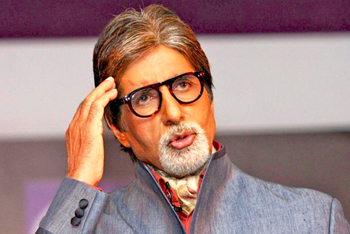
Amitabh Bachchan: It is very honest and daring of Deepika Padukone to have talked about her depression

[email protected] (Bollywoodlife)
January 19, 2015

Amitab

Mumbai, Jan 19: On my way to meet Amitabh Bachchan at his swanky office in Juhu, I passed several billboards of the actor endorsing different products. It struck me how despite an avalanche of new and young faces, Big B is still one of the most sought-after names in the advertising and film industry. When I walk into his office I am told that he’s wrapping up the shoot of yet another product endorsement! Dressed in his favourite jacket that has the words ‘Russia’ written on it, we soon settle down to talk about his upcoming film, stuff he wants to learn and what he admires in the current lot of the young actors. Excerpts from our chat…

Most actors find film promotions tiring, Do you, too?

It is tiring, but it is now an accepted norm, so we just go along with it. It has become part of every film we do. Somewhere, they feel that promotions help the final outcome of the film. So here we are!

What’s different about working with Balki from Cheeni Kum to Paa to Shamitabh?

He has a different kind of mind and unique ideas. It is interesting for an actor to interact or work with someone who keeps inventing new ideas. You are always attracted to something that is different as it tests and challenges you. But Shamitabh is no different from any other of his enterprises. It is yet again another unique story and one that Indian cinema has not seen before.

Your name is referenced in a film title…

That’s true. But it’s not just there for the sake of my name, it is there for a certain reason which is there in the script.

The promo for Shamitabh has left people trying to guess it’s plot. Comment!

This is all Balki’s doing. We have a relationship where we discuss almost everything. If there’s something troubling me, I call him up, if there is something he wants to run through me, he calls. It’s a very healthy combination of ideas, but eventually of course, it’s the director’s call. I mean even if I were to disagree, I would respect his call as the final one.

You have the maximum number of followers on Twitter, have you ever tried to analyse why?

No. I am just happy that it has happened. I keep putting out my blog and there are a few regulars that I keep talking to. It is very difficult for me to go through everyone’s tweets, but I try as much as I can. All they want is a hi and a hello and to be noticed. It’s the least that we can do.

Blogging’s part of your daily routine?

Yes, I write everyday. I need to. If I don’t write, then I get hit on the head by followerasking, ‘Where are you? Are you okay?Why haven’t you blogged?’. Sometimes I forget to press the ‘post’ button and my phone is filled with mails saying ‘Mr Bachchan, you have forgotten to press the ‘post’ button, the blog is not out.’

What is the one lesson that you have learnt from working with youngsters?

I am in great admiration of the new generation. They are very spontaneous, they are very determined, very aggressive, know exactly what they want and how to get there. They are also very brave and a million times better than what we were at that age. I am so happy and fortunate that I get to work in projects with them despite the very large age difference. But it’s a great learning for me, I love to be in their company to see how they work, to learn from them. It is a very exciting time for Indian cinema and the amount of talent that comes out every Friday is amazing and it can only bode well for all of us.

There is a director hidden inside every actor. Agree?

I don’t know direction. Sometimes, when you are enacting a sequence you may want to give your own input on how you want to say it, the way you want to move, what you want to do, sit, stand, run, cry, laugh. These are some things that are individual in an actor, but the director is the ultimate authority and he will have to decide and it will become my imperative duty to obey him. I really don’t know how to put together a scene, there enough stuff to do in front of the camera and say your lines, but to be able to direct is tough.

Is there anything you want to learn this year?

I wish I could, but there’s no time. Technology changes every five minutes so one tries to keep up with it and you feel left behind in the race if you are not up-to-date. There are so many things, if you could learn how to sing or play an instrument, piano or a language perhaps…

What are the reactions you are getting for Shweta’s column in After Hrs?

She’s always been a very good writer. She has a lot of hidden talents which she’s never put out to the public. But I am really happy that she does this column. It has a style and is very different. Lot of people say many nice things to her after reading it which is a moment of great pride for the father.

What is your barometer of success? Is it `500 crore, your satisfaction as a performer or the audience feedback on social media?

Somewhere a bit of everything. Primarily, I hope that people like me and if that comes true, it’s great. At the same time, your next job will depend upon box-office success so that is an area of concern. And then of course, the critics and what they say is all welcome.

Recently Deepika spoke about how she battled depression, have you ever faced that?

I don’t know the extent of what Deepika has said. But I think it’s very honest and daring of Deepika to talk about it not so much to gain from it, but to make people aware of it. Awareness is a huge factor in most illnesses. I work for diabetes and tuberculosis, and will be working for hepatitis, and they are all very prominent diseases, many of them people are unaware of how to avoid, or at times are even unaware that they are affected by it. If I am going to be talking about a particular disease and know enough about it, I would definitely do it. We did that with polio, worked for eight years and finally India is today polio-free. I am not saying that we don’t go through phases where you are depressed or frustrated. All of us go through it, but we try and find a way out.

Would you consider investing 12 years of your life into making a movie like Richard Linklater did, with Boyhood?

Anybody wanting to do that now with me would be stupid because I probably won’t be alive by then! But it’s a great creative effort and it is very remarkable how somebody can have the patience to wait for a kid to grow for 12 years and continue to make this film. I think it is fantastic.

Comments

Add new comment

  • Coastaldigest.com reserves the right to delete or block any comments.
  • Coastaldigset.com is not responsible for its readers’ comments.
  • Comments that are abusive, incendiary or irrelevant are strictly prohibited.
  • Please use a genuine email ID and provide your name to avoid reject.
News Network
January 23,2020

Jan 23: Calling himself an optimist who believes in the goodness of people, director Kabir Khan says everything these days is being looked at through the prism of religion but India is about more than that.

The director of blockbusters such as Bajrangi Bhaijaan and Ek Tha Tiger said he is happy he has a platform as a filmmaker to present a counterpoint to the prevailing narrative based on religious fault lines.

"I’m an optimist who believes in the goodness of the people. But yes, there is a certain level of bigotry that has crept in. Everything is being looked at through the prism of religion but India is not about that.

"It sounds like a cliché but when I was growing up, I was not aware of my religion. That was the greatness of this country,” Kabir told news agency.

He said he is a product of a mixed marriage and is pained to see the social fabric being tattered.

“I have celebrated the best that Indian secularism has to offer. But to see the greatness of this country being simplified and broken down into religious fault lines is a painful experience,” he added.

According to Kabir, it is dangerous to see history through the prism of religion, whether in cinema or society. But it is important to revisit history to know what happened and one can always find something that is relevant for the present, he said.

The director, who started as a documentary filmmaker, returns to his roots for a five-episode series on Subhas Chandra Bose's Indian National Army, The Forgotten Army: Azaadi Ke Liye, on Amazon Prime, his most expensive project yet.

Asked whether this is a difficult time for filmmakers, Kabir said he believes art thrives in the time of strife and, as a storyteller, his politics will always reflect in his work.

“Every film has its politics and every filmmaker has to reflect his or her politics. Every film of mine will reflect my politics and it will never change according to the popular mood of the audience. But a film should not be just about that. Politics should be in the layers beneath," he said.

He terms his 2015 Salman Khan-starrer Bajrangi Bhaijaan an "extremely political" film. At face value, it can also be enjoyed as the story of a mute Pakistani girl who drifts into India and is taken back to her homeland by a Hanuman devotee. But there is so much more. The "chicken song", for instance, was a sly reference to the beef ban controversy at the time, he said.

"I won’t say it is a difficult time for me as a filmmaker. It is good that I have a platform where I can talk and present a counterpoint and I refuse to believe that the entire country believes the narrative that is being sent out. There are millions and millions of people, and perhaps the majority, that does not believe. And if I present the counterpoint, they will think about it.”

Discussing his new series, the director said it has always fascinated him that the sacrifice of the men and women who comprised the INA is just a forgotten footnote in history.

“I wanted to make something that stands the test of time. It goes down in posterity,” Khan, who first explored the subject in a Doordarshan documentary 20 years ago, said.

For the documentary, he traveled with former INA officers Captain Lakshmi Sahgal and Captain Gurbaksh Singh Dhillon from Singapore to India via erstwhile Burma, retracing the route that the INA followed.

“The documentary got me a lot of attention and acclaim but the story just never left me. It's actually the first script I ever wrote and I landed up with that script in Bombay from Delhi. I realised very soon that nobody's going to give me a budget of this size to make my first film.

"And then after every film, I would pick up the script and say, ‘Okay, this is the one I want to make’, because this is the story that made me want to become a filmmaker. On the way, I ended up making eight other films but this is really the story that I wanted to make,” he said.

Kabir is happy that the story has come out as a series, not a film, as it would have required to compromise with the budget and other elements.

"Without giving any numbers, this is the most expensive project I have ever worked on… It required that kind of budget."

Kabir believes the INA was responsible for bringing down the morale of the British establishment, which realised it would be impossible to keep the country colonised without the support of the local army.

"There are a lot of debates and discussions about what happened with the INA and the controversies around it. The whole point is that, if you want to judge what the Army did, sure that's your prerogative, but at least get to know what they did. Nobody knows what happened with the Army from 1942 to 1945."

He added that 55,000 men and women of the INA fought for independence and 47,000 of them died.

"Not a single person from that Army was ever taken back into the independent Army, which is such an amazing fact... the fact that the British called them traitors became the narrative and we also started assuming that they were traitors."

"They were the only women's regiment in the whole world 70 years ago. That's what they thought about women's importance in society. I don't know whether they will be happy with what the current situation is," he said.

Comments

Add new comment

  • Coastaldigest.com reserves the right to delete or block any comments.
  • Coastaldigset.com is not responsible for its readers’ comments.
  • Comments that are abusive, incendiary or irrelevant are strictly prohibited.
  • Please use a genuine email ID and provide your name to avoid reject.
Agencies
March 24,2020

Los Angeles, Mar 24: In a bizarre video shot from her rose petal filled bathtub, pop star Madonna has called the coronavirus pandemic "a great equaliser".

The music icon said the virus doesn't discriminate between rich and poor.

That's the thing about COVID-1. It doesn't care about how rich you are, how famous you are, how funny you are, how smart you are, where you live, how old you are, what amazing stories you can tell.

It's the great equaliser and what's terrible about it is what's great about it. What's terrible about it is that it's made us all equal in many ways, and what's wonderful about is, is that it's made us all equal in many ways, Madonna said in the video while having a milky bath in tub full of roses.

The 61-year-old singer, who had to cancel two of her concerts in Paris due to coronavirus outbreak, also referenced her 1995 song Human Nature in the video saying we are all going down together .

According to the Johns Hopkins coronavirus tracker, the death toll from the virus globally has risen to 14,641 with 336,000 cases reported in 173 countries and territories.

Comments

Add new comment

  • Coastaldigest.com reserves the right to delete or block any comments.
  • Coastaldigset.com is not responsible for its readers’ comments.
  • Comments that are abusive, incendiary or irrelevant are strictly prohibited.
  • Please use a genuine email ID and provide your name to avoid reject.
News Network
April 3,2020

Washington, April 3: American actor Kristen discussed her experience being isolated with husband and their two kiddos.

According to Fox News, the 39-year-old actor discussed how she and Shepard are finding quarantine to be a little tough in a video chat to Entertainment Tonight.

Bell admitted: "We've gotten on each other's last nerve these last couple days. We're doing much better now because were laughing about it. But when we were not laughing about it for the first couple of days, that's the hard spot."

The 'Bad Mom' actor then shared her thoughts on why quarantining with loved ones can be so tough. She explained that she loves spending time with her husband and he loves spending time with her.

But what she thinks is different about this quarantine time is you have so much more time to think about the other persona and their actions and sort of replay what they said or attach a meaning to something that they did.
Bell added: "Nobody really needs time for that. That's useless."

The 'Frozen' actor also discussed having to make adjustments in regards to her kids, 7-year-old Lincoln, and 5-year-old Delta, and the schedule she tried to keep once the quarantine began.

She said that the biggest lesson she learnt, in the beginning, was that she wrote out the colour coded schedule, and noted about when will be their academic and academic time.

Kristen explained that by day five of schedule, she was making everybody miserable. About a week ago, she woke her kids up and encouraged her daughters to rip up the schedule, explaining that the kids "felt so good."

"I said the learning lesson here is that if you make a plan and it's not working, you pivot," said Bell.

Comments

Add new comment

  • Coastaldigest.com reserves the right to delete or block any comments.
  • Coastaldigset.com is not responsible for its readers’ comments.
  • Comments that are abusive, incendiary or irrelevant are strictly prohibited.
  • Please use a genuine email ID and provide your name to avoid reject.