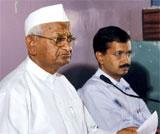
Anna to fast from tomorrow, threatens 'jail bharo' agitation

July 24, 2012

anna

New Delhi, July 24: Reversing his earlier decision, Anna Hazare today said he will sit on an indefinite fast along with his team from tomorrow even as he issued an ultimatum to the government to concede to their demands in three-four days or face a fresh 'jail bharo' agitation.

"Anna arrives in Delhi. He says he will also be fasting," his close aide Arvind Kejriwal tweeted this afternoon. A Team Anna spokesperson said Hazare will sit on an indefinite hunger strike along with Kejriwal, Manish Sisodia and Gopal Rai.

Earlier, Hazare had announced that he will not sit on fast owing to health problems while his three Team Anna members will go on hunger strike to demand setting up of a Special Investigation Team to probe corruption allegations levelled by them against Ministers, a fast track court to try cases against MPs and for bringing a strong Lokpal Bill.

The reversal of his decision seems to be part of a Team Anna strategy to step up pressure on the government and drum up support for the protest at Jantar Mantar, the dharna hot spot in the national capital.

Earlier in a video message, Hazare asked the government to take decisions on their demands in three-four days.

In his recorded message, Hazare said, "Let us see what the government does during the fast. If the government does not take any decision (on the demands raised by us) in the first three-four days of the agitation, I will tell people across the country to go on a jail bharo agitation.

"Not a single prison in the country should remain vacant," he said and added that going to jail for the sake of the country is an "embellishment for your life".

He said people should consider this protest as a second freedom struggle as the the government was "not doing anything" to bring a strong Lokpal Bill or taking action against corruption.

"Why they are not bringing Lokpal bill. Because 15 of the 35 ministers face corruption allegations. Probe them. Punish them if they are guilty. But the government is not willing to do so. We are left with only one way (to protest)," he said.

Comments

Add new comment

  • Coastaldigest.com reserves the right to delete or block any comments.
  • Coastaldigset.com is not responsible for its readers’ comments.
  • Comments that are abusive, incendiary or irrelevant are strictly prohibited.
  • Please use a genuine email ID and provide your name to avoid reject.
News Network
February 9,2020

New Delhi, Feb 9: As the outbreak of novel coronavirus has lead to the death of more than 800 Chinese nationals, aviation regulator DGCA on Saturday said that foreigners who went to China on or after January 15 will not be allowed to enter India.

The DGCA, in its circular to airlines on Saturday, reiterated that all visas issued to Chinese nationals before February 5 have been suspended.

However, the Directorate General of Civil Aviation (DGCA) clarified, "These visa restrictions will not apply to aircrew, who may be Chinese nationals or other foreign nationalities coming from China."

"Foreigners who have been to China on or after January 15, 2020, are not allowed to enter India from any air, land or seaport, including Indo-Nepal, Indo-Bhutan, Indo-Bangladesh or Indo-Myanmar land borders," the DGCA said.

Among Indian airlines, IndiGo and Air India have suspended all of their flights between the two countries. SpiceJet continues to fly on Delhi-Hong Kong route.

On February 1 and 2, Air India conducted two special flights to Chinese city of Wuhan, epicentre of the outbreak, evacuating 647 Indians and seven Maldivians.

Till date, three Indians have tested positive for novel coronavirus.

Comments

Add new comment

  • Coastaldigest.com reserves the right to delete or block any comments.
  • Coastaldigset.com is not responsible for its readers’ comments.
  • Comments that are abusive, incendiary or irrelevant are strictly prohibited.
  • Please use a genuine email ID and provide your name to avoid reject.
News Network
April 21,2020

New Delhi, Apr 21: The historic rout in oil markets that sent US crude prices plummeting to as much as minus USD 40 a barrel is unlikely to translate into any big reduction in petrol and diesel prices in India as domestic pricing is based on different benchmark, and refineries are already filled up to brim and cannot buy US crude just yet.

With storage capacity already overflowing amid coronavirus-induced demand collapse, traders rushed to to get rid of unwanted stocks triggering the collapse of US West Texas Intermediate (WTI) crude for May delivery.

Indian Oil Corp (IOC) Chairman Sanjiv Singh said the collapse was triggered by traders unable to take deliveries of crude they had previously booked because of a demand collapse. And so they paid the seller to keep oil in their storage.

"If you look at June futures, it is trading in positive territory... around USD 20 per barrel," he said.

Low oil prices may seem good in short-term but in the long run it will hurt the oil economy as producers will have no surplus to invest in exploration and production which will lead to a drop in production, he said.

He did not comment on retail fuel prices that have been static since March 16.

Oil companies have not changed rates despite a fall in international prices as they first adjusted them against the increase that was warranted from a Rs 3 per litre hike in excise duty and close to Re 1 per litre additional cost of switching over to cleaner BS-VI grade fuel from April 1.

Petrol in Delhi is priced at Rs 69.59 a litre and diesel comes for Rs 62.29 per litre.

"The negative price has no direct impact on India or Indian oil prices, as this has taken place due to crude oil produced and traded within the US. India's prices are driven partly by another benchmark, the Brent, which is still trading at USD 25/barrel. Therefore, the retail price of fuels in India are unlikely to fall," said Amit Bhandari, Fellow, Energy and Environment Studies, Gateway House.

Also, Indian refineries are already overflowing as fuel demand has evaporated due to the unprecedented nationwide lockdown imposed to curb spread of COVID-19. So, they can't rush to buy US crude.

The refineries have already cut operating rate to half because the fuel they produce has not been sold yet.

India imports 4 million barrels/day (1.4 billion barrels/year) of oil. The country has been benefitting from the falling prices of oil for the last five years, when oil dropped from a peak of USD 110/barrel to USD 50-60/barrel last year, enabling India to invest in public service programmes.

"However, the additional USD 30 fall of this week is good for India - but there is also a downside. If oil prices are too low, the economies of oil-rich gulf countries will be hurt, threatening the job prospects of the 8 million Indians working in the Gulf countries. India is the largest recipient of foreign remittances due to these workers – very low oil prices will hurt this cash stream," Bhandari said.

He said the negative price of oil shows how much oil oversupply exists in international markets today. "Global oil consumption has fallen due to the COVID-19 pandemic that traders are willing to pay customers to get rid of the barrels they can't store. The world does not have enough storage capacity, and dumping the oil is an environmental crime."

The first half of April saw Brent crude oil prices plummet 63.6 per cent to USD 26.9 per barrel. Prices of Western Texas Intermediate (WTI), the American oil, had also fallen similarly by 63.1 per cent.

But on April 20, WTI prices turned rapidly negative because traders on the Nymex exchange rushed to offload their May futures positions a day before expiry of contracts (on April 21).

Such WTI futures are traded on the Nymex exchange with contracts settled in physical crude oil. Problem is, those who had gone long are unable to find storage facilities for the oil and had to liquidate their contracts before expiry. This caused the plunge in WTI prices.

Contrast to this, June WTI Nymex futures prices is hovering around USD 21, while Brent for June delivery is at USD 25.

Miren Lodha, Director, CRISIL Research said the demand for crude oil was declining already because of economic slowdown when the COVID-19 pandemic-driven lockdowns crushed it further.

Consequently, oil demand is expected to contract by 8-10 million barrels per day (mbpd) in 2020 assuming demand recovery begins from the third quarter of the year, he said, adding if recovery doesn't happen by then, further demand destruction could occur.

On the supply side, producers reining in output following a strategic deal between OPEC members, Russia and the US.

Under this agreement, OPEC+ would reduce oil production by 9.7 mbpd for May and June, but gradually ease the curb to 7.7 mbpd between July and December 2020, and to 5.8 mbpd till April 2022 to stabilise prices.

"This is expected to reduce some surplus in the market by the end of 2020," Lodha said.

Crude oil demand is expected to decline by over 20 mbpd in April alone. Typically, monthly global demand is about 100 mbpd. Given this scenario, supply curbs would have limited influence.

Consequently, Brent oil prices is expected to be in the USD 25-30 range for the second quarter while increasing marginally in the last 2 quarters of 2020.

"The gigantic inventory build-ups and lack of storage facilities would also put pressure on prices," he said, adding overall Brent could average USD 30-35 in 2020, with a strong downward bias.


Comments

Add new comment

  • Coastaldigest.com reserves the right to delete or block any comments.
  • Coastaldigset.com is not responsible for its readers’ comments.
  • Comments that are abusive, incendiary or irrelevant are strictly prohibited.
  • Please use a genuine email ID and provide your name to avoid reject.
News Network
June 22,2020

New Delhi, Jun 22: The Delhi Police Monday urged the Delhi High Court to grant them a day’s more time for seeking instructions on a plea by Jamia student Safoora Zargar, who was pregnant and arrested under the anti-terror law --UAPA--, seeking bail in a case related to communal violence in northeast Delhi during protests against the Citizenship Amendment Act in February.

Justice Rajiv Shakdher, who conducted the hearing through video conferencing, allowed the request after Zargar’s counsel said she has no objection to it and listed the matter for Tuesday.

Zargar, M Phil student of Jamia Millia Islamia University, is more than four months pregnant.

During the hearing, Solicitor General Tushar Mehta, representing the Delhi Police, sought a day’s time to take instructions on the issue and said it will be in “larger interest” if he is given indulgence.

Additional Solicitor General (ASG) Aman Lekhi also joined Mehta and said they are ready with the arguments on merits of the case but they do not intend to proceed on merits at this stage.

Advocate Nitya Ramakrishnan, appearing for Zargar, said the woman is in a delicate state and is in a fairly advanced stage pregnancy and if the police need time to respond to the plea, she be granted interim bail for the time being.

The high court asked Solicitor General (SG) Tushar Mehta to come back with instructions on Tuesday.

The police has also filed a status report in response to the bail plea.

Jamia Coordination Committee member Zargar, who was arrested by the Special Cell of Delhi Police on April 10, has challenged in the high court the June 4 order of the trial court denying her bail in the case.

The hearing in the high court also witnessed exchange of words between Mehta, Lekhi on one side and Delhi government standing counsel (criminal) Rahul Mehra who objected the appearance of the two senior law officers on behalf of Delhi Police in the case.

Mehra contended that unlike another North East Delhi violence matter in which requisite approval was sought by the Delhi Police to be represented by a team of lawyers led by the Solicitor General, no such procedure was followed in this case.

"They know that my view in such cases will be more humanitarian and not as per their whims and fancies. I am not supposed to be the mouth piece of the Delhi Police, I am an officer of the court," he said.

Lekhi shot back "a client chooses the lawyer and a lawyer cannot impose himself on the client.

He said this controversy would deviate the court from the issue in hand and Mehra's objection can be kept aside in this case.

The high court concluded the hearing, asking the counsel for Delhi Police to sort out their battles by tomorrow.

 The trial court, in its order, had said “when you choose to play with embers, you cannot blame the wind to have carried the spark a bit too far and spread the fire.”

It had said that during the course of investigation a larger conspiracy was discernible and if there was prima facie evidence of conspiracy, acts and statements made by any one of the conspirators, it is admissible against all.

The trial court had said that even if there was no direct act of violence attributable to the accused (Zargar), she cannot shy away from her liability under the provisions of the Unlawful Activities (Prevention) Act (UAPA).

However, the trial court had asked the concerned jail superintendent to provide adequate medical aid and the assistance to Zargar.

The police had earlier claimed that Zargar allegedly blocked a road near Jaffrabad metro station during the anti-CAA protests and instigated people that led to the riots in the area.

It further claimed that she was allegedly part of the “premediated conspiracy” to incite communal riots in northeast Delhi in February.

Communal clashes had broken out in northeast Delhi on February 24 after violence between citizenship law supporters and protesters spiralled out of control leaving at least 53 people dead and scores injured.

Comments

Add new comment

  • Coastaldigest.com reserves the right to delete or block any comments.
  • Coastaldigset.com is not responsible for its readers’ comments.
  • Comments that are abusive, incendiary or irrelevant are strictly prohibited.
  • Please use a genuine email ID and provide your name to avoid reject.