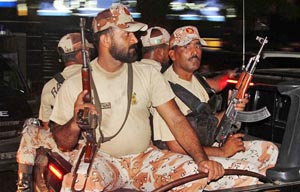
Another terror attack at Karachi airport

June 10, 2014

Karachi, Jun 10: Unidentified gunmen today opened fire outside Pakistan's Karachi international airport, a day after an all-night siege ended with the killing of more than 30 people, including 10 Taliban militants.Karachi-police 10

Heavy firing was reported at the Airport Security Force (ASF) camp number 2, situated near the Jinnah International Airport, Dawn News reported.

About four to five terrorists attacked the camp from Pehlwan Goth side, TV channels reported.

Exchange of firing continues between the ASF officials and terrorists outside the camp.

Sounds of explosions were also heard, causing panic among citizens in the vicinity.

Ranges and police continents have rushed to the scene.

An emergency situation has been imposed in the area.

The attack came a day after the deadly assault at Karachi international airport in which 12 security personnel, 8 civilian and 10 terrorists were killed.

The outlawed Tehreek-e-Taliban Pakistan (TTP) has claimed responsibility for the attack on airport.

Comments

Add new comment

  • Coastaldigest.com reserves the right to delete or block any comments.
  • Coastaldigset.com is not responsible for its readers’ comments.
  • Comments that are abusive, incendiary or irrelevant are strictly prohibited.
  • Please use a genuine email ID and provide your name to avoid reject.
Agencies
July 15,2020

Huawei will be completely removed from the UK's 5G networks by the end of 2027, the UK government announced on Tuesday after a review by the country's National Cyber Security Centre (NCSC) on the impact of US sanctions against the Chinese telecommunications giant.

In the lead up to this complete removal of all Huawei kit from UK networks, there will be a total ban on the purchase of any new 5G kit after December 31, 2020.

The decision was taken at a meeting of the UK's National Security Council (NSC) chaired by Prime Minister Boris Johnson, in response to new US sanctions against the telecom major imposed in May which removed the firm's access to products which have been built based on US semiconductor technology.

5G will be transformative for our country, but only if we have confidence in the security and resilience of the infrastructure it is built upon, said Oliver Dowden, UK Secretary of State for Digital, Culture, Media and Sport (DCMS).

Following US sanctions against Huawei and updated technical advice from our cyber experts, the government has decided it necessary to ban Huawei from our 5G networks. No new kit is to be added from January 2021, and UK 5G networks will be Huawei free by the end of 2027. This decisive move provides the industry with the clarity and certainty it needs to get on with delivering 5G across the UK, he said.

The minister, who laid out the details of the UK's ban on Huawei in the House of Commons, said the government will now seek to legislate with a new Telecoms Security Bill to put in place the powers necessary to implement the tough new telecoms security framework.

By the time of the next election (2024) we will have implemented in law an irreversible path for the complete removal of Huawei equipment from our 5G networks, said Dowden.

The new law will give the government the national security powers to impose these new controls on high risk vendors and create extensive security duties on network operators to drive up standards, DCMS said.

Technical experts at the NCSC reviewed the consequences of the US sanctions and concluded that Huawei will need to do a major reconfiguration of its supply chain as it will no longer have access to the technology on which it currently relies and there are no alternatives which we have sufficient confidence in.

They found the new restrictions make it impossible to continue to guarantee the security of Huawei equipment in the future.

After a ban on the purchase of new Huawei kit for 5G from next year, the aim is to completely remove the Chinese vendor's influence on 5G networks across the UK by the end of 2027.

The DCMS said Tuesday's decision takes into account the UK's specific national circumstances and how the risks from these sanctions are manifested in the country.

The existing restrictions on Huawei in sensitive and critical parts of the network remain in place, it highlighted.

The DCMS said the US action also affects Huawei products used in the UK's full fibre broadband networks. However, the UK has managed Huawei's presence in the UK's fixed access networks since 2005 and we also need to avoid a situation where broadband operators are reliant on a single supplier for their equipment.

As a result, following security advice from experts, DCMS is advising full fibre operators to transition away from purchasing new Huawei equipment. A technical consultation will determine the transition timetable, but it is expect this period to last no longer than two years.

The government said its new approach strikes the right balance by recognising full fibre's established presence and supporting the connections that the public relies on, while fully addressing the security concerns.

It stressed that its new policy in relation to high risk vendors has not been designed around one company, one country or one threat but as an enduring and flexible policy that will enable the UK to manage the risks to the network, now and in the future.

Comments

Add new comment

  • Coastaldigest.com reserves the right to delete or block any comments.
  • Coastaldigset.com is not responsible for its readers’ comments.
  • Comments that are abusive, incendiary or irrelevant are strictly prohibited.
  • Please use a genuine email ID and provide your name to avoid reject.
News Network
January 23,2020

Jan 23: Pakistan's Prime Minister Imran Khan called on Wednesday for the United Nations to help mediate between nuclear armed India and Pakistan over the disputed territory of Kashmir.

"This is a potential flashpoint," Khan said during a media briefing at the annual meeting of the World Economic Forum in Davos, Switzerland, adding that it was time for the "international institutions ... specifically set up to stop this" to "come into action".

The Indian government in August revoked the constitutional autonomy of Indian-administered Kashmir, splitting the Muslim-majority region into two federal territories in a bid to integrate it fully with the rest of the country.

Kashmir is claimed in full by both India and Pakistan. The two countries have gone to war twice over it, and both rule parts of it. India's portion has been plagued by separatist violence since the late 1980s.

Khan said his biggest fear was how New Delhi would respond to ongoing protests in India over a citizenship law that many feel targets Muslims.

"We're not close to a conflict right now ... What if the protests get worse in India, and to distract attention from that, what if ..."

The prime minister said he had discussed the prospect of war between his country and India in a Tuesday meeting with US President Donald Trump. Trump later said he had offered to help mediate between the two countries.

Khan said Pakistan and the United States were closer in their approach to the Taliban armed rebellion in Afghanistan than they had been for many years. He said he had never seen a military solution to that conflict.

"Finally the position of the US is there should be negotiations and a peace plan."

In a separate on-stage conversation later on Wednesday, Khan said he had told Trump in their meeting that a war with Iran would be "a disaster for the world". Trump had not responded, Khan said.

Khan made some of his most straightforward comments when asked why Pakistan has been muted in defence of Uighurs in China.

China has been widely condemned for setting up complexes in remote Xinjiang province that Beijing describes as "vocational training centres" to stamp out ""extremism and give people new skills.

The United Nations says at least one million ethnic Uighurs and other Muslims have been detained.

When pressed on China's policies, Khan said Pakistan's relations with Beijing were too important for him to speak out publicly.

"China has helped us when we were at rock bottom. We are really grateful to the Chinese government, so we have decided that any issues we have had with China we will handle privately."

Comments

Add new comment

  • Coastaldigest.com reserves the right to delete or block any comments.
  • Coastaldigset.com is not responsible for its readers’ comments.
  • Comments that are abusive, incendiary or irrelevant are strictly prohibited.
  • Please use a genuine email ID and provide your name to avoid reject.
News Network
July 11,2020

Istanbul, Jul 11: Turkish President Recep Tayyip Erdogan announced Friday that the Hagia Sophia, one of the architectural wonders of the world, would be reopened for Muslim worship, sparking fury in the Christian community and neighbouring Greece.

His declaration came after a top Turkish court revoked the sixth-century Byzantine monument's status as a museum, clearing the way for it to be turned back into a mosque.

The UNESCO World Heritage site in historic Istanbul, a magnet for tourists worldwide, was first constructed as a cathedral in the Christian Byzantine Empire but was converted into a mosque after the Ottoman conquest of Constantinople in 1453.

The Council of State, Turkey's highest administrative court, unanimously cancelled a 1934 cabinet decision to turn it into a museum and said Hagia Sophia was registered as a mosque in its property deeds.

The landmark ruling could inflame tensions not just with the West and Turkey's historic foe Greece but also Russia, with which Erdogan has forged an increasingly close partnership in recent years.

'Millions of Christians not heard'

Greece swiftly branded the move by Muslim-majority Turkey an "open provocation to the civilised world".

"The nationalism displayed by Erdogan... takes his country back six centuries," Culture Minister Lina Mendoni said in a statement.

The Russian Orthodox Church was equally scathing.

"The concern of millions of Christians were not heard," Church spokesman Vladimir Legoida told Interfax news agency.

The decision "shows that all pleas regarding the need to handle the situation extremely delicately were ignored," he said.

UNESCO chief Audrey Azoulay said she "deeply regrets" the decision made without prior dialogue with the UN's cultural agency.

The move was also condemned by the US Commission on International Religious Freedom, which said it was an "unequivocal politicisation" of the monument.

Hagia Sophia, which stands opposite the impressive Sultanahmet Mosque -- often called the Blue Mosque, has been a museum since 1935 and open to believers of all faiths.

Transforming it from a mosque was a key reform under the new republic born out of the ashes of the Ottoman Empire.

Sharing a presidential decree which named Hagia Sophia as a "mosque", Erdogan announced its administration would be handed over to Turkey's religious affairs directorate known as Diyanet.

"May we be blessed," he commented. The decree was published on the official gazette.

Erdogan has in recent years placed great emphasis on the battles which resulted in the defeat of Byzantium by the Ottomans, with lavish celebrations held every year to mark the conquest.

Muslim clerics have occasionally recited prayers in the museum on key anniversaries or religious holidays.

"The decision is intended to score points with Erdogan's pious and nationalist constituents," said Anthony Skinner of the risk assessment firm Verisk Maplecroft.

"Hagia Sophia is arguably the most conspicuous symbol of Turkey's Ottoman past -- one which Erdogan is leveraging to strengthen his base while snubbing domestic and foreign rivals," he told AFP.

'Chains broken'

A few hundred Turks carrying Turkish flags gathered outside Hagia Sophia shouting "Chains broken, Hagia Sophia reopened".

Police heightened security measures around the building, according to AFP journalists.

"It's been a dream since we were kids," said Erdal Gencler, an Istanbul resident.

"(Hagia Sophia) finds its true purpose again. We are very excited, proud, and hopeful that there will be beautiful services here," he added.

Fatma, a woman with tearful eyes, said: "Of course I am crying. (Hagia Sophia) belongs to us."

Ahead of the court decision, Justice Minister Abdulhamit Gul shared a picture of Hagia Sophia on his official Twitter account, with a message: "Have a good Friday."

Finance Minister Berat Albayrak, Erdogan's son-in-law, tweeted that Hagia Sophia would be reopened to Muslim worship "sooner or later", referring to a quote from Turkish poet Necip Fazil Kisakurek.

The Council of State had on July 2 debated the case brought by a Turkish group -- the Association for the Protection of Historic Monuments and the Environment, which demanded Hagia Sophia be reopened for Muslim prayers.

Since 2005, there have been several attempts to change the building's status. In 2018, the Constitutional Court rejected one application.

Despite occasional protests outside the site by Islamic groups, Turkish authorities had until now kept the building as a museum.


Comments

Add new comment

  • Coastaldigest.com reserves the right to delete or block any comments.
  • Coastaldigset.com is not responsible for its readers’ comments.
  • Comments that are abusive, incendiary or irrelevant are strictly prohibited.
  • Please use a genuine email ID and provide your name to avoid reject.