Anti-IS coalition chalks out strategy in Riyadh

February 19, 2015

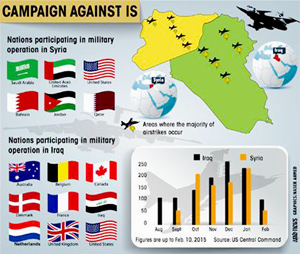
Riyadh, Feb 19: Military chiefs from more than 22 countries battling the Islamic State (IS) group began talks here Wednesday to assess the coalition’s current strategy and map out a plan to tackle other terrorist groups operating in the Middle East.against isis

A formal reception was hosted for the military chiefs of the foreign countries at a local hotel on Wednesday night, a diplomatic source, who requested anonymity, said.

This led to an informal round of discussions, but the main talks are scheduled for Thursday, he said. This high-powered military meeting is significant because of the growing threat posed by IS.

The meeting also coincides with the Summit on Countering Violent Extremism, which started in the US Wednesday.

The summit will highlight domestic and international efforts to prevent violent extremists and their supporters from radicalizing, recruiting, and inspiring individuals and groups.

The talks in Riyadh would include a general assessment of the coalition’s battle against IS, said another diplomat.

“It is more an exchange of information and a chance for coordination,” he said.

The talks also coincide with the rise of IS in Libya, which has heightened concerns in the region. The group seized parts of Iraq and Syria last year.

Arab states have intensified their bombing of IS targets since the militants in early February killed the Jordanian fighter pilot Maaz Al-Kasaasbeh, whose plane went down over Syria last year.

Bahrain has decided to send forces to Jordan to support the country and the international coalition.

Last week, the UAE sent an F-16 squadron to Jordan as part of its support for the coalition. Jordan’s information minister said Bahrain had deployed fighter jets in the kingdom to support the anti-IS air campaign.

Saudi Arabia and its Western allies including the US, France, and Germany have been participating in the airstrikes against IS in Syria since September last year.

Comments

Add new comment

  • Coastaldigest.com reserves the right to delete or block any comments.
  • Coastaldigset.com is not responsible for its readers’ comments.
  • Comments that are abusive, incendiary or irrelevant are strictly prohibited.
  • Please use a genuine email ID and provide your name to avoid reject.
News Network
June 12,2020

Beirut, Jun 12: Angry Lebanese protesters blocked roads across the country with burning tyres, debris and their vehicles, incensed over the local currency's depreciation by more than 25 percent in just two days.

The demonstrations from northern Akkar and Tripoli to central Zouk, the eastern Bekaa Valley, Beirut and southern Tyre and Nabatieh on Thursday were some of the most widespread in months of upheaval over a calamitous economic and financial crisis.

Protesters set ablaze a branch of the Central Bank, vandalised several private banks and clashed with security forces in several areas. At least 41 people were injured in Tripoli alone, according to the Lebanese Red Cross.

"I'm really pissed off, that's all. If politicians think they can burn our hearts like this the fire is going to reach them too," unemployed computer engineer Ali Qassem, 26, told Al Jazeera after pouring fuel onto smouldering tyres on a main Beirut thoroughfare.

Tens of thousands of Lebanese have lost jobs in the past six months and hundreds of businesses have shuttered as a dollar shortage led the Lebanese pound to slide from 1,500 to $1 last summer - where it was pegged for 23 years - to roughly 4,000 for each US dollar last month.

But the slide turned into a freefall between Wednesday and Thursday when the pound plummeted to roughly 5,000 to $1 on black markets, which have become a main source of hard currency. There was widespread speculation the rate hit 6,000 or even 7,000 pounds to the dollar, though most markets stopped trading.

Protesters began amassing on streets across the country before sunset and increased into the thousands across the country as the night fell.

Prime Minister Hassan Diab cancelled all meetings scheduled for Friday to hold an emergency cabinet session at 9:30am and another at 3pm at the presidential palace to be headed by President Michel Aoun.

The pound's collapse is the perhaps the biggest challenge yet for Diab's young cabinet, which gained confidence in February after former prime minister Saad Hariri's government was toppled by an unprecedented October uprising that had the country's economic crisis at its core.

Economy Minister Raoul Nehme told Al Jazeera that there was "disinformation" being circulated about the exchange rate on social media and said he was investigating possible currency manipulation.

"I don't understand how the exchange rate increased by so much in two days," he said.

Many protesters have pitted blame on Central Bank governor Riad Salameh, nominally in charge of  keeping the currency stable. But they have also called on the government to resign.

"If people want reform between dawn and dusk, that's not going to work, and if someone thinks they can do a better job then please come forward," Nehme said.

"But what we can't have is a power vacuum - then the exchange rate won't be 5000, it'll be a catastrophe."

'Everyone paying the price'

When protesters set a large fire in Beirut's Riad al-Solh Square, which lies at the foot of a grand Ottoman-era building that serves as the seat of government, firefighters did not intervene to extinguish it.

It later became clear why: Civil Defence told local news channel LBCI they had run out of diesel to fuel their firetrucks.

Basic imports such as fuel have been hit hard by the currency crisis, making already-weak state services increasingly feeble.

A half-dozen or so police officers with Lebanon's Internal Security Forces observed the scene unfolding in front of them in the square.

"Why do you destroy shops and things and attack us security forces - do you think we're happy? Go and f****** break that wall or go to the politicians' houses," one police officer told Al Jazeera, referring to a large concrete barrier separating protesters from the seat of government.

"In the end we are with you and we want the country to change. Don't you dare think we're happy. My salary is now worth $130," the officer said.

The currency's spectacular fall seems to have pushed many Lebanese to put common interests above their differences.

Large convoys of men on motorbikes from Shia-majority areas of southern Beirut joined the demonstrations on Thursday, though they have clashed with protesters many times before - including at a protest on Saturday.

Some chanted sectarian insults, leading to brief clashes in areas that were formerly front lines during the country's devastating 15-year civil war.

Instead, the motorbike-riding demonstrators on Thursday chanted: "Shia, Sunni, F*ck sectarianism."

"We are Shia, and Sunnis and Christian are our brothers," Hisham Houri, 39, told Al Jazeera, perched on a moped with his fiancee behind him just a few metres from a pile of burning tyres.

The blaze sent thick black smoke into the sky towards an iconic blue-domed mosque and church in downtown Beirut.

"Politicians play on these sectarian issues and sometimes succeed, but in the end, they'll fail because all the people have been hurt," he said. "The dollar isn't just worth 6,000 for Shias or for Sunnis, everyone is paying that price."

Comments

Add new comment

  • Coastaldigest.com reserves the right to delete or block any comments.
  • Coastaldigset.com is not responsible for its readers’ comments.
  • Comments that are abusive, incendiary or irrelevant are strictly prohibited.
  • Please use a genuine email ID and provide your name to avoid reject.
News Network
May 19,2020

Dubai, May 19: The UAE announced 832 new Covid-19 cases on Monday following 37,844 additional tests, taking the total tally of coronavirus infections in the country to 24,190.

The Ministry of Health and Prevention also reported four additional deaths, taking the death toll to 224. Meanwhile 1,065 patients also recovered after receiving the necessary treatment, taking the total number of recoveries to 9,577, the ministry said.

“We see a daily increase in cases due to the irresponsible behaviour of some people who are not aware of the consequences of not adhering to health guidelines,” said Dr Amna Al Dahak Al Shamsi, official spokesperson of the UAE government.

“The widening circle of infections requires no more than a few violations by just one or two people to completely infect families with the coronavirus,” she said.

“The decision to partially ease restrictions is aimed at achieving a balance between meeting the needs of a segment of society, whose source of income is linked to the commodity trade sector, and between continuing to adhere to the recommended health guidelines, and hence many restrictions and conditions have to be followed.”

However, she also appreciated the citizens and residents adhering to the precautionary measures.

“It is heartening for us to see many families committed to avoiding family gatherings,” she said. “As we prepare for Eid Al-Fitr, we are confident that citizens and residents will continue to adhere to health and preventive guidelines, and serve as role models to the world,” she added.

Change in disinfection programme timings

Officials also announced that the UAE’s National Disinfection Programme will now be in place from 8pm to 6am, starting Wednesday, May 20, until further notice. The scheme currently runs from 10pm until 6am.

Dr Saif Al Dhaheri, spokesman of the National Authority for Emergency, Crisis and Disaster Management said the amendment comes in light of the “increased number of Covid-19 cases, and the leniency of some members of society and their indifference to preventive measures”.

Food outlets, cooperative societies, groceries, supermarkets, and pharmacies will continue to operate 24 hours a day, seven days a week during the sterilisation programme period.

Meanwhile meat and vegetable shops and outlets selling fruits, toasters, mills, slaughterhouses, fish, coffee and tea, in addition to shops selling nuts, sweets and chocolate, can operate from 6am until 8pm.

Shopping centres and malls can stay open from 9am to 7pm starting Wednesday, May 20, officials added.

“We stress the importance of all stores and those authorised to operate to adhere to the applicable health and safety procedures, which include ensuring that the percentage of shoppers does not exceed 30 per cent of the total capacity,” said Al Dhaheri.

He also confirmed that children under 12 and those over 60 will not be permitted to enter malls and shopping centres.

“We warn visitors to the centres that the shopping period should not exceed two hours in order to reduce the crowding of shoppers, and to maintain the 30 per cent capacity.”

Eid restrictions

Al Dhaheri urged the public to avoid family visits and gatherings during Eid Al Fitr this year and to instead communicate using online means or by phone. He also stressed that people should refrain from distributing ‘Eid’ money to children.

“With regard to Eid prayers, we stress the importance of adhering to what was mentioned by the Emirates Legal Fatwa Council, which is to pray at home and to take health protection reasons as a legal obligation, a necessity of life, and a national commitment,” he added.

Heftier fines

Officials also announced heftier fines to ensure that the regulations are being adhered to.

“It was clear to us, in light of the follow-up, that there was reckless behaviour from some individuals, along with the insistence of some to commit a certain type of violation as well as indifference,” said Salem Al-Zaabi, acting head of the Public Prosecution for Emergencies, Crisis and Disasters.

The Public Prosecution has decided to update the list of previously announced violations and fines and administrative penalties to “suit the current situation”, he said.

Some of the new fines include:

– Dhs50,000 on educational institutions, cinemas, gym, stores, parks, beaches, pools or supermarkets that do not adhere to coronavirus measures

– Dhs50,000 fine on those who don’t adhere to quarantine restrictions

– Dhs10,000 for organising gatherings with participants also fined Dhs5,000 each

– Dhs5000 for refusing to do a Covid-19 test

– Dhs3,000 for not wearing a mask in public

– Dhs3,000 if more than three people are travelling in one car

– Dhs3,000 for companies failing to adhere to the 30 per cent limit on workforce at office

– Dhs3,000 for not adhering to social distancing

– Dhs3,000 fine for violating restrictions during the disinfection period

Repeat offenders will be referred to the Public Prosecution and can face a criminal trial with the possibility of imprisonment for a period not exceeding six months and/or a fine of at least Dhs100,000.

“The pictures and names of violators will be published in newspapers and media upon the decision of the Public Prosecutor if he deems it necessary,” added Al Zaabi.


Comments

Add new comment

  • Coastaldigest.com reserves the right to delete or block any comments.
  • Coastaldigset.com is not responsible for its readers’ comments.
  • Comments that are abusive, incendiary or irrelevant are strictly prohibited.
  • Please use a genuine email ID and provide your name to avoid reject.
KT
May 18,2020

May 18: As the UAE authorities have asked all residents to avoid gatherings, it is clear that - for the first time - it's going to be a #StayHome Eid. But experts say that although it will be different, the celebration will be just as meaningful.

It is important to remember that the Eid prayer can be performed at home either individually or with family members under the sane roof, said Dr Mohammed Eyada Ayoub Alkobaisi, a Grand Mufti with the Islamic Affairs and Charitable Activities Department in Dubai.

Dr Alkobaisi said this prayer is a highly recommended Sunnah or practice urged by the Prophet Muhammad (Peace be upon him).

"Eid Prayer must be performed openly, unless we are prevented for an acceptable reason, such as fear for self, wellbeing, property, etc." Under the current circumstances, prayers can be offered from home, he said.

But what the faithful will likely miss is listening to the khutbah or the sermon of Eid with a crowd. The sight of people pouring out into the streets and coming together for prayer and worship would not be unfolding this time.

Dr Sheikh Mohamed Ashmawy, an Islamic researcher, said that in this time of Covid, doing away with several Eid traditions would be necessary for everyone's safety.

"The ban is is line with the ongoing preventive measures to curb the spread of Covid-19," he said.

However, it doesn't mean people can't celebrate and exchange heartfelt greetings, he added.

"We can greet each other remotely on the phone or via social media networks."

Islamic researcher Sheikh Mohamed Wasfi said audio-visual smart apps have made communication much easier, even bringing people closer than before.

"Of course, families and friends wish to hug, shake hands and see each other personally, but this will be a big risk these days," he said.

Sheikh Asadullah Del Mohamed, an imam, reminded that banquets, parties and visits are discouraged to avoid crowds and gathering.

Recently, 30 people from two families tested positive for the virus after breaking social distancing rules and holding a gathering.

Faithful's sentiments

Ibrahim Abdelkader, an Egyptian auditor, said that while it would be sad to spend Eid Al Fitr at home, he understood that it is for everyone's safety.

"Better to stay home than be sorry," said Ahmad Jamil, a Syrian resident.

Rashid Saeed, an Emirati national, said people are advised to just check on each other by phone or video and voice call apps.

"While Eid prayers is banned in congregation, it's not acceptable at all for some people to carelessly gather and exchange visits," he said.

Abdullah Al Saleh, an Emirati national, said he and all his relatives used to gather for breakfast after the Eid prayer - but this time, they are ready to do it in their own homes.

Mohamed Ibrahim, another Emirati, said he would surely miss seeing his kids happily prancing around with their new clothes and enjoying the outdoors like every year.

"But, I agree as it is for their health, safety and wellbeing," he said.

THINGS TO REMEMBER IN CELEBRATING EID THIS YEAR

>Perform the Eid prayer at home, individually or with family members living with you

>Exchange greetings with loved ones and friends via phone calls or online

>No hugs

>No handshakes

>No gatherings

>No visits to other homes

Comments

Add new comment

  • Coastaldigest.com reserves the right to delete or block any comments.
  • Coastaldigset.com is not responsible for its readers’ comments.
  • Comments that are abusive, incendiary or irrelevant are strictly prohibited.
  • Please use a genuine email ID and provide your name to avoid reject.