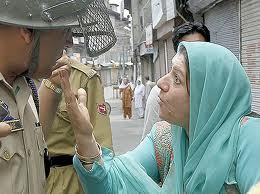
Army guideline on Kashmiri ‘pherans’ triggers row

February 22, 2014

Srinagar, Feb 22: A guideline to Kashmiri journalists not to wear 'pherans', a traditional Kashmiri attire, to army press briefings has triggered a row, with Jammu and Kashmir Chief Minister Omar Abdullah Saturday calling it "unacceptable".pheran

An invitation to the press briefing for Saturday of the commander of army's Srinagar-based 15th corps said that journalists should not come wearing 'pherans' during the briefing.

Local journalists Friday protested the army's guideline saying a 'pheran', which is a tweed over garment worn by Kashmiris during the winter months, is a traditional Kashmiri dress.

Omar Abdullah tweeted Saturday: "If the army has in fact told journalists not to wear a pheran to Corps headquater events that is unacceptable and the order should be withdrawn.

"People wear their pheran with pride. It's part of our identity aside from the best way to stay warm in the cold. Can't ban pherans."

The army's Srinagar-based PRO has withdrawn the guideline, saying it had been inadvertent.

Comments

Add new comment

  • Coastaldigest.com reserves the right to delete or block any comments.
  • Coastaldigset.com is not responsible for its readers’ comments.
  • Comments that are abusive, incendiary or irrelevant are strictly prohibited.
  • Please use a genuine email ID and provide your name to avoid reject.
News Network
May 26,2020

New Delhi, May 26: With India now in the bracket of top 10 nations worst hit by the novel coronavirus, experts have attributed the surge in cases to easing of travel restrictions and movement of migrants besides enhanced testing capacity.

According to AIIMS Director, Randeep Guleria, the present rise in cases has been reported predominantly from hotspot areas but there is a possibility of further rise in the number of COVID-19 cases in the coming few days due to increased travel.

"Those who are asymptomatic or are in presymptomatic stage will pass through screening mechanisms and may reach areas where there have been minimal or less cases," Guleria said.

He said there was a need for more intense surveillance and monitoring in areas where migrants have returned to contain the spread of the disease.

If proper social distancing and hand hygiene is not maintained at a time when people are out on roads, the coronavirus infection will transmit much faster, he said.

Guleria also noted that testing capacity has been significantly ramped up which is reflecting in the increasing number of cases being detected.

Commenting on the partial resumption of rail and road transport services and migrants returning to their native places, Dr Chandrakant S Pandav, former president of the Indian Public Health Association and Indian Association of Preventive and social medicine, said the floodgates have been opened.

"This is a classic case of creating an enabling environment for coronavirus to spread like wildfire. In the coming few days, the number will rise dramatically. While it is true that lockdown cannot go on forever, the opening up should have been in a measured, calibrated and informed manner," he said.

"Travelling leads to spread of the infection. Now, the government will have to ensure even stronger surveillance to curb the infection but if that will be done is something to be observed," he said.

The death toll due to COVID-19 rose to 4,167 and the number of cases climbed to 1, 45,380 in the country, registering an increase of 146 deaths and 6,535 cases since Monday 8 am, according to the Union Health Ministry.

Dr K K Aggarwal, President of the Confederation of Medical Association of Asia and Oceania (CMAAO), and former IMA President, said there will be a further surge in cases in the coming days if migration continues without any proper social distancing.

"Within the next ten days, the cases will cross two lakh. The very fact that number of cases was rising before the end of the third lockdown and continuing during the fourth lockdown means that people are not following physical distancing as required," he said.

"Even in the last week of May when the temperature is very high, the rising number of cases would mean that human-to-human transmission is more important than surface-to-human transmission. Normally in heat the surface-to-human transmission should have reduced the new cases by half which has not happened," Aggarwal said.

However, Professor K Srinath Reddy, president of the Public Health Foundation of India, said an increase in the number of cases reflects both an increase in testing rates and an increase in spread.

"What we need to see is the number of new tests performed per day and the number of new cases that were identified from them. That gives a better idea of the rate of spread than the total number of new cases alone.

"We also have to see if the testing criteria has remained the same between the two periods of comparison.We may open up gradually but will have to continue case detection, contact tracing and follow personal protection measures as vigorously as possible," he added.

A total of 31,26,119 samples have been tested as on May 26, 9 am and 92,528 samples have been tested in the last 24 hours, ICMR officials said.

India is the tenth most affected nation by the pandemic after the US, Russia, UK, Spain, Italy, Brazil, Germany, Turkey and France, as per the John Hopkins University data.

The country has recorded 6,088, 6,654, 6,767 and 6977 cases on May 22, 23, 24 and 25 respectively. Also, the number of RT-PCR tests for detection of COVID-19 in the country crossed the 30-lakh mark on Monday.

The first two phases of the lockdown led to 14-29 lakh COVID-19 cases being averted, while the number of lives saved in that period was between 37,000 and 78,000, the government said last Friday, citing various studies, and asserted that the unprecedented shutdown has paid "rich dividends" in the fight against the pandemic.


Comments

Add new comment

  • Coastaldigest.com reserves the right to delete or block any comments.
  • Coastaldigset.com is not responsible for its readers’ comments.
  • Comments that are abusive, incendiary or irrelevant are strictly prohibited.
  • Please use a genuine email ID and provide your name to avoid reject.
News Network
January 29,2020

Aurangabad, Jan 29: Accusing Prime Minister Narendra Modi and Union Home Minister Amit Shah of creating a conflict between Hindu and Muslim communities in the country, former JNU student leader Kanhaiya Kumar has said the Citizenship (Amendment) Act (CAA) was adding fuel to the fire.

He was speaking at a rally held on Tuesday at Pathri in Parbhani district of Maharashtra against the CAA and the National Register of Citizens (NRC). It was organised by NCP MLC Abdullah Durrani.

"Modi and Shah used to create conflicts between Hindus and Muslims during the Gujarat elections. Now they are adopting the same strategy in the country," Kumar alleged.

Citizens should keep the religious conflicts aside and question the present government about unemployment and the poor state of the economy, he said.

"Through the CAA, the government is adding fuel to the fire, which is already raging in the country," he alleged.

When anyone questions the government about the problems existing in the country, it in turn asks him about his citizenship, the former JNUSU leader alleged.

Comments

Add new comment

  • Coastaldigest.com reserves the right to delete or block any comments.
  • Coastaldigset.com is not responsible for its readers’ comments.
  • Comments that are abusive, incendiary or irrelevant are strictly prohibited.
  • Please use a genuine email ID and provide your name to avoid reject.
Agencies
May 4,2020

New Delhi, May 4: The government has not talked about charging anything from migrant labourers as 85 per cent of the transportation cost is borne by the railways and 15 per cent by state governments, the Centre said on Monday amid a row over the national transporter allegedly charging the workers for ferrying them home during the COVID-19-induced lockdown.

The government also said the process of transporting the stranded migrant labourers was being coordinated by states “except for one or two states”.

Asked if the migrant labourers were being charged for being ferried home, Joint Secretary at the Health Ministry Lav Agarwal said that as far as migrant labourers are concerned, the guidelines have clearly stated that under the infectious disease management one should stay where he or she is.

“Based on the request given from states for particular cases, permission was given to run special trains. Be it government of India or the Railways, we have not talked about charging from workers. Eighty-five per cent of the transportation cost is borne by the Railways, while states have to bear 15 per cent of the cost,” he told reporters.

“Based on the request of the states the process that started, under which limited number of stranded migrant labourers have to be transported for a particular reason, is being coordinated by the state governments, except for one or two states,” Agarwal said.

At the daily briefing on the COVID-19 situation, Agarwal also said that in the last 24 hours, 1,074 COVID-19 patients have recovered, the highest number of recoveries in one day.

The recovery rate stands at 27.52 per cent with 11,706 COVID-19 patients cured till now, he said.

Agarwal said in the last 24 hours, 2,553 novel coronavirus cases were reported, taking the number of overall cases to 42,533. The total number of active cases stands at 29,453, he said.

The joint secretary also said that the COVID-19 curve is relatively flat as of now and it was not right to talk in terms of when the peak would come.

“If we collectively work then the peak might not ever come, while if we fail in any way we might experience a spike in cases,” he said.

Amitabh Kant, Chairman of the Empowered Group dealing with civil society, NGOs, industries and international partners, said in 112 aspirational districts, “we worked with the collectors and in these 112 districts only 610 cases have been reported which is two per cent of the national level infection”.

In these 112 districts, 22 per cent of India's population resides, he said.

In a few districts like Baramulla, Nuh Rachi, Kupwara and Jaisalmer more than 30 cases have been reported, while in the rest of the places very few cases are there, Kant said.

Comments

alert
 - 
Tuesday, 5 May 2020

why is no one talking about privatized railways? why Adani is not offering free travel to laborers?

Add new comment

  • Coastaldigest.com reserves the right to delete or block any comments.
  • Coastaldigset.com is not responsible for its readers’ comments.
  • Comments that are abusive, incendiary or irrelevant are strictly prohibited.
  • Please use a genuine email ID and provide your name to avoid reject.