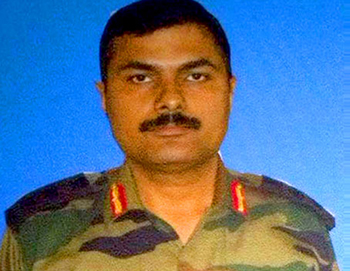
Army honours colonel who was killed a day after getting R-Day gallantry medal

January 28, 2015

Army honours

New Delhi, Jan 28: The army on Wednesday honoured Colonel Munindra Nath Rai, who died fighting militants in Kashmir's Pulwama district, just a day after he was awarded a Republic Day gallantry medal.

Lt Gen Subrata Saha, GOC of the army's 15 Corps, led the wreath laying ceremony at the Badami Bagh cantonment headquarters in Srinagar.

The army also honoured Sanjeevan Singh of the Jammu and Kashmir Police who also died in Tuesday's gunfight in which militants of Hizbul Mujahideen were killed.

"They made the supreme sacrifice yesterday in a daring operation at Tral. The supreme sacrifice of these two brave men only strengthens our resolve to fight all elements inimical to the security of Jammu and Kashmir," the GOC said.

Colonel Rai, 39,commanding officer of 42 Rashtriya Rifles, was awarded Yudh Seva medal on Republic Day for his role in a gunbattle with militants in south Kashmir last year. The Yudh Seva Medal is awarded for the highest degree of distinguished service in a war or conflict.

On Tuesday morning, he received information that militants were hiding in a house at a village in Tral, and rushed there with a quick reaction team.

The militants started firing as the forces surrounded them, cutting down Col Rai and police head constable Sanjeevan Singh.

The forces cornered the militants after a while and gunned down Firdous Ahmed and Shiraz Ahmad, who were local recruits of the Hizbul.

Colonel Rai is the highest-ranking military officer to be killed in the south Kashmir region in nearly a year.

His last status on the mobile messaging service WhatsApp, posted two months ago, read: "Play your role in life with such passion, that even after the curtains come down, the applause doesn't stop."

Comments

Add new comment

  • Coastaldigest.com reserves the right to delete or block any comments.
  • Coastaldigset.com is not responsible for its readers’ comments.
  • Comments that are abusive, incendiary or irrelevant are strictly prohibited.
  • Please use a genuine email ID and provide your name to avoid reject.
Agencies
March 12,2020

The Ministry of Health and Family Welfare has prepared a draft for guidelines for home quarantine, as well as for the use of masks by public, in view of coronavirus.

What to do in Home Quarantine?

The government says, for those taking refuge to home quarantine should stay in a well-ventilated single-room preferably with an attached or separate toilet. It adds that if another family member needs to stay in the same room, it's advisable to maintain a distance of at least 1 metre between the two.

The government advised, coronavirus patients to stay away from elderly people, pregnant women, children and persons with co-morbidities within the household as their immune system may be low. The health minister also suggested to restrict the patient's movement within the house. "Under no circumstances attend any social/religious gathering e.g. wedding, condolences, etc, said the guideline.

It also instructed the corona virus infected person to avoid sharing household items like dishes, drinking glasses, cups, eating utensils, towels, bedding, or other items with others at home. The guideline also demanded that even though home quarantine, the patient should wear a surgical mask at all times. "The mask should be changed every 6-8 hours and disposed off. Disposable masks are never to be reused, it added.

"Masks used by patients/ caregivers/ close contacts during home care should be disinfected using ordinary bleach solution (5 per cent) or sodium hypochlorite solution (1%) and then disposed of either by burning or deep burial," instructs the government.

Even for family members of a patient, the health ministry clearly instructs to use disposable gloves when cleaning the surfaces or handling soiled linen. No visitors, under any circumstances will be allowed, said the guideline.

"In case the person being quarantined becomes symptomatic, all his close contacts will be home quarantined (for 14 days) and followed up for an additional 14 days or till the report of such case turns out negative on lab testing," states the draft.

How to wear & dump masks?

There is a specific and elaborate do's and don'ts also released by the ministry. For those unsure in which mask to choose, it says, "Medical masks of different sizes and shapes are available in the market. The common ones are flat pleated masks of woven fabric which covers the nose and mouth and affixed behind the head with straps/ elastic fasteners. There are also conical or duck bill shaped masks with valves (or without valves) that fit in the contour of face over the nose and mouth, but are costlier."

However, the ministry warns, medical masks should not be used by healthy persons who are not having any symptoms "because it creates a false sense of security". Instead, it suggests to refrain from touching face, mouth, nose and eyes as well as washing hands regularly with soap for 20 seconds each time.

However, when a person develops a cough or fever, the suspected patient needs to switch to medical masks. "Use of medical three layer masks when ill, will prevent your infection from spreading to others. However you also need to wash your hands frequently to avoid spreading infection to others," read the guideline.

Even if one is not tested positive but showing symptoms, they are advised to wear masks while visiting a healthcare facility. "Close family contacts of such suspect/confirmed cases undergoing home care should also use Triple layer medical mask," it warns.

The ministry has also given point by point guideline on how to use a mask like to make sure that they are facing down while unfolding or for that matter to ensure there are no gaps on either side of the mask.

It even warns, "Fit flexible nose piece (a metallic strip that can easily be located) over nose-bridge" to ensure no one else are infected. The government also warns against simple dumping of the masks once used. Instead one should disinfect "using ordinary bleach solution (5 per cent) or sodium hypochlorite solution (1 per cent) and then disposed of either by burning or deep burial," says the Health Ministry.

COVID-19 emerged in early December 2019 in China's Wuhan province and has now spread to over 100 countries. As on March 9, 2020, India has reported 42 cases mostly among those who had travelled from affected countries.

However the government says, "It causes a minor illness in majority of patients with symptoms of fever and or cough. A small proportion of such persons may progress to severe disease with difficulty in breathing."


Comments

Add new comment

  • Coastaldigest.com reserves the right to delete or block any comments.
  • Coastaldigset.com is not responsible for its readers’ comments.
  • Comments that are abusive, incendiary or irrelevant are strictly prohibited.
  • Please use a genuine email ID and provide your name to avoid reject.
Agencies
April 23,2020

More and more Indians have become better prepared in the last one month, as far as stocking of their ration, medicine or money is concerned, according to the IANS-CVoter COVID-19 Tracker.

With the second leg of the lockdown half way through and Prime Minister Narendra Modi saying it's a long haul, 57.2% respondents said they have less than three weeks of stock while 43.3% said they have a stock that will last beyond that

However, if one breaks into weeks, most respondents said they are prepared for a week's time. 24.5% respondents said they have ration, medicine or money to last a week. This is closely followed by 21.9 % respondents saying they are ready for a month.

Meanwhile, 20.4 % said they are ready for a couple of weeks. There are 15.8 % who said they are ready for more than a month with food, ration and medicine. A tiny 5.6 % said they are ready with three weeks of stock.

However, there is 12.3% who still seem to live on the edge with less than a week's preparation.

But, the biggest takeaway from the IANS-CVoter COVID-19 Tracker is that in the last one month, a massive segment of society realised that the fight is long and the preparation should also be to last that long.

o put things into context, on March 16 when the tracker started, a whopping 77.1% said they have stock to last for less than a week. More than a month later on April 21, that number jumped to just 12.3%, which essentially means, people have become better prepared for a long-hauled lockdown period.

Similarly, on April 21, a sizable 21.9% respondents claimed they are ready with ration and medicine that will last them a month. On March 16, not even one respondent could claim they have a month's stock. In fact till March 22, just ahead of the announcement of the first lockdown, no respondent the IANS-CVoter tracker said that they have a month's preparation.

Similarly, when the tracker started, 9.9% said they simply ‘don't know'. As on April 21, that number is a big zero.

Comments

Add new comment

  • Coastaldigest.com reserves the right to delete or block any comments.
  • Coastaldigset.com is not responsible for its readers’ comments.
  • Comments that are abusive, incendiary or irrelevant are strictly prohibited.
  • Please use a genuine email ID and provide your name to avoid reject.
News Network
April 11,2020

Malappuram, Apr 11: Farmers in Malappuram district are facing problems in selling cucumbers and watermelons due to the drop in demand and prices in the market amid the nationwide COVID-19 lockdown.

"We have cultivated cucumbers for our Vishu festival in Kerala. In recent conditions, we are facing issues in selling our crops. In comparison to the previous years, we have a huge production this time," said Saifu, a farmer in the Malappuram district.

"We have also cultivated different kinds of watermelons here. The major issues that we are facing are the low prices and the lockdown," he added.

The nationwide COVID-19 lockdown was imposed by Prime Minister Narendra Modi form March 25 for 21 days as a precautionary measure against the spread of the virus.

According to the Union Ministry of Health and Family Welfare, the total number of positive COVID-19 cases in Kerala is 364. Till now, 123 people have either been cured or discharged, while two deaths have been reported.

The total number of positive coronavirus cases across the country are 7,529 including 6,634 active cases. So far, 652 patients have either been cured or discharged while 242 deaths have been recorded in the country, as per data provided by the Ministry of Health on Saturday evening.

Comments

Add new comment

  • Coastaldigest.com reserves the right to delete or block any comments.
  • Coastaldigset.com is not responsible for its readers’ comments.
  • Comments that are abusive, incendiary or irrelevant are strictly prohibited.
  • Please use a genuine email ID and provide your name to avoid reject.