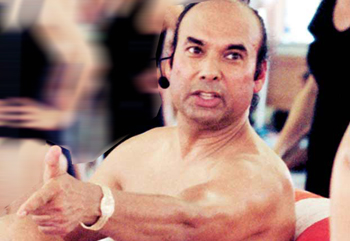
Arrest warrant issued against yoga guru in US

May 25, 2017

Washington, May 25: A Los Angeles judge has issued an arrest warrant for Bikram Choudhury, the Indian American "hot" yoga guru, after he failed to pay more than $7 million in 2016 to his former lawyer who was the victim in a sexual harassment case against him.

Choudhury has not paid the lawyer and authorities believe that he has hidden his assets and left the country, ABC News reported on Wednesday.Bikram

The 69-year-old yoga guru had claimed last year that he was nearly bankrupt as his business was no longer thriving.

According to the report, the warrant, issued on Wednesday, allows authorities to arrest Choudhury if he returns to the US or, possibly, in Mexico.

In January 2016, a jury determined that Choudhury had sexually harassed and then unfairly fired Minakshi "Miki" Jafa-Bodden, his onetime lawyer.

He was ordered to pay nearly $6.5 million in punitive damages in addition to $924,000 in compensatory damages.

Jafa-Bodden was general counsel to Bikram's Yoga College of India but was fired after refusing to cover up allegations that Bikram had raped and sexually assaulted a yoga student.

"I feel vindicated," she told ABC News in 2016. "I'm elated."

She convinced the jury that Choudhury had repeatedly sexually harassed her and subjected her to obscene comments about women.

Jafa-Bodden also claimed she was fired after she tried to investigate another woman's sexual harassment and rape allegations against the yoga guru.

During the trial over Jafa-Bodden's allegations, Bikram strongly denied sexually assaulting any women. He also denied having any sexual contact with his students or followers. His bail was set at $8 million.

Choudhury was one of the pioneers of yoga in the US, setting up shop in Beverly Hills in the 1970s. His client list included top celebrities like Madonna, Andy Murray, Gwyneth Paltrow and Goldie Hawn.

His yoga studios are franchised worldwide.

Outside of court on Wednesday, Jafa-Bodden celebrated her latest legal victory, saying: "It's a win for women everywhere who've endured sexual harassment."

"To have that bench warrant issued for Bikram... It sends a message to a debtor like Bikram that he will be held accountable and that the wheels of justice, although they don't turn as fast as we would want them to, they do turn," she said.

Comments

Add new comment

  • Coastaldigest.com reserves the right to delete or block any comments.
  • Coastaldigset.com is not responsible for its readers’ comments.
  • Comments that are abusive, incendiary or irrelevant are strictly prohibited.
  • Please use a genuine email ID and provide your name to avoid reject.
Agencies
July 9,2020

The new visa regulations requiring international students in the US with an F-1 visa to take at least one in-person course or face the prospect of deportation is likely to "cause uncertainties and difficulties" for some students, the Indian Embassy has said.

"These new modifications at a time when many of the US universities and colleges are yet to announce their plans for the new academic year are likely to cause uncertainties and difficulties for some Indian students wishing to pursue their studies in the US," said a spokesperson of the Indian Embassy.

Responding to media queries, the spokesperson said the Indian government has taken up the matter with concerned US officials.

At the India US Foreign Office Consultations held on July 7, Foreign Secretary Harsh Vardhan Shringla conveyed India's concerns on the matter to Under Secretary of State for Political Affairs David Hale.

According to a recent report of Student and Exchange Visitor Program (SEVP), there were 1,94,556 Indian students enrolled in various academic institutions of the US in January this year. Of these 1,26,132 were males and 68,405 were females.

Noting that partnership in higher education is a key component of the strong people-to-people ties between India and the US, the spokesperson said in the last two decades Indian students in American universities and colleges have been the harbingers of a strong partnership between technology and innovation sectors between the two countries.

The spokesperson hoped that the US authorities would provide adequate flexibility in their visa rule, keeping in mind the extraordinary circumstances created by the COVID-19 pandemic for the Indian students community.

We continue to engage all the stakeholders in the matters, including the US administration officials, Congressional leaders, universities and colleges as well as the Indian students community in the US as we move forward towards the 2020-21 academic year to further strengthen our bilateral partnership in higher education, the spokesperson said.

Announced by the SEVP on July 6, the new rules provide temporary exemptions for nonimmigrant students on F-1 and M-1 visas taking online classes due to the COVID-19 pandemic for the fall semester of the 2020 academic year.

While these modifications do provide some flexibility for US universities and colleges to adopt a hybrid model -- that is a mixture of online and in person classes -- they also restrict international students on F-1 and M-1 visas from taking courses entirely online, the spokesperson said.

Comments

Add new comment

  • Coastaldigest.com reserves the right to delete or block any comments.
  • Coastaldigset.com is not responsible for its readers’ comments.
  • Comments that are abusive, incendiary or irrelevant are strictly prohibited.
  • Please use a genuine email ID and provide your name to avoid reject.
News Network
July 23,2020

Minneapolis, Jul 23: The former Minneapolis police officer charged with murder in the death of George Floyd was charged Wednesday with multiple felony counts of tax evasion.

Derek Chauvin and his wife, Kellie May Chauvin, were each charged in Washington County with six counts of filing false or fraudulent tax returns for the tax years 2014 through 2019 and three counts of failing to file tax returns for 2016, 2017 and 2018.

Floyd, a Black man who was handcuffed, died May 25 after Chauvin, who is white, pressed his knee against Floyd's neck for nearly eight minutes as Floyd pleaded for air.

Chauvin is charged with second-degree murder, third-degree murder and manslaughter. He and three other officers who were at the scene were fired.

Chauvin is in custody on the charges in the Floyd case. Kellie Chauvin, who filed for divorce after Floyd's death, is not in custody.

Online court records didn't list attorneys for either in the tax evasion case, and calls to Kellie Chauvin did not go through.

Washington County Attorney Pete Orput said the investigation into the Chauvins was started in June by the Minnesota Department of Revenue and Oakdale Police Department.

Authorities allege in the criminal complaints that the Chauvins failed to file income tax returns and pay state income taxes, and that they underreported and underpaid taxes on income they earned from various jobs each year.

The complaints allege that they also failed to pay proper sales tax on a $100,000 BMW purchased in Minnesota in 2018.

Prosecutors say the Chauvins bought the car in Minnetonka but registered it in Florida, where they paid lower sales taxes.

Comments

Add new comment

  • Coastaldigest.com reserves the right to delete or block any comments.
  • Coastaldigset.com is not responsible for its readers’ comments.
  • Comments that are abusive, incendiary or irrelevant are strictly prohibited.
  • Please use a genuine email ID and provide your name to avoid reject.
News Network
June 9,2020

Washington, Jun 9: When epidemiologists talked about "flattening the curve," they probably didn't mean it this way: the US hit its peak coronavirus caseload in April, but since that time the graph has been on a seemingly unending plateau.

That's unlike several other hard-hit countries which have successfully pushed down their numbers of new cases, including Spain and Italy, which now have bell-shaped curves.

Experts say the prolonged nature of the US epidemic is the result of the cumulative impact of regional outbreaks, as the virus that started out primarily on the coasts and in major cities moves inward.

Layered on top of that are the effects of lifting lockdowns in parts of the country that are experiencing rising cases, as well as a lapse in compliance with social distancing guidelines because of economic hardship, and in some cases a belief that the threat is overstated.

"The US is a large country both in geography and population, and the virus is at very different stages in different parts of the country," Tom Frieden, a former director of the Centers for Disease Control and Prevention told AFP.

The US saw more than 35,000 new cases for several days in April. While that figure has declined, it has still been exceeding 20,000 regularly in recent days.

By contrast, Italy was regularly hitting more than 5,000 cases per day in March but is currently experiencing figures in the low hundreds.

"We did not act quickly and robustly enough to stop the virus spreading initially, and data indicate that it travelled from initial hotspots along major transport routes into other urban and rural areas," added Frieden, now CEO of the non-profit Resolve to Save Lives.

To wit: the East Coast states of New York, New Jersey and Massachusetts accounted for about 50 percent of all cases until about a month or so ago -- but now the geographic footprint of the US epidemic has shifted to the Midwest and southeast, including Florida.

Another key problem, said Jennifer Nuzzo, an epidemiologist at Johns Hopkins, is that the United States is still not doing enough testing, contact tracing and isolation.

After coming late to the testing party -- for reasons ranging from technical issues to regulatory hurdles -- the US has now conducted more COVID-19 tests than any other country.

It even has one of the highest per capita rates per country of 62 per 1,000 people, according to the website ourworldindata.org -- better than Germany (52 per 1,000) and South Korea (20 per 1,000).

But according to Nuzzo, these numbers are misleading, because "the amount of testing that a country should do should be scaled to the size of its epidemic.

"The United States has the largest epidemic in the world so obviously we need to do a lot more testing than any other country."

For Johns Hopkins, the more important metric is the positivity rate -- that is, out of all tests conducted, how many came back positive for COVID-19.

As of June 7, the United States had an average daily positivity rate of 14 percent, well above the World Health Organization guideline of 5 percent over two weeks before social distancing guidelines should be relaxed.

By contrast, Germany, which has tested far fewer people in relation to its population, has a positivity rate of 5 percent.

Even if testing were scaled up, carrying out tests in of itself does very little good without the next steps -- finding out who was exposed and then asking them to isolate.

Here also, too many US states are lagging woefully behind.

Texas, which is experiencing a surge in cases after relaxing its lockdown, is a case in point. The state targeted hiring a modest 4,000 tracers by June, but according to local reports is still more than a thousand shy of even that goal.

Opt-in app based efforts have also been slow to get off the ground.

Then there is the fact that some people are growing tired of lockdowns, while others don't have the economic luxury of being able to stay home for prolonged periods.

The government sent some 160 million Americans a single stimulus check of up to $1,200 back in April but it's not clear whether more will be forthcoming.

Still others, particularly in so-called red states under Republican leadership, have chafed under restrictions and mask-wearing guidelines that they see as an affront to their personal freedom.

"The US is kind of on the extreme of the individual liberty side," Sten Vermund, dean of the Yale School of Public Health, told AFP.

Part of this has to do with mixed messaging from Republican leaders, including President Donald Trump, said Nuzzo.

"We have had at the highest political level an assertion that this is a situation that's been overblown, and that maybe certain protective behaviors are not necessary," she said.

More recently, tens of thousands of people across the country have taken to the streets to protest the killing on an unarmed black man by police, risking coronavirus infection to demonstrate against the public health threat of racialized state violence.


Comments

Add new comment

  • Coastaldigest.com reserves the right to delete or block any comments.
  • Coastaldigset.com is not responsible for its readers’ comments.
  • Comments that are abusive, incendiary or irrelevant are strictly prohibited.
  • Please use a genuine email ID and provide your name to avoid reject.