


Assassination in Ankara: Cop guns down Russian ambassador

December 20, 2016

Ankara, Dec 20: Russia’s Ambassador to Turkey Andrey Karlov was assassinated Monday night during the opening ceremony of a photo exhibition in Ankara when he took to the podium to make a speech.
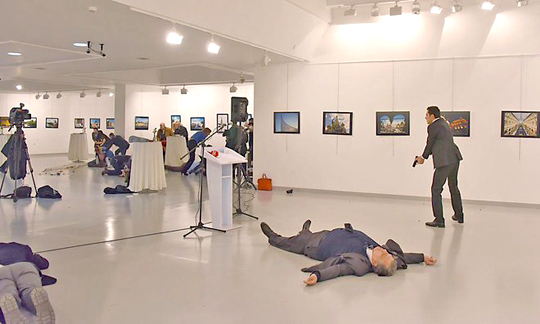
russian

Turkey’s interior minister said the gunman, 22-year-old Mevlut Mert Altintas, who was killed, was part of Ankara’s anti-riot police.

The assailant was on duty as a security officer during rallies by President Recep Tayyip Erdogan, Turkey’s mainstream HaberTurk news reported.

After shooting the ambassador, the gunman shouted: “Don’t forget Aleppo. Don’t forget Syria. Until our towns are safe, you won’t be able to enjoy safety. Whoever has a role in this cruelty will pay for it one by one.”

This marks the first assassination of an ambassador in Turkey. It comes a day before the planned visit of Turkish Foreign Minister Mevlut Cavusoglu to Moscow for talks on Syria with his Russian and Iranian counterparts.

Erdogan phoned his Russian counterpart Vladimir Putin to share information. “We have to know who gave the orders to the assassin,” Putin said. In a public statement, Erdogan condemned the attack and said it aimed to harm improved ties with Moscow.

Experts say the assassination puts Turkey in a difficult diplomatic position.

“It doesn’t look like a Daesh attack because the gunman evacuated the art gallery to shoot the ambassador,” Ahmet Han, an international relations professor from Istanbul Kadir Has University, told Arab News.

“This might be an attack carried out by an individual who is ideologically or emotionally vested in developments in Aleppo,” he said.

“He might be a member or sympathizer of an organization on the ground in Syria, or an isolated individual. Otherwise we have to think of a connection with a national intelligence agency.”

Han added: “Turkey wouldn’t be involved in such a crisis if it hadn’t been so exposed to regional dynamics as a party. It’s inevitable that comments on Turkey’s intelligence deficit will follow from the international community.”

However, he said if Ankara cooperated with Moscow, the assassination would not lead to a crisis similar to which occurred when Turkey shot down a Russian warplane in November 2015. “At this point, common sense and restraint should rule,” Han said.

Aykan Erdemir, a former Turkish MP and now senior fellow at the Foundation for Defense of Democracies, a Washington-based think tank, said Moscow gained concessions from Ankara following the downing of the warplane before going forward with normalization.

“Putin could again leverage the attack to gain further concessions from Turkey,” Erdemir told Arab News.

“Turkish government officials argue that the attack targeted Turkish-Russian cooperation, and point the finger at the West. The assassination could bolster conspiracy theories at home and speed Turkey’s pivot toward Russia.”

Selim Sazak, a researcher at the Century Foundation, a New York-based think tank, said: “The assailant could be a Turkish nationalist gone rogue, a Gulenist (supporter of US-based cleric Fethullah Gulen, whom Ankara accuses of masterminding the July 15 coup attempt in Turkey), a Daesh subvert, or even a Eurasianist, for this plays right into the hands of those trying to bring Turkey and Russia closer.”

Mainstream Turkish media are reporting that the attacker being a Gulenist is the most likely option.

Sazak says this will impact US-Turkish relations more than it will Turkish-Russian ties. “Pro-government media are already spinning this as a US conspiracy, and trying to paint the cop as a Gulenist,” he told Arab News.

Sazak says diplomatically the game plan is fairly simple, at least publicly: “You express condolences, high-level authorities attend the funeral in Moscow, and Putin says a few things about how this is regrettable but thanks Turkish police and reiterates the solidarity of the Turkish and Russian peoples.”

However, Sazak says the only exit strategy for Ankara is to try to spin the assassination into anti-Western propaganda.

“As of today, Turkey’s Syria game is over,” Sazak said, adding that this puts Turkey in the worst bargaining position imaginable.

In a similar vein, the Russian Federation Council considers the assassination a grave failure of Turkish law-enforcement, Interfax reported.

However, other messages coming from Moscow suggest that Russia does not intend to turn the assassination into a major diplomatic crisis.

Frants Klintsevic, deputy chairman of the Russian Federation Council Defense and Security Committee, said the perpetrator wanted “to turn Turkey and Russia against each other.”

In a statement, the Turkish Foreign Ministry said: “Ambassador Karlov was a unique diplomat who earned the appreciation of all state cadres for his professional and personal competencies, as he carried out successful work at a very difficult time in Turkey.

“His memory will always be with us. We will not allow this attack to overshadow Turkish-Russian friendship.”

Comments

Add new comment

  • Coastaldigest.com reserves the right to delete or block any comments.
  • Coastaldigset.com is not responsible for its readers’ comments.
  • Comments that are abusive, incendiary or irrelevant are strictly prohibited.
  • Please use a genuine email ID and provide your name to avoid reject.
News Network
April 5,2020

Beirut, Apr 5: The novel coronavirus has put global trade on hold, placed half of the world population in confinement and has the potential to topple governments and reshape diplomatic relations.

The United Nations has appealed for ceasefires in all the major conflicts rocking the planet, with its chief Antonio Guterres on Friday warning "the worst is yet to come". But it remains unclear what the pandemic's impact will be on the multiple wars roiling the Middle East.

Here is an overview of the impact so far on the conflicts in Syria, Yemen, Libya and Iraq:

The COVID-19 outbreak turned into a pandemic just as a ceasefire reached by the two main foreign power brokers in Syria's nine-year-old war -- Russia and Turkey -- was taking effect.

The three million people living in the ceasefire zone, in the country's northwestern region of Idlib, had little hope the deal would hold.

Yet fears the coronavirus could spread like wildfire across the devastated country appear to have given the truce an extended lease of life.

According to the Syrian Observatory for Human Rights, the month of March saw the lowest civilian death toll since the conflict started in 2011, with 103 deaths.

The ability of the multiple administrations in Syria -- the Damascus government, the autonomous Kurdish administration in the northeast and the jihadist-led alliance that runs Idlib -- to manage the coronavirus threat is key to their credibility.

"This epidemic is a way for Damascus to show that the Syrian state is efficient and all territories should be returned under its governance," analyst Fabrice Balanche said.

However the pandemic and the global mobilisation it requires could precipitate the departure of US-led troops from Syria and neighbouring Iraq.

This in turn could create a vacuum in which the Islamic State jihadist group, still reeling from the demise of its "caliphate" a year ago, could seek to step up its attacks.

The Yemeni government and the Huthi rebels initially responded positively to the UN appeal for a ceasefire, as did neighbouring Saudi Arabia, which leads a military coalition in support of the government.

That rare glimmer of hope in the five-year-old conflict was short-lived however and last week Saudi air defences intercepted ballistic missiles over Riyadh and a border city fired by the Iran-backed rebels.

The Saudi-led coalition retaliated by striking Huthi targets in the rebel-held capital Sanaa on Monday.

Talks have repeatedly faltered but the UN envoy Martin Griffiths is holding daily consultations in a bid to clinch a nationwide ceasefire.

More flare-ups in Yemen could compound a humanitarian crisis often described as the worst in the world and invite a coronavirus outbreak of catastrophic proportions.

In a country where the health infrastructure has collapsed, where water is a rare commodity and where 24 million people require humanitarian assistance, the population fears being wiped out if a ceasefire doesn't allow for adequate aid.

"People will end up dying on the streets, bodies will be rotting in the open," said Mohammed Omar, a taxi driver in the Red Sea port city of Hodeida.

Much like Yemen, the main protagonists in the Libyan conflict initially welcomed the UN ceasefire call but swiftly resumed hostilities.

Fierce fighting has rocked the south of the capital Tripoli in recent days, suggesting the risk of a major coronavirus outbreak is not enough to make guns fall silent.

Turkey has recently played a key role in the conflict, throwing its weight behind the UN-recognised Government of National Accord.

Fabrice Balanche predicted that accelerated Western disengagement from Middle East conflicts could limit Turkish support to the GNA.

That could eventually favour forces loyal to eastern-based strongman Khalifa Haftar, who launched an assault on Tripoli one year ago and has the backing of Russia, Egypt and the United Arab Emirates.

Western countries have been hit hardest by the pandemic, which could prompt them to divert both military resources and peace-brokering capacity from foreign conflicts.

A report by the International Crisis Group said European officials had reported that efforts to secure a ceasefire in Libya were no longer receiving high-level attention due to the pandemic.

Iraq is no longer gripped by fully-fledged conflict but it remains vulnerable to an IS resurgence in some regions and its two main foreign backers are at each other's throats.

Iran and the United States are two of the countries most affected by the coronavirus but there has been no sign of any let-up in their battle for influence that has largely played out on Iraqi soil.

With most non-US troops in the coalition now gone and some bases evacuated, American personnel are now regrouped in a handful of locations in Iraq.

Washington has deployed Patriot air defence missiles, prompting fears of a fresh escalation with Tehran, whose proxies it blames for a spate of rocket attacks on bases housing US troops.

Comments

Add new comment

  • Coastaldigest.com reserves the right to delete or block any comments.
  • Coastaldigset.com is not responsible for its readers’ comments.
  • Comments that are abusive, incendiary or irrelevant are strictly prohibited.
  • Please use a genuine email ID and provide your name to avoid reject.
coastaldigest.com web desk
July 6,2020

Dubai, July 6: In an attempt to make a comeback in the tourism sector amidst managing covid-19 crisis, Dubai is all set to welcome holiday-makers from foreign countries from July 7.

It said those entering would have to present certificates to show they had recently tested negative for the coronavirus or would undergo tests on arrival at Dubai airports.

Reassuring tourists of several comprehensive measures to prevent the transmission of the pandemic, Dubai Tourism urged global travellers to make the city that boasts world class health and safety standards "a must-visit destination."

Dubai Tourism hosted a virtual forum for stakeholders and partners to share its industry outlook ahead of the city's reopening to international tourists.

The forum, which was attended by nearly 2,000 key executives from the aviation, travel and hospitality sectors and across tourism touch-points, provided a first-hand insight into current and post-pandemic strategies that will help accelerate tourism momentum and position Dubai as a safe global destination.

Helal Saeed Almarri, director general, Dubai Tourism, said that the city has put in place a robust strategy to manage the pandemic with the key priority being to safeguard the health and well-being of citizens, residents and guests.

Dubai, which saw a 5.1 per cent in tourist traffic to 16.73 million in 2019, remains top of mind for travellers and ranks high in global Internet search rankings for tourist destinations.

Dubai Tourism has launched marketing activities designed to convey positive messages about travel in today's environment, Dubai's preparedness, high standards of quality and safety, unique experiences that await visitors and also address traveller concerns across every touch-point in their journey.

The forum highlighted the preventive measures taken so far against Covid-19 that have further elevated the UAE's standing as one of the world's safest countries. The UAE is globally ranked No.3 in testing per million of population. It was also ranked No.3 in an international survey that assessed satisfaction with governments' response to the pandemic.

Over 350 influencers were also deployed to take the Dubai story in 14 different languages to a global audience spanning 18 markets, which yielded over 21 million engagements across multiple social media platforms.

Comments

Add new comment

  • Coastaldigest.com reserves the right to delete or block any comments.
  • Coastaldigset.com is not responsible for its readers’ comments.
  • Comments that are abusive, incendiary or irrelevant are strictly prohibited.
  • Please use a genuine email ID and provide your name to avoid reject.
Agencies
June 5,2020

Dubai, Jun 5: A new set of coronavirus guidelines for UAE hotels has been published by the National Emergency Crisis and Disasters Management Authority.

The guidelines, released late Thursday, require all employees to be tested for Covid-19 before reopening, and to be re-tested every 15 days.

Hotels are expected to provide an infrared thermometer and thermal camera, with employee temperatures to be tested several times per working day.

Any guest or employee showing coronavirus symptoms will not be permitted to enter hotel facilities, the guidelines stress.

Hotels must also leave a 24-hour gap between guests leaving a room, and the next guests arriving.

Facilities such as restaurants, cafes, gyms, swimming pools and beaches in hotels will resume operation under a minimum capacity.

Customers must have their temperatures taken before they enter.

The working hours of restaurants and cafes will be from 6am until 9pm, allowing four people to sit at the same table with 2.5 metres left between tables. Menus must be sterilised after each use.

Comments

Add new comment

  • Coastaldigest.com reserves the right to delete or block any comments.
  • Coastaldigset.com is not responsible for its readers’ comments.
  • Comments that are abusive, incendiary or irrelevant are strictly prohibited.
  • Please use a genuine email ID and provide your name to avoid reject.