Astronomers discover 83 supermassive black holes 13 billion light-years away

Agencies
March 15, 2019

Washington, Mar 15: Astronomers have discovered 83 quasars powered by supermassive black holes 13 billion light-years away from the Earth, from a time when the universe was less than 10 per cent of its present age.

“It is remarkable that such massive dense objects were able to form so soon after the Big Bang,” said Michael Strauss, a professor at Princeton University in the US.

“Understanding how black holes can form in the early universe, and just how common they are, is a challenge for our cosmological models,” Strauss said in a statement.

This finding, published in The Astrophysical Journal, increases the number of black holes known at that epoch  considerably, and reveals, for the first time, how common they are early in the universe’s history.

In addition, it provides new insight into the effect of black holes on the physical state of gas in the early universe in its first billion years.

Supermassive black holes, found at the centers of galaxies, can be millions or even billions of times more massive than the Sun.

While they are prevalent today, it is unclear when they first formed, and how many existed in the distant early universe.

A supermassive black hole becomes visible when gas accretes onto it, causing it to shine as a “quasar.” Previous studies have been sensitive only to the very rare, most luminous quasars, and thus the most massive black holes.

The new discoveries probe the population of fainter quasars, powered by black holes with masses comparable to most black holes seen in the present-day universe.

The team used data taken with “Hyper Suprime-Cam” (HSC) instrument, mounted on the Subaru Telescope of the National Astronomical Observatory of Japan, which is located on the summit of Maunakea in Hawaii.

The researchers selected distant quasar candidates from the sensitive HSC survey data.

They then carried out an intensive observational campaign to obtain spectra of those candidates, using three telescopes: the Subaru Telescope; the Gran Telescopio Canarias on the island of La Palma in the Canaries, Spain; and the Gemini South Telescope in Chile.

The survey revealed 83 previously unknown very distant quasars.

Comments

ABDUL AZIZ SHE…
 - 
Saturday, 16 Mar 2019

SUBHAANALLAH


ALLAH ALMIGHTY CREATED EVERTHING  INCLUDING WHOLE UNIVERSE AND WHAT IS IN IT,

HUMAN BEING CANNOT REACH TO UNDERSTAND IT,  HUMAN LIFE NOT SUFFEICENT TO REACH AND KNOW EVERYTHING.

Add new comment

  • Coastaldigest.com reserves the right to delete or block any comments.
  • Coastaldigset.com is not responsible for its readers’ comments.
  • Comments that are abusive, incendiary or irrelevant are strictly prohibited.
  • Please use a genuine email ID and provide your name to avoid reject.
Agencies
January 14,2020

Farukkhabad, Jan 14: In a shocking incident, a new-born baby was mauled to death by a dog inside the operation theatre (OT) of a private hospital in Farukkhabad on Monday.

Family members of the baby boy said that they noticed the hospital staff shooing a dog away from inside the operation theatre and soon after, they were told the baby boy, born just two hours ago, was dead.

The family members said that they found the baby's body on the floor and it had deep gashes around the neck and other parts of the body.

District magistrate Manvendra Singh has ordered an FIR and the Chief Medical Officer (CMO) Chandra Shekhar said the hospital has been sealed and an inquiry ordered into the incident.

Sources said that the hospital where the incident took place was unregistered and was being run adjacent to a government hospital.

According to the FIR lodged with Sadar Kotwali police, the infant's father Ravi Kumar said he had admitted his wife Kanchan in the hospital on Monday and she was taken for a C-section to the operation theatre.

After the delivery, Kanchan was shifted to the ward but the family was told that the baby would be shifted later.

An hour later, the family was informed that the baby had died.

The family members then saw the hospital staff trying to chase a dog out of the operation theatre.

The family members forced their way into the operation theatre and found the infant lying on the floor with several injuries on the neck.

The police said that the baby's body has been preserved for examination and post mortem.

The FIR has been registered against Dr Mohit Gupta, and some of the staff members who were present during the delivery.

The hospital owner, Vijay Patel, however, feigned complete ignorance about the incident and said that he had been told that the baby was born dead.

Comments

Add new comment

  • Coastaldigest.com reserves the right to delete or block any comments.
  • Coastaldigset.com is not responsible for its readers’ comments.
  • Comments that are abusive, incendiary or irrelevant are strictly prohibited.
  • Please use a genuine email ID and provide your name to avoid reject.
Agencies
July 29,2020

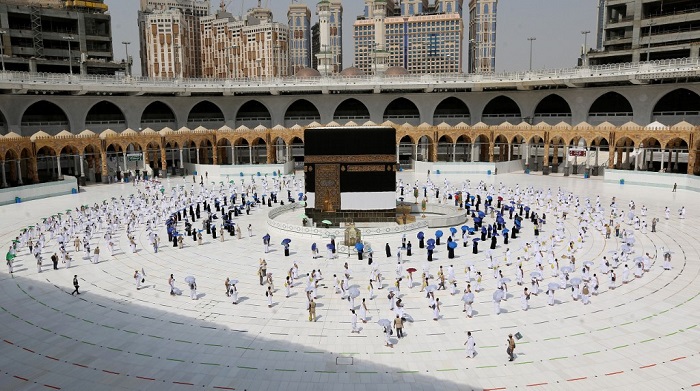
Dubai, Jul 29: Muslim pilgrims on Wednesday begin the annual Haj, downsized this year as the Saudi hosts strive to prevent a coronavirus outbreak during the five-day pilgrimage.

The Haj, one of the five pillars of Islam and a must for able-bodied Muslims at least once in their lifetime, is usually one of the world's largest religious gatherings.

But this year only up to 10,000 people already residing in the Kingdom will participate in the ritual, a tiny fraction of the 2.5 million pilgrims from around the world that attended last year.

"There are no security-related concerns in this pilgrimage, but (downsizing) is to protect pilgrims from the danger of the pandemic," said Khalid bin Qarar Al Harbi, Saudi Arabia's director of public security.

Pilgrims will be required to wear masks and observe social distancing during a series of religious rites that are completed over five days in the holy city of Makkah and its surroundings in western Saudi Arabia.

Those selected to take part in the Haj were subject to temperature checks and placed in quarantine as they began trickling into Makkah at the weekend.

State media showed health workers sanitising their luggage, and some pilgrims reported being given electronic wristbands to allow authorities to monitor their whereabouts.

Workers, clutching brooms and disinfectant, were seen cleaning the area around the Kaaba, the structure at the centre of the Grand Mosque draped in gold-embroidered cloth towards which Muslims around the world pray.

Haj authorities have cordoned off the Holy Kaaba this year, saying pilgrims will not be allowed to touch it, to limit the chances of infection.

They also reported setting up multiple health facilities, mobile clinics and ambulances to cater to the pilgrims.

Saudi authorities said only around 1,000 pilgrims residing in the Kingdom would be permitted for the Haj. Some 70 per cent of the pilgrims are foreigners residing in the Kingdom, while the rest will be Saudi citizens, authorities said.

All worshippers were required to be tested for coronavirus before arriving in the holy city of Makkah and will also have to quarantine after the pilgrimage as the number of cases in the Kingdom nears 270,000.

They were given elaborate amenity kits that include sterilised pebbles for a stoning ritual, disinfectants, masks, a prayer rug and the Ihram, a seamless white garment worn by pilgrims, according to a Haj ministry programme document.

"I did not expect, among millions of Muslims, to be blessed with approval," Emirati pilgrim Abdullah Al Kathiri said in a video released by the Saudi media ministry.

"It is an indescribable feeling... especially since it is my first pilgrimage."

The Haj ministry said non-Saudi residents of the Kingdom from around 160 countries competed in the online selection process but it did not say how many people applied.

Despite the pandemic, many pilgrims consider it safer to participate in this year's ritual without the usual colossal crowds cramming into tiny religious sites, which make it a logistical nightmare and a health hazard.

Comments

Add new comment

  • Coastaldigest.com reserves the right to delete or block any comments.
  • Coastaldigset.com is not responsible for its readers’ comments.
  • Comments that are abusive, incendiary or irrelevant are strictly prohibited.
  • Please use a genuine email ID and provide your name to avoid reject.
Agencies
May 27,2020

New Delhi, May 27: India’s fourth recession since Independence, first since liberalisation, and perhaps the worst to date is here, according to rating agency, Crisil.

CRISIL sees the Indian economy shrinking 5 per cent in fiscal 2021 (on-year), because of the Covid-19 pandemic. The first quarter will suffer a staggering 25 per cent contraction.

About 10 per cent of gross domestic product (GDP) in real terms could be permanently lost. "So going back to the growth rates seen before the pandemic is unlikely in the next three fiscals", Crisil said.

Crisil has revised its earlier forecast downwards. "Earlier, on April 28, we had slashed our prediction to 1.8 per cent growth from 3.5 per cent growth. Things have only gone downhill since", it said.

While we expect non-agricultural GDP to contract 6 per cent, agriculture could cushion the blow by growing at 2.5 per cent.

In the past 69 years, India has seen a recession only thrice as per available data in fiscals 1958, 1966 and 1980. The reason was the same each time a monsoon shock that hit agriculture, then a sizeable part of the economy.

"The recession staring at us today is different," it added. For one, agriculture could soften the blow this time by growing near its trend rate, assuming a normal monsoon. Two, the pandemic-induced lockdowns have affected most non-agriculture sectors. And three, the global disruption has upended whatever opportunities India had on the exports front.

Economic conditions have slid precipitously since the April-end forecast of 1.8 per cent GDP growth for fiscal 2021 (baseline), Crisil said.

On the lockdown extension, it said that the government has extended the lockdown four times to deal with the rising number of cases, curtailing economic activity severely (lockdown 4.0 is ending on May 31).

The first quarter of this fiscal will be the worst affected. June is unlikely to see major relaxations as the Covid-19 affliction curve is yet to flatten in India.

"Not only will the first quarter be a washout for the non-agricultural economy, services such as education, and travel and tourism among others, could continue to see a big hit in the quarters to come. Jobs and incomes will see extended losses as these sectors are large employers," Crisil said.

CRISIL also foresees economic activity in states with high Covid-19 cases to suffer prolonged disruption as restrictions could continue longer.

A rough estimate based on a sample of eight states, which contribute over half of India's GDP, shows that their 'red zones' (as per lockdown 3.0) contributed 42 per cent to the state GDP on average regardless of the share of such red zones.

On average, the orange zones contribute 46 per cent, while the green zones where activity is allowed to be close to normal contribute only 12 per cent to state GDP.

The economic costs are higher than earlier expectations, according to Crisil. The economic costs now beginning to show up in the hard numbers are far worse than initial expectations.

Industrial production for March fell by over 16%. The purchasing managers indices for the manufacturing and services sectors were at 27.4 and 5.4, respectively, in April, implying extraordinary contraction. That compares with 51.8 and 49.3, respectively, in March.

Exports contracted 60.3 per cent in April, and new telecom subscribers declined 35 per cent, while railway freight movement plunged 35 per cent on-year.

"Indeed, given one of the most stringent lockdowns in the world, April could well be the worst performing month for India this fiscal," it said.

Added to that is the economic package without enough muscle. The government recently announced a Rs 20.9 lakh crore economic relief package to support the economy. The package has some short-term measures to cushion the economy, but sets its sights majorly on reforms, most of which will have payoffs only over the medium term.

"We estimate the fiscal cost of this package at 1.2 per cent of GDP, which is lower than what we had assumed in our earlier estimate (when we foresaw a growth in GDP)," it said.

"We believe a catch-up to the pre-crisis trend level of GDP growth will not be possible in the next three fiscals despite policy support. Under the base case, we estimate a 10 per cent permanent loss to real GDP (from the decadal-trend level), assuming average growth of about 7 per cent between fiscals 2022 and 2024," Crisil said.

Interestingly, after the Global Financial Crisis (GFC), a sharp growth spurt helped catch up with the trend within two years. GDP grew 8.2 per cent on average in the two fiscals following the GFC. Massive fiscal spending, monetary easing and swift global recovery played a role in a V-shaped recovery.

To catch-up would require average GDP growth to surge to 11 per cent over the next three fiscals, something that has never happened before.

The research said that successive lockdowns have a non-linear and multiplicative effect on the economy a two-month lockdown will be more than twice as debilitating as a one-month imposition, as buffers keep eroding.

Partial relaxations continue to be a hindrance to supply chains, transportation and logistics. Hence, unless the entire supply chain is unlocked, the impact of improved economic activity will be subdued.

Therefore, despite the stringency of lockdown easing a tad in the third and the fourth phases, their negative impact on GDP is expected to massively outweigh the benefits from mild fiscal support and low crude oil prices, especially in the April-June quarter. "Consequently, we expect the current quarter's GDP to shrink 25 per cent on-year," it said.

Counting lockdown 4.0, Indians have had 68 days of confinement. S&P Global estimates that one month of lockdown shaves 3 per cent off annual GDP on average across Asia-Pacific.

Since India's lockdown has been the most stringent in Asia, the impact on economic growth will be correspondingly larger.

Google's Community Mobility Reports show a sharp fall in movement of people to places of recreation, retail shops, public transport and workplace travel. While data for May shows some improvement in India, mobility trends are much below the average or baseline, and lower compared with countries such as the US, South Korea, Brazil and Indonesia.


Comments

Add new comment

  • Coastaldigest.com reserves the right to delete or block any comments.
  • Coastaldigset.com is not responsible for its readers’ comments.
  • Comments that are abusive, incendiary or irrelevant are strictly prohibited.
  • Please use a genuine email ID and provide your name to avoid reject.