Astronomers discover 83 supermassive black holes 13 billion light-years away

Agencies
March 15, 2019

Washington, Mar 15: Astronomers have discovered 83 quasars powered by supermassive black holes 13 billion light-years away from the Earth, from a time when the universe was less than 10 per cent of its present age.

“It is remarkable that such massive dense objects were able to form so soon after the Big Bang,” said Michael Strauss, a professor at Princeton University in the US.

“Understanding how black holes can form in the early universe, and just how common they are, is a challenge for our cosmological models,” Strauss said in a statement.

This finding, published in The Astrophysical Journal, increases the number of black holes known at that epoch  considerably, and reveals, for the first time, how common they are early in the universe’s history.

In addition, it provides new insight into the effect of black holes on the physical state of gas in the early universe in its first billion years.

Supermassive black holes, found at the centers of galaxies, can be millions or even billions of times more massive than the Sun.

While they are prevalent today, it is unclear when they first formed, and how many existed in the distant early universe.

A supermassive black hole becomes visible when gas accretes onto it, causing it to shine as a “quasar.” Previous studies have been sensitive only to the very rare, most luminous quasars, and thus the most massive black holes.

The new discoveries probe the population of fainter quasars, powered by black holes with masses comparable to most black holes seen in the present-day universe.

The team used data taken with “Hyper Suprime-Cam” (HSC) instrument, mounted on the Subaru Telescope of the National Astronomical Observatory of Japan, which is located on the summit of Maunakea in Hawaii.

The researchers selected distant quasar candidates from the sensitive HSC survey data.

They then carried out an intensive observational campaign to obtain spectra of those candidates, using three telescopes: the Subaru Telescope; the Gran Telescopio Canarias on the island of La Palma in the Canaries, Spain; and the Gemini South Telescope in Chile.

The survey revealed 83 previously unknown very distant quasars.

Comments

ABDUL AZIZ SHE…
 - 
Saturday, 16 Mar 2019

SUBHAANALLAH


ALLAH ALMIGHTY CREATED EVERTHING  INCLUDING WHOLE UNIVERSE AND WHAT IS IN IT,

HUMAN BEING CANNOT REACH TO UNDERSTAND IT,  HUMAN LIFE NOT SUFFEICENT TO REACH AND KNOW EVERYTHING.

Add new comment

  • Coastaldigest.com reserves the right to delete or block any comments.
  • Coastaldigset.com is not responsible for its readers’ comments.
  • Comments that are abusive, incendiary or irrelevant are strictly prohibited.
  • Please use a genuine email ID and provide your name to avoid reject.
Agencies
January 15,2020

New Delhi, Jan 15: A Delhi court on Wednesday granted bail to Bhim Army chief Chandrashekhar Azad in connection with the Daryaganj violence case.

The court has ordered him not to hold any protest in Delhi till February 16th.

While hearing the case, the Judge had asked Azad's counsel to read out some of his social media posts.

Advocate Mehmood Pracha, representing Azad, had on Tuesday said that the petitioner was sent to jail without any evidence in connection with anti-CAA protests in Delhi's Darya Ganj area last year.

"I think the court's comments should become a precedent for the country. The Public Prosecutor at the behest of police tried to make this a communal issue. We told the court that the government has a problem with Azad because he made the CAA-NPR-NRC an issue for everyone. 
The Court also sought evidence," Pracha told ANI after Delhi's Tis Hazari court deferred the bail plea of Azad till today.

On Wednesday, the court pulled up the Delhi Police for failing to show any evidence against Azad.

Azad was arrested on December 21 last year after he led a march from Jama Masjid against the Citizenship (Amendment) Act. He was sent to judicial custody till January 18 at Tihar jail.

The Bhim Army chief was charged with rioting, unlawful assembly and inciting the mob to indulge in violence after vandalism in Delhi's Daryaganj area.

Comments

Add new comment

  • Coastaldigest.com reserves the right to delete or block any comments.
  • Coastaldigset.com is not responsible for its readers’ comments.
  • Comments that are abusive, incendiary or irrelevant are strictly prohibited.
  • Please use a genuine email ID and provide your name to avoid reject.
Agencies
July 29,2020

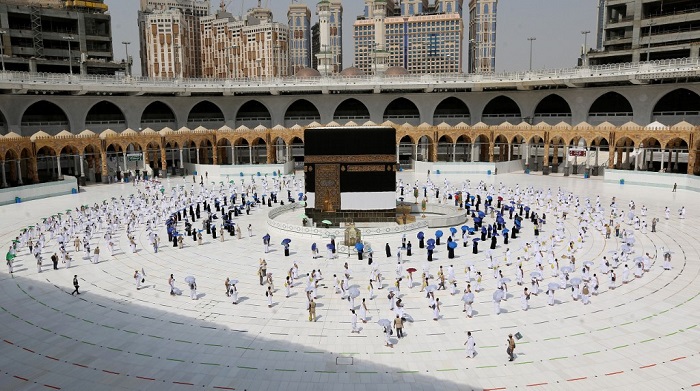
Dubai, Jul 29: Muslim pilgrims on Wednesday begin the annual Haj, downsized this year as the Saudi hosts strive to prevent a coronavirus outbreak during the five-day pilgrimage.

The Haj, one of the five pillars of Islam and a must for able-bodied Muslims at least once in their lifetime, is usually one of the world's largest religious gatherings.

But this year only up to 10,000 people already residing in the Kingdom will participate in the ritual, a tiny fraction of the 2.5 million pilgrims from around the world that attended last year.

"There are no security-related concerns in this pilgrimage, but (downsizing) is to protect pilgrims from the danger of the pandemic," said Khalid bin Qarar Al Harbi, Saudi Arabia's director of public security.

Pilgrims will be required to wear masks and observe social distancing during a series of religious rites that are completed over five days in the holy city of Makkah and its surroundings in western Saudi Arabia.

Those selected to take part in the Haj were subject to temperature checks and placed in quarantine as they began trickling into Makkah at the weekend.

State media showed health workers sanitising their luggage, and some pilgrims reported being given electronic wristbands to allow authorities to monitor their whereabouts.

Workers, clutching brooms and disinfectant, were seen cleaning the area around the Kaaba, the structure at the centre of the Grand Mosque draped in gold-embroidered cloth towards which Muslims around the world pray.

Haj authorities have cordoned off the Holy Kaaba this year, saying pilgrims will not be allowed to touch it, to limit the chances of infection.

They also reported setting up multiple health facilities, mobile clinics and ambulances to cater to the pilgrims.

Saudi authorities said only around 1,000 pilgrims residing in the Kingdom would be permitted for the Haj. Some 70 per cent of the pilgrims are foreigners residing in the Kingdom, while the rest will be Saudi citizens, authorities said.

All worshippers were required to be tested for coronavirus before arriving in the holy city of Makkah and will also have to quarantine after the pilgrimage as the number of cases in the Kingdom nears 270,000.

They were given elaborate amenity kits that include sterilised pebbles for a stoning ritual, disinfectants, masks, a prayer rug and the Ihram, a seamless white garment worn by pilgrims, according to a Haj ministry programme document.

"I did not expect, among millions of Muslims, to be blessed with approval," Emirati pilgrim Abdullah Al Kathiri said in a video released by the Saudi media ministry.

"It is an indescribable feeling... especially since it is my first pilgrimage."

The Haj ministry said non-Saudi residents of the Kingdom from around 160 countries competed in the online selection process but it did not say how many people applied.

Despite the pandemic, many pilgrims consider it safer to participate in this year's ritual without the usual colossal crowds cramming into tiny religious sites, which make it a logistical nightmare and a health hazard.

Comments

Add new comment

  • Coastaldigest.com reserves the right to delete or block any comments.
  • Coastaldigset.com is not responsible for its readers’ comments.
  • Comments that are abusive, incendiary or irrelevant are strictly prohibited.
  • Please use a genuine email ID and provide your name to avoid reject.
Agencies
June 14,2020

New Delhi, Jun 14: Petrol price on Sunday was hiked by a record 62 paise per litre and that of diesel by 64 paise as oil companies for the eighth day in a row adjusted retail rates in line with cost since ending an 82-day hiatus in rate revision.

Petrol price in Delhi was hiked to Rs 75.78 per litre from Rs 75.16 while diesel rates were increased to Rs 74.03 a litre from Rs 73.39, according to a price notification of state oil marketing companies.

Rates have been increased across the country and vary from state to state depending on the incidence of local sales tax or VAT.

The 62 paise a litre increase in petrol and 64 paise hike in diesel price is the highest surge in rates since the daily price revision was started in June 2017.

This is the eighth daily increase in rates in a row since oil companies on June 7 restarted revising prices in line with costs, after ending an 82-day hiatus.

In eight hikes, petrol price has gone up by Rs 4.52 per litre and diesel by Rs 4.64 -- a record increase in rates in any eight days since the daily price revision was introduced.

The freeze in rates was imposed in mid-March soon after the government hiked excise duty on petrol and diesel to shore up additional finances.

Oil PSUs Indian Oil Corp (IOC), Bharat Petroleum Corp Ltd (BPCL) and Hindustan Petroleum Corp Ltd (HPCL), instead of passing on the excise duty hikes to customers, adjusted them against the fall in the retail rates that was warranted because of international oil prices falling to two-decade lows.

The government had first raised excise duty on petrol and diesel by Rs 3 per litre each on March 14 and then again on May 5 by a record Rs 10 per litre in case of petrol and Rs 13 on diesel. The two hikes gave the government Rs 2 lakh crore in additional tax revenues.

State-owned fuel retailers IOC, BPCL and HPCL had frozen petrol and diesel prices since March 16, as if anticipating the government move and set off gains they accrued from continuing drop in international oil prices against the excise duty hike.

They, however, promptly passed the increase in local sales tax or VAT by state governments such as Rs 1.67 increase in VAT on petrol and Rs 7.10 in diesel by the Delhi government on May 4.

The total incidence of excise duty on petrol has risen to Rs 32.98 per litre and that on diesel to Rs 31.83. The excise tax on petrol was Rs 9.48 per litre when the Narendra Modi government took office in 2014 and that on diesel was Rs 3.56 a litre.

The government had between November 2014 and January 2016 raised excise duty on petrol and diesel on nine occasions to take away gains arising from plummeting global oil prices.

In all, duty on petrol rate was hiked by Rs 11.77 per litre and that on diesel by 13.47 a litre in those 15 months that helped government's excise mop up more than double to Rs 2,42,000 crore in 2016-17 from Rs 99,000 crore in 2014-15.

It cut excise duty by Rs 2 in October 2017 and by Rs 1.50 a year later. But it raised excise duty by Rs 2 per litre in July 2019.

It again raised excise duty on March 14 by Rs 3 per litre.

Comments

Add new comment

  • Coastaldigest.com reserves the right to delete or block any comments.
  • Coastaldigset.com is not responsible for its readers’ comments.
  • Comments that are abusive, incendiary or irrelevant are strictly prohibited.
  • Please use a genuine email ID and provide your name to avoid reject.