


Athletics: Leaked blood test results claim one in three medallists have doped

August 2, 2015

Paris/France, Aug 2: Athletics faced a fresh doping scandal Saturday when leaked results from 12,000 blood tests taken from 5,000 competitors allegedly demonstrated instances of cheating and "a shameful betrayal" of clean athletes.
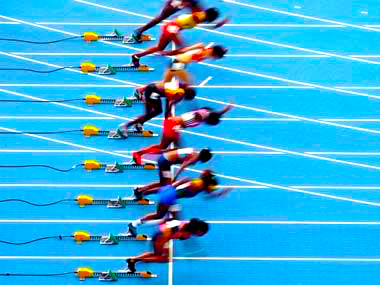
raceGerman broadcaster ARD as well as Britain's Sunday Times say they passed on their information to leading blood doping experts who concluded that track and field is in "the same diabolical position today that professional cycling was in 20 years ago".

The database, reportedly created by the International Association of Athletics Federations (IAAF), covers the period from 2001 to 2012, a statement from ARD said.

The findings were broadcast in a documentary screened in Germany on Saturday -- “Doping – Top Secret: The Shadowy World of Athletics.”

Australian doping experts Michael Ashenden and Robin Parisotto came to a series of conclusions:

- A total of 800 athletes in disciplines from 800m to the marathon registered values which, according to the definition of the biological passport of the World Anti-Doping Agency (WADA) are regarded as suspicious or even highly suspicious.

- In the analysis of the blood levels of the medal-winners at world championships and Olympics between 2001 and 2012, every third medal was won by athletes, for whom one or even both experts had identified suspicious blood values in the database.

- For every sixth medal winner at least one, they claimed, had doped in the course of his/her career.

“Often two out of the three medallists had probably engaged in blood doping during their career," Ashenden told the programme.

"In one event the entire podium was comprised of athletes, who in my opinion had most probably doped at some point in their career.”

Ashenden lashed out at the IAAF and their anti-doping policy.

“For the IAAF to have harvested millions of dollars from the broadcasting of athletics competitions...yet only devote a relative pittance of those funds towards anti-doping.

"...in my opinion (it's) a shameful betrayal of their primary duty to police their sport and to protect the clean athletes,” he said.

The values in the tests are not proof of cheating and the IAAF rejected criticism of its management.

"The IAAF has always been at the forefront in combating anti-doping, searching and implementing new analytical techniques and methodologies," said a statement released to the Sunday Times and carried by the BBC.

Since the introduction of the biological passport, the IAAF says it has "pursued more cases than all other anti-doping organisations together".

It added that it spent $2million a year on fighting doping.

The IAAF added in defence of its biological passport: "Any other approach, in particular, the use of data collected over a longer period for different purposes, with different objectives and with different methods of analysis, is nothing more than speculation."

Meanwhile, Russia and Kenya were subjected to new doping allegations in the documentary.

ARD, who last December aired similar accusations of doping and corruption in Russia, returned to the controversy just three weeks out from the world championships in Beijing.

"Despite assurances from the Russian authorities (in favour of a clean sport) doped competitors and their suppliers are always protected," the public broadcaster said in a statement.

The makers of the film claim to have evidence of human growth hormone being used to boost Russian runners.

They also say that a hidden camera recorded 800m athlete Anastasia Bazdireva as praising the benefits of drugs.

"With anabolics, I have stiff muscles. But I can run. It's hard but it's OK. You feel different with anabolics," she is recorded as claiming.

Journalists also returned to Kenya where they claim another hidden camera showed injections of "dangerous" doping products being administered.

The programme claimed that there is "massive corruption" within the Kenyan set-up and "a desire to cover-up doping...to the summit of the Kenyan athletics federation".

Kenya was rocked this year when marathon star Rita Jeptoo was banned for two years after being caught doping with the banned blood-boosting hormone EPO.

"Since 2006, I have not been forced to do a single blood test in Kenya," the 34-year-old is quoted as saying by ARD, adding that only urine tests were carried out.

Comments

Add new comment

  • Coastaldigest.com reserves the right to delete or block any comments.
  • Coastaldigset.com is not responsible for its readers’ comments.
  • Comments that are abusive, incendiary or irrelevant are strictly prohibited.
  • Please use a genuine email ID and provide your name to avoid reject.
News Network
July 9,2020

Tokorozawa, Jul 9: Olympic boxing hopeful Arisa Tsubata is used to taking blows in the ring but it is during her work as a nurse that she faces her toughest opponent: coronavirus.

The 27-year-old juggles a brutal training regime in boxing gloves with long, irregular hours in surgical gloves at a hospital near Tokyo.

Tsubata mainly treats cancer patients but she said the virus was a constant threat, with medical experts warning at the peak of the pandemic that Japan's health system was close to collapse.

"We always face the risk of infection at medical facilities," she said.

"My colleagues and I have all worked under the stress of possibly getting infected."

Like most elite athletes, the virus played havoc with Tsubata's training schedules, meaning she welcomed the postponement of this year's Tokyo Olympics until 2021.

"It was a plus for me, giving me more time for training, although I wasn't sure if I should be so happy because the reason for the postponement was the spread of the infectious disease," she said.

Tsubata took up boxing only two years ago as a way to lose weight but quickly rose through the ranks.

"In a few years after becoming a nurse, I gained more than 10 kilos (22 pounds)," she laughed.

"I planned to go to Hawaii with my friends one summer, and I thought I wouldn't have much fun in a body like that. That is how I started boxing."

She quickly discovered a knack for the ring, winning the Japan national championship and a place on the national team.

But juggling her medical and sporting career has not always been easy and the first time she fought a foreign boxer came only in January, at an intensive training camp in Kazakhstan.

"That made me realise how inexperienced I am in my short boxing career. I was scared," she admitted.

Japanese boxing authorities decided she was not experienced enough to send her to the final qualifying tournament in Paris, which would have shattered her Tokyo 2020 dreams -- if coronavirus had not given her an extra year.

Now she is determined to gain the experience needed to qualify for the rescheduled Games, which will open on July 23, 2021.

"I want to train much more and convince the federation that I could fight in the final qualifiers," she said.

Her coach Masataka Kuroki told AFP she is a subtle boxer and a quick learner, as he put her through her paces at a training session.

She now needs to add more defensive technique and better core strength to her fighting spirit and attacking flair, said Kuroki.

"Defence! She needs more technique for defence. She needs to have a more agile, stronger lower body to fend off punches from below," he said.

Her father Joji raised Arisa and her three siblings single-handedly after separating from his Tahitian wife and encouraged his daughter into nursing to learn life-long skills.

He never expected his daughter to be fighting for a place in the Olympics but proudly keeps all her clippings from media coverage.

"She tried not to see us family directly after the coronavirus broke out," the 58-year-old told AFP. "She was worried."

Tsubata now want to compete in the Games for all her colleagues who have supported her and the patients that have cheered her on in her Olympic ambitions.

"I want to be the sort of boxer who keeps coming back no matter how many punches I take," she said.

"I want to show the people who cheer for me that I can work hard and compete in the Olympics, because of them."

Comments

Add new comment

  • Coastaldigest.com reserves the right to delete or block any comments.
  • Coastaldigset.com is not responsible for its readers’ comments.
  • Comments that are abusive, incendiary or irrelevant are strictly prohibited.
  • Please use a genuine email ID and provide your name to avoid reject.
News Network
January 23,2020

Melbourne, Jan 23: Sania Mirza's return to her first Grand Slam after a two-year break was cut short on Thursday when the former world number one was forced to retire midway through her first round match in women's doubles at the Australian Open due to a calf injury.

India's Mirza, who won six Grand Slam doubles titles, took a break from the game after the China Open in October 2017 and gave birth to her son a year later.

The 33-year-old made a winning return to the WTA Tour at this month's Hobart International with Ukrainian Nadiia Kichenok, picking up her 42nd WTA doubles title and the first since winning the women's doubles in Brisbane in 2017.

Mirza said she strained her calf muscle in her right leg during the Hobart final.

"It just got worse in the match. It was bit of a bad strain, but I had a few days off," she told reporters. "So I obviously had to try to do whatever I could to try to get on the court.

"It felt okay when I went on the court, but it was tough to move right. I just felt like I'm gonna tear it or something pretty bad."

Mirza won her first Grand Slam in mixed doubles at the Australian Open in 2009 and also bagged the women's doubles in 2016.

Mirza always believed there was tennis left in her which inspired her comeback, she told Reuters on Sunday.

She had already pulled out of the Australian Open mixed doubles, where she was to partner compatriot Rohan Bopanna.

Mirza and Kichenok were trailing the Chinese pair of Xinyun Han and Lin Zhu 6-2 1-0 on Thursday when the Indian had to call it quits due to the injury.

"As a tennis player you want to compete, it is the Grand Slam. If it's any other tournament, you would probably take a call and be like 'I don't want to risk it'," she said.

Mirza, who is married to former Pakistan cricket captain Shoaib Malik, said she would take two weeks to recover and was hoping to play at next month's Dubai championships.

"When you play a professional sport, injuries are really part of it. And it's something that you have to accept," she said. "Sometimes the timing is really not ideal, it's tough that it happened in a Grand Slam, or just before a Grand Slam."

Comments

Add new comment

  • Coastaldigest.com reserves the right to delete or block any comments.
  • Coastaldigset.com is not responsible for its readers’ comments.
  • Comments that are abusive, incendiary or irrelevant are strictly prohibited.
  • Please use a genuine email ID and provide your name to avoid reject.
News Network
March 5,2020

Mar 5: India reached a maiden women's Twenty20 World Cup final Thursday after their last four clash against England was washed out, sparking calls for the International Cricket Council to include reserve days in future events.

Harmanpreet Kaur's unbeaten side were due to face the 2009 champions at the Sydney Cricket Ground, but the rain began pouring early in the day with barely any let-up.

With a minimum 10 overs per side needed for a result and no break in the weather, the umpires called it off without a ball being bowled.

Normally, five overs per side are needed to constitute a Twenty20 match, but the rules are different for ICC tournaments.

Four-time champions Australia are scheduled to take on South Africa later in the second semi-final, with that match also under threat.

With no reserve day, the highest-ranked teams from the two groups move into the final if play is not possible

That would pit India against South Africa at the Melbourne Cricket Ground on Sunday, where organisers are hoping to attract 90,000 plus fans, denying Australia a chance to defend their crown.

A reserve day is allowed for the final and the lack of one for the semis has been criticised by some players, with England captain Heather Knight among those calling for change.

"If both semi-finals are lost it would be a sad time for the tournament," she told reporters ahead of the match. "It's obviously going to be a shame if it does happen and I'm sure there will be a lot of pressure on the ICC to change that."

Cricket Australia chief Kevin Roberts said he sought clarification from the ICC about adding a reserve day with the Sydney weather looking ominous, but the request was denied.

"We've asked the question and it's not part of the playing conditions and we respect that," he told Melbourne's SEN radio.

"It gives you cause to reflect and think about how you might improve things in the future, but going into a tournament with a given set of playing conditions and rules, I don't think it's time to tinker with the rules."

It is not the way India would have wanted to make the final, but they are deserving of being there having gone through the group phase as the only unbeaten team.

After opening their campaign by upsetting Australia, they beat Bangladesh, New Zealand and then Sri Lanka.

While the entire team played well, teenage batting prodigy Shafali Verma excelled, which saw her elevated to the top of the ICC T20 batting rankings this week aged just 16.

She is only the second Indian after Mithali Raj to reach number one, pushing New Zealand veteran Suzie Bates down to second.

Ranked four in the world, India had made three semi-finals before this year and lost every time, including against England at the last World Cup.

Comments

Add new comment

  • Coastaldigest.com reserves the right to delete or block any comments.
  • Coastaldigset.com is not responsible for its readers’ comments.
  • Comments that are abusive, incendiary or irrelevant are strictly prohibited.
  • Please use a genuine email ID and provide your name to avoid reject.