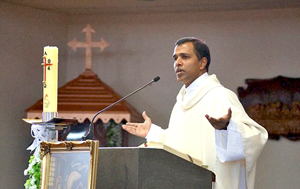
Australia: Indian priest stabbed, asked about nationality before attack

March 20, 2017

Melbourne, Mar 20: In an apparent hate crime, an Indian Catholic priest was attacked by a 72-year-old man while leading the Sunday mass in a Melbourne church.

priestRacism may be the reason the priest was stabbed in the neck moments before he was about to say mass at a Melbourne church, reports News.com.au.

According to the report, it is believed that the offender told the priest that because he was Indian, he must be a Hindu or a Muslim and therefore can't be saying mass.

The man has been charged for stabbing Rev Tomy Kalathoor Mathew, 48, in the neck moments before the priest was due to give the 11am Italian-language mass on Sunday.

He has been charged with intentionally and recklessly causing injury and bailed to appear in the Broadmeadows Magistrates' Court on June 13.

Father Tomy is recovering from non life-threatening injuries in hospital.

The attack was described as "appalling" by the Catholic Archdiocese of Melbourne.

Comments

Add new comment

  • Coastaldigest.com reserves the right to delete or block any comments.
  • Coastaldigset.com is not responsible for its readers’ comments.
  • Comments that are abusive, incendiary or irrelevant are strictly prohibited.
  • Please use a genuine email ID and provide your name to avoid reject.
News Network
June 24,2020

Geneva, Jun 24: The global cumulative count of confirmed coronavirus cases is approaching nine million, with 133,326 cases recorded over the past day, the World Health Organisation (WHO) said in its daily situation report on Tuesday.

Over the past 24 hours, 3,847 people died from COVID-19 worldwide, taking the cumulative death toll to 469,587 fatalities, according to the report.

The global case total has now reached 8,993,659.

The Americas still account for the majority of cases and deaths -- 4.4 million and 224,207, respectively.

The United States remains the country with the highest count of cases and fatalities -- 2.3 million and 119,761, respectively.

Comments

Add new comment

  • Coastaldigest.com reserves the right to delete or block any comments.
  • Coastaldigset.com is not responsible for its readers’ comments.
  • Comments that are abusive, incendiary or irrelevant are strictly prohibited.
  • Please use a genuine email ID and provide your name to avoid reject.
News Network
July 4,2020

Geneva, Jul 4: The World Health Organization has updated its account of the early stages of the COVID crisis to say it was alerted by its own office in China, and not by China itself, to the first pneumonia cases in Wuhan.

The UN health body has been accused by US President Donald Trump of failing to provide the information needed to stem the pandemic and of being complacent towards Beijing, charges it denies.

On April 9, WHO published an initial timeline of its communications, partly in response to criticism of its early response to the outbreak that has now claimed more than 521,000 lives worldwide.

In that chronology, WHO had said only that the Wuhan municipal health commission in the province of Hubei had on December 31 reported cases of pneumonia. The UN health agency did not however specify who had notified it.

WHO director Tedros Adhanom Ghebreyesus told a press conference on April 20 the first report had come from China, without specifying whether the report had been sent by Chinese authorities or another source.

But a new chronology, published this week by the Geneva-based institution, offers a more detailed version of events.

It indicates that it was the WHO office in China that on December 31 notified its regional point of contact of a case of "viral pneumonia" after having found a declaration for the media on a Wuhan health commission website on the issue.

The same day, WHO's epidemic information service picked up another news report transmitted by the international epidemiological surveillance network ProMed -- based in the United States -- about the same group of cases of pneumonia from unknown causes in Wuhan.

After which, WHO asked the Chinese authorities on two occasions, on January 1 and January 2, for information about these cases, which they provided on January 3.

WHO emergencies director Michael Ryan told a press conference on Friday that countries have 24-48 hours to officially verify an event and provide the agency with additional information about the nature or cause of an event.

Ryan added that the Chinese authorities immediately contacted WHO's as soon as the agency asked to verify the report.

US President Donald Trump has announced that his country, the main financial contributor to WHO, will cut its bridges with the institution, which he accuses of being too close to China and of having poorly managed the pandemic.

The WHO denies any complacency toward China.

Comments

Add new comment

  • Coastaldigest.com reserves the right to delete or block any comments.
  • Coastaldigset.com is not responsible for its readers’ comments.
  • Comments that are abusive, incendiary or irrelevant are strictly prohibited.
  • Please use a genuine email ID and provide your name to avoid reject.
News Network
April 28,2020

Washington, Apr 28: After nearly three weeks in an intensive care unit in Los Angeles, doctors treating 41-year-old Broadway actor Nick Cordero for COVID-19 were forced to amputate his right leg.

The flow of blood had been impeded by a blood clot: yet another dangerous complication of the disease that has been bubbling up in frontline reports from China, Europe and the United States.

To be sure, so-called "thrombotic events" occur for a variety of reasons among intensive care patients, but the rates among COVID-19 patients are far higher than would be otherwise expected.

"I have had 40-year-olds in my ICU who have clots in their fingers that look like they'll lose the finger, but there's no other reason to lose the finger than the virus," Shari Brosnahan, a critical care doctor at NYU Langone said.

One of these patients is suffering from a lack of blood flow to both feet and both hands, and she predicts an amputation may be necessary, or the blood vessels may get so damaged that an extremity could drop off by itself.

Blood clots aren't just dangerous for our limbs, but can make their way to the lungs, heart or brain, where they may cause lethal pulmonary embolisms, heart attacks, and strokes.

A recent paper from the Netherlands in the journal Thrombosis Research found that 31 percent of 184 patients suffered thrombotic complications, a figure that the researchers called "remarkably high" -- even if extreme consequences like amputation are rare.

Behnood Bikdeli, a doctor at New York-Presbyterian Hospital, assembled an international consortium of experts to study the issue. Their findings were published in the Journal of The American College of Cardiology.

The experts found the risks were so great that COVID-19 patients "may need to receive blood thinners, preventively, prophylactically," even before imaging tests are ordered, said Bikdeli.

What exactly is causing it? The reasons aren't fully understood, but he offered several possible explanations.

People with severe forms of COVID-19 often have underlying medical conditions like heart or lung disease -- which are themselves linked to higher rates of clotting.

Next, being in intensive care makes a person likelier to develop a clot because they are staying still for so long. That's why for example people are encouraged to stretch and move around on long haul flights.

It's also now clear the COVID-19 illness is associated with an abnormal immune reaction called "cytokine storm" -- and some research has indicated this too is linked to higher rates of clotting.

There could also be something about the virus itself that is causing coagulation, which has some precedent in other viral illnesses.

A paper in the journal The Lancet last week showed that the virus can infect the inner cell layer of organs and of blood vessels, called the endothelium. This, in theory, could interfere with the clotting process.

According to Brosnahan, while thinners like Heparin are effective in some patients, they don't work for all patients because the clots are at times too small.

"There are too many microclots," she said. "We're not sure exactly where they are."

Autopsies have in fact shown some people's lungs filled with hundreds of microclots.

The arrival of a new mystery however helps solve a slightly older one.

Cecilia Mirant-Borde, an intensive care doctor at a military veterans hospital in Manhattan, told AFP that lungs filled with microclots helped explain why ventilators work poorly for patients with low blood oxygen.

Earlier in the pandemic doctors were treating these patients according to protocols developed for acute respiratory distress syndrome, sometimes known as "wet lung."

But in some cases, "it's not because the lungs are occupied with water" -- rather, it's that the microclotting is blocking circulation and blood is leaving the lungs with less oxygen than it should.

It has just been a little under five months since the virus emerged in Wuhan, China, and researchers are learning more about its impact every day.

"While we react surprised, we shouldn't be as surprised as we were. Viruses tend to do weird things," said Brosnahan.

While the dizzying array of complications may seem daunting, "it's possible there'll be one or a couple of unifying mechanisms that describe how this damage happens," she said.

"It's possible it's all the same thing, and that there'll be the same solution."

Comments

Add new comment

  • Coastaldigest.com reserves the right to delete or block any comments.
  • Coastaldigset.com is not responsible for its readers’ comments.
  • Comments that are abusive, incendiary or irrelevant are strictly prohibited.
  • Please use a genuine email ID and provide your name to avoid reject.