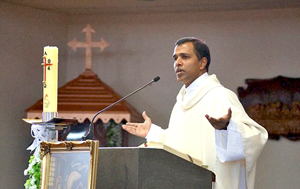
Australia: Indian priest stabbed, asked about nationality before attack

March 20, 2017

Melbourne, Mar 20: In an apparent hate crime, an Indian Catholic priest was attacked by a 72-year-old man while leading the Sunday mass in a Melbourne church.

priestRacism may be the reason the priest was stabbed in the neck moments before he was about to say mass at a Melbourne church, reports News.com.au.

According to the report, it is believed that the offender told the priest that because he was Indian, he must be a Hindu or a Muslim and therefore can't be saying mass.

The man has been charged for stabbing Rev Tomy Kalathoor Mathew, 48, in the neck moments before the priest was due to give the 11am Italian-language mass on Sunday.

He has been charged with intentionally and recklessly causing injury and bailed to appear in the Broadmeadows Magistrates' Court on June 13.

Father Tomy is recovering from non life-threatening injuries in hospital.

The attack was described as "appalling" by the Catholic Archdiocese of Melbourne.

Comments

Add new comment

  • Coastaldigest.com reserves the right to delete or block any comments.
  • Coastaldigset.com is not responsible for its readers’ comments.
  • Comments that are abusive, incendiary or irrelevant are strictly prohibited.
  • Please use a genuine email ID and provide your name to avoid reject.
News Network
June 16,2020

Beijing, Jun 16: The coronavirus situation in China's capital is "extremely severe", a city official warned Tuesday, as 27 new infections were reported from Beijing where a new cluster has sparked a huge trace-and-test programme.

The COVID-19 resurgence -- believed to have started at the sprawling Xinfadi wholesale food market in the capital -- has sparked alarm as China had largely brought its outbreak under control through mass testing and lockdowns imposed earlier in the year.

The new cases took the number of confirmed infections in Beijing over the past five days to 106, as authorities locked down almost 30 communities in the city and tested tens of thousands of people.

"The epidemic situation in the capital is extremely severe," Beijing city spokesman Xu Hejian warned at a press conference.

The World Health Organization had already expressed concern about the cluster, pointing to Beijing's size and connectivity.

Officials in the capital have said they will test stall owners and managers at all of the city's food markets, restaurants and government canteens.

Beijing's coronavirus testing capacity has been expanded to 90,000 a day, according to China's official news agency Xinhua.

On Tuesday, the capital's transport commission banned taxi- and ride-hailing services from driving out of the city, Xinhua reported, in another move to try and contain the new outbreak.

All indoor sports and entertainment venues in Beijing were ordered to shut on Monday, and some other cities across China warned they would quarantine those arriving from the capital.

The National Health Commission also reported four new domestic infections in Hebei province, which surrounds Beijing, and a case reported in southwestern Sichuan province was linked to the Beijing cluster.

Authorities were also racing to track people from Beijing who had travelled to other parts of China, and those who visited the capital have been encouraged to get tested.

Beijing spokesman Xu said: "High-risk people who have left Beijing must inform local authorities immediately."

Market inspections

Authorities shut down another market on Tuesday -- Tiantaohonglian in the central Xicheng district -- after one employee there was diagnosed with COVID-19, state broadcaster CCTV reported.

Seven residential estates surrounding that market were also locked down.

In total, Beijing officials said Tuesday they have disinfected 276 agricultural markets, closed 11 markets, and disinfected more than 33,000 food and beverage businesses in a bid to stamp out the new cluster.

Officials had warned Sunday that since May 30, 200,000 people had visited the Xinfadi market -- the original site of the new outbreak.

More than 8,000 workers from Xinfadi have been tested and sent to centralised quarantine facilities.

Until this recent outbreak, most of China's cases in recent months were nationals returning home as the pandemic spread to other countries.

China's Center for Disease Control and Prevention said Monday that the virus strain found in the Beijing outbreak was a "major epidemic strain in the European countries".

While the virus was detected on chopping boards used to handle imported salmon at Xinfadi, "it does not clearly or definitely indicate it's from imported seafood", Wu Zunyou, the body's chief epidemiologist, said in an interview with state broadcaster CCTV.

"Ever since new cases suddenly emerged in Beijing, we have tried to figure out the reasons for the outbreak since there were no COVID-19 cases found over the past two months," Wu Zunyou said.

"We came up with several possibilities, and the most likely one is that the carrier of the novel coronavirus comes from outside China or other parts of China and brought it here."

On Tuesday, another eight imported cases were reported.

Comments

Add new comment

  • Coastaldigest.com reserves the right to delete or block any comments.
  • Coastaldigset.com is not responsible for its readers’ comments.
  • Comments that are abusive, incendiary or irrelevant are strictly prohibited.
  • Please use a genuine email ID and provide your name to avoid reject.
News Network
June 9,2020

Washington, Jun 9: When epidemiologists talked about "flattening the curve," they probably didn't mean it this way: the US hit its peak coronavirus caseload in April, but since that time the graph has been on a seemingly unending plateau.

That's unlike several other hard-hit countries which have successfully pushed down their numbers of new cases, including Spain and Italy, which now have bell-shaped curves.

Experts say the prolonged nature of the US epidemic is the result of the cumulative impact of regional outbreaks, as the virus that started out primarily on the coasts and in major cities moves inward.

Layered on top of that are the effects of lifting lockdowns in parts of the country that are experiencing rising cases, as well as a lapse in compliance with social distancing guidelines because of economic hardship, and in some cases a belief that the threat is overstated.

"The US is a large country both in geography and population, and the virus is at very different stages in different parts of the country," Tom Frieden, a former director of the Centers for Disease Control and Prevention told AFP.

The US saw more than 35,000 new cases for several days in April. While that figure has declined, it has still been exceeding 20,000 regularly in recent days.

By contrast, Italy was regularly hitting more than 5,000 cases per day in March but is currently experiencing figures in the low hundreds.

"We did not act quickly and robustly enough to stop the virus spreading initially, and data indicate that it travelled from initial hotspots along major transport routes into other urban and rural areas," added Frieden, now CEO of the non-profit Resolve to Save Lives.

To wit: the East Coast states of New York, New Jersey and Massachusetts accounted for about 50 percent of all cases until about a month or so ago -- but now the geographic footprint of the US epidemic has shifted to the Midwest and southeast, including Florida.

Another key problem, said Jennifer Nuzzo, an epidemiologist at Johns Hopkins, is that the United States is still not doing enough testing, contact tracing and isolation.

After coming late to the testing party -- for reasons ranging from technical issues to regulatory hurdles -- the US has now conducted more COVID-19 tests than any other country.

It even has one of the highest per capita rates per country of 62 per 1,000 people, according to the website ourworldindata.org -- better than Germany (52 per 1,000) and South Korea (20 per 1,000).

But according to Nuzzo, these numbers are misleading, because "the amount of testing that a country should do should be scaled to the size of its epidemic.

"The United States has the largest epidemic in the world so obviously we need to do a lot more testing than any other country."

For Johns Hopkins, the more important metric is the positivity rate -- that is, out of all tests conducted, how many came back positive for COVID-19.

As of June 7, the United States had an average daily positivity rate of 14 percent, well above the World Health Organization guideline of 5 percent over two weeks before social distancing guidelines should be relaxed.

By contrast, Germany, which has tested far fewer people in relation to its population, has a positivity rate of 5 percent.

Even if testing were scaled up, carrying out tests in of itself does very little good without the next steps -- finding out who was exposed and then asking them to isolate.

Here also, too many US states are lagging woefully behind.

Texas, which is experiencing a surge in cases after relaxing its lockdown, is a case in point. The state targeted hiring a modest 4,000 tracers by June, but according to local reports is still more than a thousand shy of even that goal.

Opt-in app based efforts have also been slow to get off the ground.

Then there is the fact that some people are growing tired of lockdowns, while others don't have the economic luxury of being able to stay home for prolonged periods.

The government sent some 160 million Americans a single stimulus check of up to $1,200 back in April but it's not clear whether more will be forthcoming.

Still others, particularly in so-called red states under Republican leadership, have chafed under restrictions and mask-wearing guidelines that they see as an affront to their personal freedom.

"The US is kind of on the extreme of the individual liberty side," Sten Vermund, dean of the Yale School of Public Health, told AFP.

Part of this has to do with mixed messaging from Republican leaders, including President Donald Trump, said Nuzzo.

"We have had at the highest political level an assertion that this is a situation that's been overblown, and that maybe certain protective behaviors are not necessary," she said.

More recently, tens of thousands of people across the country have taken to the streets to protest the killing on an unarmed black man by police, risking coronavirus infection to demonstrate against the public health threat of racialized state violence.


Comments

Add new comment

  • Coastaldigest.com reserves the right to delete or block any comments.
  • Coastaldigset.com is not responsible for its readers’ comments.
  • Comments that are abusive, incendiary or irrelevant are strictly prohibited.
  • Please use a genuine email ID and provide your name to avoid reject.
News Network
April 6,2020

Tokyo, April 6: Japan Prime Minister Shinzo Abe is planning to declare a state of emergency in view of the surging cases of coronavirus in the country, especially in Tokyo and other large cities, government sources said on Monday.

Pressure had been mounting on Abe to make the declaration amid a spurt in COVID-19 cases recently, with calls for the move from Tokyo Governor Yuriko Koike and the Japan Medical Association intensifying, Xinhua news agency reported.

The Tokyo metropolitan government, along with healthcare specialists, said that the number of hospital beds available for coronavirus patients will soon reach capacity, with the health ministry rapidly trying to secure more beds.

Adding to pressure on the government to demonstrably bolster its preventive and countermeasures to the spread of the virus, a panel of government experts warned recently that the country's healthcare system could collapse if coronavirus cases continue to spike.

The healthcare system in Tokyo and four other prefectures are under increased strain and "drastic countermeasures need to be taken as quickly as possible," the experts said.

As of Sunday, 143 new cases of COVID-19 were recorded in Tokyo, a record daily high for the capital, bringing the total to 1,034, with Japan's health ministry and local governments adding that nationwide cases rose to 3,531 as of Sunday afternoon.

Comments

Add new comment

  • Coastaldigest.com reserves the right to delete or block any comments.
  • Coastaldigset.com is not responsible for its readers’ comments.
  • Comments that are abusive, incendiary or irrelevant are strictly prohibited.
  • Please use a genuine email ID and provide your name to avoid reject.