



Australia: 'Massive fireball' as small aircraft crashes into shops

February 21, 2017

Melbourne, Feb 21: A light aircraft exploded Tuesday in a "massive fireball" with police saying none of the five people aboard survived as it smashed into a shopping centre near the Australian city of Melbourne.
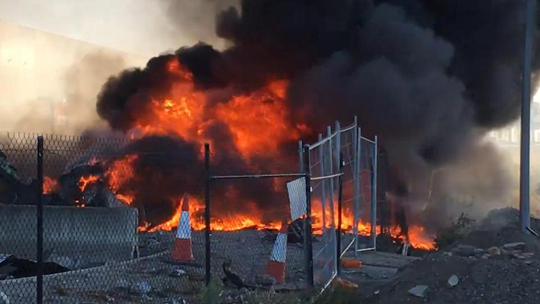
Fireball

The Beechcraft plane veered just after take-off into the shopping centre, that was still closed, next to Essendon Fields airport.

"Five on the aircraft and looks like no-one has survived the crash," said Victoria police assistant commissioner Stephen Leane.

Victoria premier Daniel Andrews described it as the state's worst air accident in three decades.

The private charter from Essendon, north of Melbourne, to King Island, 55 minutes to the south, came down just short of a major motorway packed with the heavy traffic of early morning commuters.

Live television footage showed burned out wreckage, flames and major damage at the shopping centre and adjacent buildings.

A column of thick black smoke rose into the air as witnesses spoke of an explosion.

"It appears a light plane, which is a charter flight, has impacted the DFO (Direct Factory Outlet) at Essendon Fields," police minister Lisa Neville said.

The centre was not due to open for another hour and the authorities confirmed no one inside was hurt.

"There's also debris that's been left on the freeway," she added.

A taxi driver called ABC radio and told of the "massive fireball".

"I saw this plane ... when it hit the building there was a massive fireball," said the man called Jason.

"I could feel the heat through the window of the taxi, and then a wheel -- it looked like a plane wheel -- bounced on the road and hit the front of the taxi as we were driving along."

Victoria police superintendent Mick Frewen said investigations centred on a "catastrophic engine failure".

The flight made a May-Day call before crashing, he added.

A DFO shopworker identified as Ash told Sky News he saw "the fireball go up into the air", adding it "felt like a bomb had gone off".

"The fire was just so hot we could not get anywhere near it," he said. "We could see the wreckage, or what was left of it.

Plumber Michael Howard, 29, told the Australian Broadcasting Corporation he saw a "blue flash".

"I was ... just looking out the window ... and then all of a sudden I just saw a blue flash come down and then all of a sudden there was a massive fireball."

"It was like something from a movie," Howard said.

Melbourne fire brigade chief Paul Stacchino tweeted that "more than 60 firefighters have worked hard to bring the fire ... under control. Crews to remain on scene for some time".

The Australian Safety Transport Bureau said it had sent investigators to the scene.

Essendon Fields had been closed and all traffic diverted to Melbourne's two larger airports Tullamarine and Avalon.

One side of a major freeway which runs alongside the local airport remained shut to allow wreckage to be cleared.

Comments

Add new comment

  • Coastaldigest.com reserves the right to delete or block any comments.
  • Coastaldigset.com is not responsible for its readers’ comments.
  • Comments that are abusive, incendiary or irrelevant are strictly prohibited.
  • Please use a genuine email ID and provide your name to avoid reject.
News Network
March 2,2020

Paris, Mar 2: A global agency says the spreading new virus could make the world economy shrink this quarter, for the first time since the international financial crisis more than a decade ago.

The Organization for Economic Cooperation and Development says Monday in a special report on the impact of the virus that the world economy is still expected to grow overall this year and rebound next year.

But it lowered its forecasts for global growth in 2020 by half a percentage point, to 2.4 per cent, and said the figure could go as low as 1.5 per cent if the virus lasts long and spreads widely.

The last time world GDP shrank on a quarter-on-quarter basis was at the end of 2008, during the depths of the financial crisis. On a full-year basis, it last shrank in 2009.

The OECD said China's reduced production is hitting Asia particularly hard but also companies around the world that depend on its goods.

It urged governments to act fast to prevent contagion and restore consumer confidence.

The Paris-based OECD, which advises developed economies on policy, said the impact of this virus is much higher than past outbreaks because "the global economy has become substantially more interconnected, and China plays a far greater role in global output, trade, tourism and commodity markets."

Comments

Add new comment

  • Coastaldigest.com reserves the right to delete or block any comments.
  • Coastaldigset.com is not responsible for its readers’ comments.
  • Comments that are abusive, incendiary or irrelevant are strictly prohibited.
  • Please use a genuine email ID and provide your name to avoid reject.
Agencies
April 17,2020

Washington, Apr 17: A record number of 4,591 Americans have died in the last 24 hours due to the deadly novel coronavirus in the US, which has the highest number of COVID-19 casualties in the world.

According to the Johns Hopkins University data, by 8 pm on Thursday, as many as 4,591 Americans have died in the last 24 hours, The Wall Street Journal said.

The previous highest was 2,569 on Wednesday.

By Thursday, more than 662,000 Americans tested positive with the coronavirus.

The dreaded disease, which originated in Wuhan city in China in December last year, has so far claimed more than 144,000 lives and infected over 2.1 million people.

The virus has infected over 671,000 people and claimed more than 33,000 lives, the highest for any country in the world.

New York City and its adjoining areas, including New Jersey and Connecticut have emerged as the epicenter of the virus in the US.

New York alone accounts for 226,000 cases of infections and 16,106 deaths.

In New Jersey, as many as 3,518 people have died of the disease and 75,317 have tested positive.

According to the US Centers for Disease Control and Prevention, till April 14, four per cent of the Americans infected with COVID-19 were of Asian origin and nearly one-third (30 per cent) were African Americans.

US President Donald Trump told reporters at the White House that experts and scientists report that his strategy to slow the spread of the virus has saved hundreds of thousands of lives.

Models predicted between 1.5 million and 2.2 million US deaths. If there was no mitigation, it could have even been higher than that and between 100,000 and 240,000 deaths with mitigation. It is looking like we will come far under even these lowest numbers, he said.

Noting that experts say the curve of the virus has flattened, and the peak in the new cases has passed, Trump said that nationwide, more than 850 counties or nearly 30 per cent of the country have reported no new cases in the last seven days.

Because of our early and aggressive action, we have avoided the tragedy of health care rationing and deadly shortfalls that have befallen in many other nations, nations which wherever possible we are helping, he said.

According to Trump, at least 35 clinical trials are already underway, including antiviral therapies, immune therapies, and blood therapies in the form of convalescent plasma. So far, more than 3.5 million tests have been carried out.

Comments

Add new comment

  • Coastaldigest.com reserves the right to delete or block any comments.
  • Coastaldigset.com is not responsible for its readers’ comments.
  • Comments that are abusive, incendiary or irrelevant are strictly prohibited.
  • Please use a genuine email ID and provide your name to avoid reject.
News Network
April 26,2020

Apr 26: The remarkable story of an airman who overcame prejudice to become one of only a handful of Indian fighter pilots in the First World War has emerged in newly-released archive files by the UK's Commonwealth War Graves Commission (CWGC).

Lieutenant Shri Krishna Chanda Welinkar is one of the thousands of moving stories from the war preserved in family correspondence and being brought alive as part of a digitisation project.

The never-before-published files contain thousands of letters, pictures and other papers sent between the Commission and the next of the kin of First World War dead.

Among them is the story of Welinkar, who hailed from Bombay in colonial India. After much hardship and discrimination, he eventually became a pilot and went missing while on patrol over the skies above the Western Front in June 1918.

His family had to wait nearly three years before they finally knew for certain that he had died, and his grave was located.

“For everyone who died in the First World War, there was inevitably a partner, parent or child back home who had questions. The heartbreaking letters in CWGC's archive give us an insight into what it was like for those families trying to come to terms with their loss,” said Andrew Fetherston, chief archivist for CWGC.

“They are stories that show desperate searches for closure, former enemies uniting and, on many occasions, the sad realisation that a missing loved one would always remain so. We are pleased to be able to make this invaluable piece of World War history accessible to a new generation and help deepen our understanding of how the First World War impacted those who were left behind,” he said.

Welinkar was one of the 1.3 million Indians who answered the call to fight for the British Empire. Nearly 74,000 never saw their homeland again and are remembered today in cemeteries and memorials throughout the world, including France, Belgium, the Middle East and Africa.

Welinkar was a well-educated man studying at Cambridge University. He trained to become an aviator in Middlesex and wished to join the Royal Flying Corps, later known as the Royal Air Force.

Upon attempting to enlist, Welinkar encountered the same prejudices as his other fellow Indian airmen and was encouraged to become an air mechanic instead.

He was eventually given a commission in the Royal Flying Corps as an Officer. In 1918, he was posted to France and patrolled the skies above the Western Front.

In June 1918, Lieutenant Welinkar embarked on what would be his final patrol; he did not return and was reported missing. His fate remained unknown for many months afterwards.

The newly-released e-files chronicle the remarkable discovery of Welinkar and his final resting place long after the war had ended. Colonel Barton, who knew Welinkar, acted on behalf of his mother and helped find her missing son. They spoke to former enemies and honed their search to the grave of an unidentified man, buried by the Germans as “Oberleutnant S.C. Wumkar” in a grave in Rouvroy, Belgium.

The body was later moved and reinterred in Hangard Communal Cemetery Extension but it wasn't until the vital clue, found in the original German burial records in February 1921, that it was confirmed beyond doubt this grave was of Welinkar's.

In May 1921, Colonel Barton, on behalf of Welinkar's mother, requested that a Commission headstone be placed on the grave with the following personal inscription: “To the Honoured Memory of One of the Empire's Bravest Sons”.

This records – known as Enquiry Files – are part of a collection of nearly 3,000 files which have never been made available to the public before. Nearly half have been digitised so far, alongside a previously unreleased collection of more than 16,000 photographs held in negatives in the Commission's archive.

The files, internally referred to simply as E-Files, contain correspondence between the CWGC and the next of kin of the war dead. They often contain letters, typed memos between Commission staff and on occasion photos, maps and diagrams.

CWGC only holds an enquiry file for a small proportion of the 1.7 million people it commemorates from the Commonwealth. Today it is only possible to release those surviving records from the First World War because correspondence with families of Second World War casualties often involves people still alive today and cannot be made public for many years, due to the UK's data protection rules.

To date, more than 1,300 of the surviving 3,000 First World War enquiry files have been digitised.

The CWGC commemorates the 1.7 million Commonwealth servicemen and women who died during the two World Wars. It also holds and updates an extensive and accessible records archive, while operating over 23,000 locations in more than 150 countries and territories.

Comments

Add new comment

  • Coastaldigest.com reserves the right to delete or block any comments.
  • Coastaldigset.com is not responsible for its readers’ comments.
  • Comments that are abusive, incendiary or irrelevant are strictly prohibited.
  • Please use a genuine email ID and provide your name to avoid reject.