


Balochistan Dargah blast: death toll mounts to 52

November 13, 2016

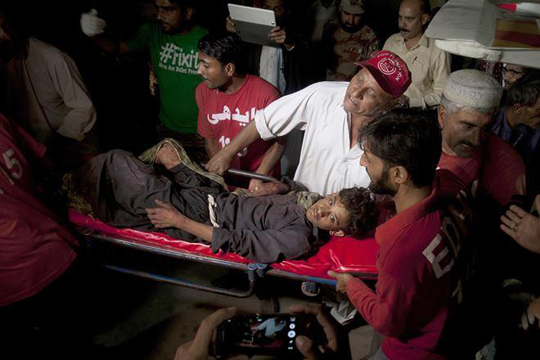
Karachi, Nov 13: At least 52 people, including women and children, were killed and more than 100 others injured today in a suicide bombing at a popular sufi shrine in Pakistan's restive Balochistan province, an attack claimed by the Islamic State terror group.
Balochistan

The blast occurred in the remote Hub region in Khuzdar district of the province while devotees were participating in a Sufi dance called "dhamaal" at Dargah Shah Noorani.

At least 52 people were killed and more than 100 have been injured in the blast, rescue officials said. Balochistan Home Minister Sarfaraz Bugti said ambulances and rescue teams had rushed to site.

"The rescue operations are going on and the casualties could rise as some people are still trapped at the place where the blast took place," Bugti said. Some local media reports put the death toll as high as 62.

The target of the attack was the area where devotees perform 'dhamaal'. The blast site is situated some 250 km away from Karachi. The blast happened when about 500 to 600 devotees were present at shrine.

Islamic State group claimed responsibility for the attack via Amaq news agency.

"35 dead and 95 wounded Shiite visitors in...operation attack by the Islamic State fighter that targeted a shrine in a city in Balochistan," the agency said.

The Express Tribune quoted police sources as saying that the blast was a suicide attack carried out by a 14-year-old boy. Colonel Junaid Kakar of the Frontier Corps also told the media that it appeared to be the work of a suicide bomber.

"All evidences point to a suicide bombing," he said. Rrescuers were facing difficulty in accessing the site as the shrine is located in a remote area. Women and children were among those killed in the blast.

"The shrine is located some 250 kilometres from Karachi in the remote mountains of Uthal and our vehicles have been dispatched there to carry out rescue operations and shift the injured to the hospitals," said Hakeen Lassi, an official of the Edhi Trust Foundation.

Local tehsildar Javed Iqbal said security arrangements at the shrine were not proper.

"It is sad that although thousands of devotees from Karachi and other parts of the country visit the shrine everyday but there are no medical emergency facilities or ambulances at the site," he said.

He said the devotees take part in the 'dhamaal' everyday after sunset and the blast took place close to where they were dancing inside the compound of the shrine.

President Mamnoon Hussain and Prime Minister Nawaz Sharif strongly condemned the bomb blast and directed authorities to speed up the rescue activities.

This is the third major incident of a bombing in the province since August. In August, about 70 people were killed in a suicide bomb attack outside the civil hospital in the provincial capital Quetta. Last month, 64 police cadets and two army men were killed when three terrorists raided a police training centre in Quetta.

Comments

Add new comment

  • Coastaldigest.com reserves the right to delete or block any comments.
  • Coastaldigset.com is not responsible for its readers’ comments.
  • Comments that are abusive, incendiary or irrelevant are strictly prohibited.
  • Please use a genuine email ID and provide your name to avoid reject.
News Network
April 10,2020

Melbourne, Apr 10: Scientists have identified six drug candidates from more than 10,000 compounds that may help treat COVID-19.

The research, published in the journal Nature, tested the efficacy of approved drugs, drug candidates in clinical trials and other compounds.

"Currently there are no targeted therapeutics or effective treatment options for COVID-19," said Professor Luke Guddat from the University of Queensland in Australia.

"In order to rapidly discover lead compounds for clinical use, we initiated a programme of high-throughput drug screening, both in laboratories and also using the latest computer software to predict how different drugs bind to the virus," Guddat said.

The project targeted the main COVID-19 virus enzyme, known as the main protease or Mpro, which plays a pivotal role in mediating viral replication, the researchers said.

This makes it an attractive drug target for this virus, and as people don't naturally have this enzyme, compounds that target it are likely to have low toxicity, they said.

"We add the drugs directly to the enzyme or to cell cultures growing the virus and assess how much of each compound is required to stop the enzyme from working or to kill the virus. If the amount is small, then we have a promising compound for further studies," said Guddat.

After assaying thousands of drugs, researchers found of the six that appear to be effective in inhibiting the enzyme, one is of particular interest.

"We're particularly looking at several leads that have been subjected to clinical trials including for the prevention and treatment of various disorders such as cardiovascular diseases, arthritis, stroke, atherosclerosis and cancer," Guddat said.

Researchers said compounds that are already along the pipeline to drug discovery are preferred, as they can be further tested as antivirals at an accelerated rate compared to new drug leads that would have to go through this process from scratch.

"With continued and up-scaled efforts we are optimistic that new candidates can enter the COVID-19 drug discovery pipeline in the near future," Guddat said.

Comments

Add new comment

  • Coastaldigest.com reserves the right to delete or block any comments.
  • Coastaldigset.com is not responsible for its readers’ comments.
  • Comments that are abusive, incendiary or irrelevant are strictly prohibited.
  • Please use a genuine email ID and provide your name to avoid reject.
News Network
May 7,2020

United Nations, May 7: An average of 80,000 COVID-19 cases were reported each day in April to the World Health Organization, the top UN health agency has said, noting that South Asian nations like India and Bangladesh are seeing a spike in the infections while the numbers are declining in regions such as Western Europe.

WHO Director-General Tedros Adhanom Ghebreyesus said on Wednesday that countries must also be able to manage any risk of the disease being imported into their territories, and communities should be fully educated to adjust to what will be a "new norm".

He said as the countries press forward in the common fight against COVID-19, they should also lay the groundwork for resilient health systems globally.

"More than 3.5 million cases of COVID-19 and almost 250,000 deaths have now been reported to the WHO. Since the beginning of April, an average of around 80,000 new cases have been reported to the WHO every day," Ghebreyesus said in Geneva yesterday.

Asserting that the virus cases were not just numbers, he said: "every single case is a mother, a father, a son, a daughter, a brother, sister or friend".

He said while the numbers are declining in Western Europe, more cases are being reported every day from Eastern Europe, Africa, South-East Asia, the Eastern Mediterranean and the Americas. Even within regions and within countries, there are divergent trends, the agency added.

While some countries are reporting an increase in COVID-19 cases over time, many have seen caseloads rise because they have ramped up testing, the WHO official said.

"We've also seen in Europe and Western Europe a fundamental decrease in the number of cases, but we have seen an associated increase in the number of cases reported in places like the Russian Federation. Southeast, the Western Pacific areas are relatively on the downward trend like Korea and others, but then we do see in South Asia, in places like Bangladesh, in India, some trends towards increase.

"So it's very difficult to say that any particular region is improving or (not improving). There are individual countries within each region that are having difficulties getting on top of this disease and I am particularly concerned about those countries that have (an) ongoing humanitarian crisis," WHO's Executive Director Michael Ryan said.

The death toll due to COVID-19 in India rose to 1,783 while the number of cases climbed to 52,952 on Thursday, registering an increase of 89 deaths and 3,561 cases in the last 24 hours, the Union Health Ministry said.

The number of active COVID-19 cases stood at 35,902 while 15,266 people have recovered, it said.

Noting that while seeing an increase in the number of cases is not good in terms of transmission, WHO's Emerging Diseases and Zoonoses Unit head Maria Van Kerkhove said: "but I don't want to equate that with something (being) wrong".

"I want to equate that with countries are working very hard to increase their ability to find the virus, to find people with the virus, to have testing in place to identify who has COVID-19, and putting into place what they need to do to care for those patients," Kerkhove said.

With more countries considering easing restrictions implemented to curb the spread of the coronavirus, the WHO has again reminded the authorities of the need to maintain vigilance.

"The risk of returning to lockdown remains very real if countries do not manage the transition extremely carefully, and in a phased approach," Ghebreyesus said.

He urged countries to consider the UN agency's six criteria for lifting stay-at-home measures.

That advice includes ensuring surveillance is strong, cases are declining and transmission is controlled. Health systems also must be able to detect, isolate, test and treat cases, and to trace all contacts.

Additionally, the risk of outbreak in settings such as health facilities and nursing homes needs to be minimised, while schools, workplaces and other public locations should have preventive measures in place.

"The COVID-19 pandemic will eventually recede, but there can be no going back to business as usual. We cannot continue to rush to fund panic but let preparedness go by the wayside," he said.

He said the crisis has highlighted the importance of strong national health systems as the foundation of global health security: not only against pandemics but also against the multitude of health threats that people across the world face every day.

"If we learn anything from COVID-19, it must be that investing in health now will save lives later," Ghebreyesus said.

While the world currently spends around USD 7.5 trillion on health annually, the WHO believes the best investments are in promoting health and preventing disease.

"Prevention is not only better than cure, it's cheaper, and the smartest thing to do," he said.

The deadly coronavirus, which originated from the Chinese city of Wuhan in December last year, has infected over 3.7 million people and killed 263,831 people globally, according to a tally by Johns Hopkins University.

Comments

Add new comment

  • Coastaldigest.com reserves the right to delete or block any comments.
  • Coastaldigset.com is not responsible for its readers’ comments.
  • Comments that are abusive, incendiary or irrelevant are strictly prohibited.
  • Please use a genuine email ID and provide your name to avoid reject.
Agencies
July 7,2020

Washington, Jul 7: The US House of Representatives Judiciary Committee will grill the CEOs of US tech giants Apple, Google, Facebook and Amazon during an antitrust hearing on July 27.

Apple's Tim Cook, Facebook's Mark Zuckerberg, Alphabet's Sundar Pichai and Amazon's Jeff Bezos will testify before the antitrust panel that is working on proposals to reform and regulate the digital market.

The hearing would mark the first time all four top executives testify together in front of Congress, virtually or in-person depending on the panel's call in the COVID-19 pandemic times.

"Since last June, the Subcommittee has been investigating the dominance of a small number of digital platforms and the adequacy of existing antitrust laws and enforcement," House Judiciary Committee Chairman Jerrold Nadler (D-NY) and Antitrust Subcommittee Chairman David Cicilline (D-RI) said in a statement on Monday.

"Given the central role these corporations play in the lives of the American people, it is critical that their CEOs are forthcoming. As we have said from the start, their testimony is essential for us to complete this investigation.”

The House Judiciary Committee announced its antitrust probe into the four tech giants in June last year.

Last month, the committee sent letters to technology giants Apple, Facebook, Amazon and Alphabet (Google's parent company), asking them to confirm if their chief executives will testify as part of the committee's tech competition investigation.

Committee chair David Cicilline said the documents that the investigators sought were "essential" to the probe and that requests like this were part of the "appropriate process" to obtain them.

"The only CEO who has expressed reservation about appearing, through a representative, has been Amazon," Cicilline said. "No one in this country is above the law ... nobody is above answering a congressional subpoena".

The lawmakers want the tech giants to furnish documents that have been produced in relation to other competition probes and internal communications.

The letters that the committee sent also posed questions related to possible harms to competition in the market.

In addition to the antitrust probe, Apple's App Store policies are also facing scrutiny from the US Department of Justice.

Comments

Add new comment

  • Coastaldigest.com reserves the right to delete or block any comments.
  • Coastaldigset.com is not responsible for its readers’ comments.
  • Comments that are abusive, incendiary or irrelevant are strictly prohibited.
  • Please use a genuine email ID and provide your name to avoid reject.