



Ban on Kambala stays as HC decides to await SC order on Jallikattu

January 30, 2017

Bengaluru, Jan 30: The interim ban on annual buffalo race Kambala in Karnataka will remain for at least another two weeks as the High Court today decided to await the Supreme Court verdict on Jallikattu pending before it.
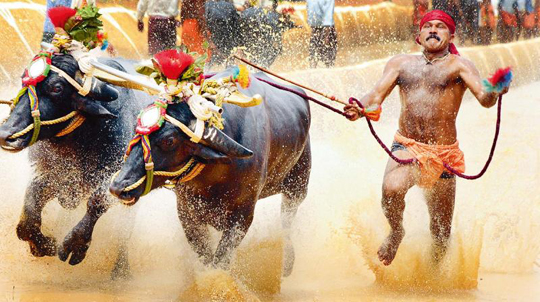
Kambalahc

"This honourable court will wait for the Supreme Court order on Jallikattu (bull taming sport) and accordingly decide on Kambala," Chief Justice Subhro Kamal Mukherjee heading a division bench said in his order.

The case was then adjourned for two weeks. The Supreme Court is scheduled to hear all Jallikattu matters tomorrow after the Centre filed a plea seeking to withdraw the January 6 notification, so as to allow the bull-taming sport in Tamil Nadu.

A bench headed by Justice Dipak Misra had allowed all the applications related to Jallikattu to be filed. A division bench of the Karnataka High Court headed by Chief Justice had in November last passed an interim order banning all Kambala races until the disposal of PIL filed by the People for the Ethical Treatment of Animals (PETA).

Reacting to the court order, Kambala Committee President Ashok Pai said they would soon decide on resuming massive protests across the state.

"We may decide to resume our protests, beginning from tomorrow itself. The only hope before us is the state government. We hope it issues the ordinance paving the way for conducting Kambala," Pai said

The interim order hit Kambala organisers who were not permitted to conduct the event held in Dakshina Kannada and Udupi districts in the coastal region.

Kambala committees had filed an interim application, seeking vacation of the stay spurred by the success of the Jallikattu stir in Tamil Nadu.

Amid continuing protests against the ban, Karnataka Cabinet on January 28 had decided to amend the Prevention of Cruelty to Animals Act to pave the way for Kambala.

The protesters are demanding an ordinance, as was done in the case of Jallikattu to permit holding of the folk sport.

The annual sport, held from November to March, involves a pair of buffaloes tied to the plough and anchored by one person. They are made to run in parallel muddy tracks in a competition in which the fastest team wins.

It is believed to be held to propitiate the Gods for a good harvest, besides being a recreational sport for farmers.

PETA, on the other hand, has been arguing that the agitators in Karnataka have taken a leaf out of the pro-Jallikattu protesters' book and begun to falsely label PETA India as 'foreign' and were now calling for banning the organisation.

Facing growing demand for holding Kambala, Chief Minister Siddaramaiah has said an ordinance could be brought in, if necessary, to allow the event after seeking legal opinion.

He had also asked the Centre to take a favourable stand on Kambala as it did on Jallikattu, where both Tamil Nadu and Central governments, after facing public pressure moved swiftly to facilitate the sport.

Comments

Rikaz
 - 
Monday, 30 Jan 2017

Kambala should be banned once and for all....ill treating animal...not good at all....animal rights groups should take action on this....

Add new comment

  • Coastaldigest.com reserves the right to delete or block any comments.
  • Coastaldigset.com is not responsible for its readers’ comments.
  • Comments that are abusive, incendiary or irrelevant are strictly prohibited.
  • Please use a genuine email ID and provide your name to avoid reject.
Ram Puniyani
February 10,2020

Noam Chomsky is one of the leading peace workers in the world. In the wake of America’s attack on Vietnam, he brought out his classic formulation, ‘manufacturing consent’. The phrase explains the state manipulating public opinion to have the public approve of it policies—in this case, the attack of the American state on Vietnam, which was then struggling to free itself from French colonial rule.

In India, we are witness to manufactured hate against religious minorities. This hatred serves to enhance polarisation in society, which undermines India’s democracy and Constitution and promotes support for a Hindu nation. Hate is being manufactured through multiple mechanisms. For example, it manifests in violence against religious minorities. Some recent ghastly expressions of this manufactured hate was the massive communal violence witnessed in Mumbai (1992-93), Gujarat (2002), Kandhamal (2008) and Muzaffarnagar (2013). Its other manifestation was in the form of lynching of those accused of having killed a cow or consumed beef. A parallel phenomenon is the brutal flogging, often to death, of Dalits who deal with animal carcasses or leather.

Yet another form of this was seen when Shambhulal Regar, indoctrinated by the propaganda of Hindu nationalists, burned alive Afrazul Khan and shot the video of the heinous act. For his brutality, he was praised by many. Regar was incited into the act by the propaganda around love jihad. Lately, we have the same phenomenon of manufactured hate taking on even more dastardly proportions as youth related to Hindu nationalist organisations have been caught using pistols, while police authorities look on.

Anurag Thakur, a BJP minster in the central government recently incited a crowd in Delhi to complete his chant of what should happen to ‘traitors of the country...” with a “they should be shot”. Just two days later, a youth brought a pistol to the site of a protest at Jamia Millia Islamia university and shouted “take Azaadi!” and fired it. One bullet hit a student of Jamia. This happened on 30 January, the day Nathuram Godse had shot Mahatma Gandhi in 1948. A few days later, another youth fired near the site of protests against the CAA and NRC at Shaheen Bagh. Soon after, he said that in India, “only Hindus will rule”.

What is very obvious is that the shootings by those associated with Hindu nationalist organisations are the culmination of a long campaign of spreading hate against religious minorities in India in general and against Muslims in particular. The present phase is the outcome of a long and sustained hate campaign, the beginning of which lies in nationalism in the name of religion; Muslim nationalism and Hindu nationalism. This sectarian nationalism picked up the communal view of history and the communal historiography which the British introduced in order to pursue their ‘divide and rule’ policy.

In India what became part of “social common sense” was that Muslim kings had destroyed Hindu temples, that Islam was spread by force, and that it is a foreign religion, and so on. Campaigns, such as the one for a temple dedicated to the Hindu god Rama to be built at the site where the Babri masjid once stood, further deepened the idea of a Muslim as a “temple-destroyer”. Aurangzeb, Tipu Sultan and other Muslim kings were tarnished as the ones who spread Islam by force in the subcontinent. The tragic Partition, which was primarily due to British policies, and was well-supported by communal streams also, was entirely attributed to Muslims. The Kashmir conflict, which is the outcome of regional, ethnic and other historical issues, coupled with the American policy of supporting Pakistan’s ambitions of regional hegemony, (which also fostered the birth of Al-Qaeda), was also attributed to the Muslims.

With recurring incidents of communal violence, these falsehoods went on going deeper into the social thinking. Violence itself led to ghettoisation of Muslims and further broke inter-community social bonds. On the one hand, a ghettoised community is cut off from others and on the other hand the victims come to be presented as culprits. The percolation of this hate through word-of-mouth propaganda, media and re-writing of school curricula, had a strong impact on social attitudes towards the minorities.

In the last couple of decades, the process of manufacturing hate has been intensified by the social media platforms which are being cleverly used by the communal forces. Swati Chaturvedi’s book, I Am a Troll: Inside the Secret World of the BJP’s Digital Army, tells us how the BJP used social media to spread hate. Whatapp University became the source of understanding for large sections of society and hate for the ‘Other’, went up by leaps and bounds. To add on to this process, the phenomenon of fake news was shrewdly deployed to intensify divisiveness.

Currently, the Shaheen Bagh movement is a big uniting force for the country; but it is being demonised as a gathering of ‘anti-nationals’. Another BJP leader has said that these protesters will indulge in crimes like rape. This has intensified the prevalent hate.

While there is a general dominance of hate, the likes of Shambhulal Regar and the Jamia shooter do get taken in by the incitement and act out the violence that is constantly hinted at. The deeper issue involved is the prevalence of hate, misconceptions and biases, which have become the part of social thinking.

These misconceptions are undoing the amity between different religious communities which was built during the freedom movement. They are undoing the fraternity which emerged with the process of India as a nation in the making. The processes which brought these communities together broadly drew from Gandhi, Bhagat Singh and Ambedkar. It is these values which need to be rooted again in the society. The communal forces have resorted to false propaganda against the minorities, and that needs to be undone with sincerity.

Combating those foundational misconceptions which create hatred is a massive task which needs to be taken up by the social organisations and political parties which have faith in the Indian Constitution and values of freedom movement. It needs to be done right away as a priority issue in with a focus on cultivating Indian fraternity yet again.

Comments

Add new comment

  • Coastaldigest.com reserves the right to delete or block any comments.
  • Coastaldigset.com is not responsible for its readers’ comments.
  • Comments that are abusive, incendiary or irrelevant are strictly prohibited.
  • Please use a genuine email ID and provide your name to avoid reject.
News Network
August 6,2020

Chennai, Aug 5: Karnataka on Wednesday crossed the 1.5 lakh mark in respect of COVID-19 cases and Kerala was on the verge of 30,000 while Andhra Pradesh witnessed a five- digit daily caseload after a lull. 

Tamil Nadu saw a small jump in its daily cases as compared to Tuesday while Telangana and union territory Puducherry reported their respective record single-day spikes. 

The five states and the union territory reported a combined 24,415 fresh confirmed coronavirus cases and 316 fatalities on Wednesday. 

A Puducherry Minister tested positive for the deadly virus while an opposition AINRC legislator who contracted the coronavirus earlier was discharged after being cured of it. 

In Karnataka, the coronavirus cases stood at 1,51,449 with the addition of 5,619 fresh cases while 100 deaths were reported, pushing the total fatalities to 2,804, the health department said.

According to a health bulletin, 74,679 persons have been discharged so far, leaving 73,958 active cases. Andhra Pradesh''s COVID-19 surge continued on Wednesday too, with 10,128 cases reported afresh after easing a little in the last four days. 

The overall tally rose to 1,86,461 on Wednesday. The state had last reported its five-figure daily tally on July 31 when it was 10,376. 

The state also saw a record number of 77 coronavirus deaths in a day, pushing the toll to 1,681, the latest bulletin said. 

In the last 24 hours, 8,729 patients had also recovered from the infection and there were 80,426 active cases. 

As many as 1,04,354 patients have been cured and discharged so far. Kerala was on the verge of 30,000 cases, as its tally stood at 29,145 with the addition of 1,195 new COVID-19 cases on Wednesday.

The toll from the virus so far climbed to 94 with seven more deaths. Thiruvananthapuram continued to top the districts in infections with 274 cases on Wednesday, of whom 248 had been infected through contact. 

Malappuram (167), Kasaragod (128), Ernakulam (120) and Alappuzha (108) reported over 100 cases. As many as 112 patients died of COVID-19 in Tamil Nadu, the highest reported in a single day so far, taking the toll to 4,461 on Wednesday while 5,175 more people tested positive, propelling the case count to 2.73 lakh.

Recoveries outnumbered fresh cases with 6,031 people getting discharged from various hospitals, taking the total cured to 2,14,815 as the active cases dropped to 54,184, a government bulletin said. 

In Telangana, 2,012 new cases emerged while 13 related fatalities were reported, taking the total infection tally in the state to 70,958. Out of the new cases, 532 were from the Greater Hyderabad Municipal Corporation (GHMC), followed by Medchal-Malkajgiri 198 and Rangareddy 188, a state government bulletin said on Wednesday, providing data as of 8 PM on August 4. 

The total number of people who recovered from the infectious disease touched 50,814, while 19,568 were under treatment.

The COVID-19 fatality rate in the state was 0.81 per cent, while it was 2.10 per cent at the national level, it said. The recovery rate was 71.6 per cent in the state, while it was 66.31 per cent in the country, it added. 

Puducherry clocked its worst single-day spike of 286 infections, recording seven deaths, even as the overall tally of cases went up to 4,432. 

The deaths during the 24 hours in the Union Territory took the toll to 65 so far since the outbreak of the virus, Health Minister Malladi Krishna Rao told a virtual press conference. 

His cabinet colleague M Kandasamy and his son reported positive for the virus and were admitted to JIPMER.

Comments

Add new comment

  • Coastaldigest.com reserves the right to delete or block any comments.
  • Coastaldigset.com is not responsible for its readers’ comments.
  • Comments that are abusive, incendiary or irrelevant are strictly prohibited.
  • Please use a genuine email ID and provide your name to avoid reject.