Bapu's Charkha among 100 'Most Influential Photos of All Time'

November 30, 2016

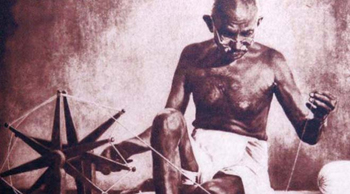
New York, Nov 30: A 1946 picture of Mahatma Gandhi with his Charkha (spinning wheel) in the foreground is among the 100 most influential images of all time, according to a compilation by Time magazine of "images that changed the world."

gandhiThe black and white photo of a bespectacled Gandhi taken by Margaret Bourke-White shows Gandhi sitting on a thin mattress on the floor, head bent down as he is reading the news while his spinning wheels sits in the foreground.

The picture was taken for an article on India's leaders but less than two years later it was featured prominently in a tribute published after Gandhi's assassination.

"It soon became an indelible image, the slain civil- disobedience crusader with his most potent symbol, and helped solidify the perception of Gandhi outside the subcontinent as a saintly man of peace," Time said.

The Time collection includes 100 of the most iconic and history-altering images, dating from the 1820s to 2015 that have remained engrained in the human psyche from the time they were taken.

Among the pictures is the tragic photo of the lifeless body of three-year old Syrian Alan Kurdi lying face down on the shore near the coastal town of Bodrum, the 2011 Situation Room photo where US President Barack Obama and his team of senior officials watching the secret operation to kill Osama Bin Laden in real time.

The 2001 image of man falling from the Twin Towers in a desperate attempt to save his life as well as the 1993 heart-renching photo of an emaciated toddler being stared at by a vulture as the young boy collapsed on the way to a feeding centre in famine-ravaged Sudan.

Comments

Add new comment

  • Coastaldigest.com reserves the right to delete or block any comments.
  • Coastaldigset.com is not responsible for its readers’ comments.
  • Comments that are abusive, incendiary or irrelevant are strictly prohibited.
  • Please use a genuine email ID and provide your name to avoid reject.
Agencies
January 10,2020

Indian enterprises were flooded with a whopping 14.6 crore malware threats in 2019 - a growth of 48 per cent (year-on-year) compared to 2018, a new report said on Friday.

Manufacturing, BFSI (banking, financial services and insurance), education, healthcare, IT/ITES, and the government were the most at-risk industries in the country, said the report from Seqrite, the enterprise arm of Pune-based IT security firm Quick Heal Technologies.

Interestingly, almost a quarter (23 per cent) of the threats were identified through 'Signatureless behaviour-based' detection by Seqrite, indicating how a growing number of cybercriminals were deploying new or previously unknown threat vectors to compromise enterprise security.

"With the latest Seqrite annual threat report, we want to empower CIOs, CISOs, business leaders and all key public stakeholders with the insights they need to combat the growing complexity of the threat landscape," said Sanjay Katkar, Joint Managing Director and CTO, Quick Heal Technologies.

The most prominent trend was the drastic increase in the volume, intensity, and sophistication of cyber-attack campaigns targeting Indian enterprises in 2019.

The rapid integration of IoT devices, BYOD (bring your own device), and third-party APIs into enterprise networks has created newer security vulnerabilities that might go unnoticed until a major breach occurs.

Threat researchers at Seqrite observed several large-scale advanced persistent threats (APT) attacks deployed against organisations in the government sector.

"The entry of nation-states and organised cybercrime cells into the fray is expected to add more complication to this situation and will require Indian government bodies and corporate enterprises to shore up their cyber defence strategies in 2020 and beyond," the report noted.

More alarming, however, was the continued lack of security awareness amongst enterprises and government organisations.

"Unsecured Remote Desktop Protocol (RDP) and Server Message Block (SMB) protocols continued to be targeted through brute-force attacks," said the report.

Spear phishing attack campaigns leveraging Office exploits and infected macros were also used extensively by cybercriminals to gain access to enterprise networks and steal critical data.

"India's digital journey depends on ensuring robust cybersecurity for all stakeholders within the enterprise ecosystem," said Katkar.

The sharp spike should be a cause of concern for CIOs and CISOs in the country, especially given the growing digital penetration within their enterprise networks.

"With network vulnerabilities and potential entry points increasing at a rapid pace, threat actors are expected to leverage artificial intelligence (AI) capabilities to power their malware campaigns in the future to capitalise on newer attack vectors," the report added.

Comments

Add new comment

  • Coastaldigest.com reserves the right to delete or block any comments.
  • Coastaldigset.com is not responsible for its readers’ comments.
  • Comments that are abusive, incendiary or irrelevant are strictly prohibited.
  • Please use a genuine email ID and provide your name to avoid reject.
News Network
February 5,2020

Feb 5: Tesla is making Elon Musk a lot richer without paying him a dime.

A blistering stock rally has bolstered the value of CEO Musk's 19% stake in the electric car maker by $16 billion since the start of 2020, to $30 billion.

Tuesday's steep climb in the share price could sweeten Musk's payday under his record-breaking compensation package, which is built on stock options that rely on market value targets. Two milestones have now been achieved that could see Musk unlock options worth $1.8 billion.

The controversial chief executive, who is also the majority owner and CEO of rocket maker SpaceX, recently testified that he did not have a lot of cash as he successfully defended himself in a defamation lawsuit. He previously has taken loans using his Tesla shares as collateral.

Musk does not take a salary, choosing instead a risky options package that envisions the stock market value of Tesla rising to $650 billion over 10 years, a prospect that was derided by some investors when the deal was announced in 2018.

That target now looks less crazy. Shares of Tesla have rallied over 50% since the company posted its second consecutive quarterly profit last Wednesday, which was viewed as a major accomplishment for a company competing against established automotive heavyweights including General Motors Co  and BMW.

Tesla shares have climbed about 400% since early June, helped by the company's better-than-expected financial results and ramped-up production at its new car factory in Shanghai.

On Tuesday, Tesla surged as much as 24% before falling back in the final minutes of the trading session to end the day up 13.7%. That put its market capitalization at $160 billion, almost twice the combined value of Ford Motor and General Motors.

The shares had also rallied on Monday, partly fueled by Panasonic Corp's 6752.T saying its automotive battery venture with Tesla was profitable for the first time.

The options Musk was awarded in 2018 vest incrementally based on targets for Tesla's stock market value and its financial performance. The market capitalization would have to sustainably rise by $50 billion increments over the agreement's 10-year period, with the full package payout reached if the market cap reaches $650 billion, as well as the company's meeting revenue and profit targets.

Musk is on his way to seeing his first two tranches of options vest. He achieved operational targets on revenue and adjusted earnings last year.

The rise in Tesla's market capitalization last month to a target of $100 billion opened the way for Musk's first tranche of options to vest. With Tuesday's surging share price, the market capitalization blew past the second target of $150 billion, opening the way for the second tranche to vest. Tesla's market capitalization must stay at or above each target level for one- and six-month averages for each set of options to vest.

Tesla was valued at about $52 billion when shareholders approved the pay package in March 2018, a time when the company faced a cash crunch, production delays and increasing competition from rivals.

A full payoff for Musk would surpass anything previously granted to U.S. executives, according to Institutional Shareholder Services, a proxy advisor that recommended investors reject the pay package deal at the time.

Musk currently owns about 34 million Tesla shares, and his compensation package would let him buy another 20.3 million shares if all his options tranches vest.

When Tesla unveiled Musk’s package, it said he could in theory reap as much as $55.8 billion if no new shares were issued. However, Tesla has since awarded stock to employees and last year sold $2.7 billion in shares and convertible bonds, diluting the value of the stock.

Musk has transformed Tesla from a niche car maker with production problems into the global leader in electric vehicles, with U.S. and Chinese factories. So far it has stayed ahead of more established rivals including BMW and Volkswagen.

Many investors remain skeptical that Tesla can consistently deliver profit, cash flow and growth. More Wall Street analysts rate Tesla "sell" than "buy," and the company's stock is the most shorted on Wall Street.


Comments

Add new comment

  • Coastaldigest.com reserves the right to delete or block any comments.
  • Coastaldigset.com is not responsible for its readers’ comments.
  • Comments that are abusive, incendiary or irrelevant are strictly prohibited.
  • Please use a genuine email ID and provide your name to avoid reject.
Agencies
July 11,2020

Citing the current dismal aviation scenario, Air India is terminating the services of trainee cabin crew and cabin crew by withdrawing the offer of employment of those who were under training.

As per sources, the new crew and trainee pilots might reduce contracts from five years to one year. Sources said Air India is terminating 1,200 crew and employees who are more than 55-yr-old including 190 trainee pilots.

In a letter reviewed by IANS, Air India has informed an applicant who had been selected as cabin crew in August 2019 subject to successful completion of training.

"On behalf of Air India we would like to thank you for the interest shown by you in joining our organization. However, in view of the current aviation scenario, it would not be possible for Air India to impart any further training to you for engaging your services," the company said.

"In view of the above reasons, which are beyond the control of the company, it has been decided to discontinue your training arrangements and dispense with the offer of engagement with immediate effect. The bank guarantee furnished by you at the time of joining is returned herewith," Air India told the cabin crew.

"Once again on behalf of Air India we thank you for your cooperation and trust that you will appreciate the circumstances under which we are constrained to discontinue the training arrangements," the carrier said.

Comments

Add new comment

  • Coastaldigest.com reserves the right to delete or block any comments.
  • Coastaldigset.com is not responsible for its readers’ comments.
  • Comments that are abusive, incendiary or irrelevant are strictly prohibited.
  • Please use a genuine email ID and provide your name to avoid reject.