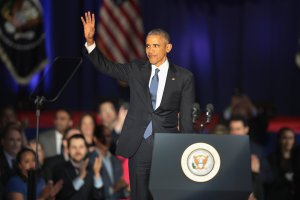
Barack Obama delivers farewell speech, says `we rise or fall as one`

January 11, 2017

Illinois, Jan 11: President Barack Obama warned on Tuesday that the United States faces a stern test of its democracy, in a speech to the nation that was both a fond goodbye and a call to arms.

farewellCapping his eight years in office, Obama returned to his adoptive hometown of Chicago to recast his "yes we can" campaign credo as "yes we did."

He also called on supporters to pick up the torch and forge a new "social compact".

"Democracy does require a basic sense of solidarity," he said. "For all our outward differences, we are all in this together," he said. "We rise or fall as one."

Comments

Add new comment

  • Coastaldigest.com reserves the right to delete or block any comments.
  • Coastaldigset.com is not responsible for its readers’ comments.
  • Comments that are abusive, incendiary or irrelevant are strictly prohibited.
  • Please use a genuine email ID and provide your name to avoid reject.
Agencies
April 28,2020

United Nations, Apr 28: UN chief Antonio Guterres has warned that extremist groups are taking advantage of the COVID-19 lockdowns and intensifying efforts on social media to recruit youths online by exploiting their anger and despair, asserting that the world cannot afford a lost generation due to the unprecedented global health crisis.

The UN Secretary-General made the remarks on Monday during a video conference to review the five years since its adoption of a landmark resolution on youth, peace and security.

We can already see such groups taking advantage of the COVID-19 lockdowns, intensifying their efforts on social media to spread hatred and to recruit young people who may be spending more time at home and online, he said.

Guterres told the Security Council that even before the current crisis, young people were facing enormous challenges.

Listing startling numbers, he said one of every five young people was already not in education, training or employment and one of every four is affected by violence or conflict. Every year, 12 million girls become mothers while they themselves are still children.

These frustrations and, frankly, failures to address them by those in power today, fuel declining confidence in political establishments and institutions. And when such a cycle takes hold, it is all too easy for extremist groups to exploit the anger and despair, and the risk of radicalisation climbs, he said.

Issuing a call to action on youth, peace and security, Guterres said the world cannot afford a lost generation of youth, their lives set back by COVID-19 and their voices stifled by a lack of participation. Let us do far more to tap their talents as we tackle the pandemic and chart a recovery that leads to a more peaceful, sustainable and equitable future for all.

With over 1.54 billion children and youth out-of-school and young people acutely feeling the impact of the COVID-19 crisis, Guterres said countries must do more to harness the talents of young people to address the crisis and its aftermath.

In presenting his first report on the Security Council resolution, the UN chief said youth were already confronting numerous challenges even before the pandemic, including in accessing education, or through being affected by violence and conflict. Those pressing for peace or upholding human rights have been threatened.

Despite these obstacles, young people across the world have joined the common fight against the coronavirus disease, supporting both frontline workers and people in need. And they continue to push for change.

UN Youth Envoy Jayathma Wickramanayake spoke of the need for more meaningful partnerships between young people and the civil society organisations and government institutions that work on the youth, peace and security (YPS) agenda.

To date, there are no national action plans on YPS but I'm pleased to note that in some countries, these are in the process of development, she said.

For a national roadmap to be successful, a participatory, transparent and youth-led process with adequate resources are needed, she said.

Issuing his four-point call to action for the Council, Guterres urged members to do more to address the various challenges facing young people.

He also called for investment in youth participation, but also in their organisations and initiatives.

We must strengthen human rights protections and protect the civic space on which youth participation depends, he said. And fourth, we must emerge from the COVID-19 crisis with a determination to recover better - massively increasing our investment in young people's capacities as we deliver the Sustainable Development Goals.

Comments

Add new comment

  • Coastaldigest.com reserves the right to delete or block any comments.
  • Coastaldigset.com is not responsible for its readers’ comments.
  • Comments that are abusive, incendiary or irrelevant are strictly prohibited.
  • Please use a genuine email ID and provide your name to avoid reject.
Agencies
July 1,2020

The ILO has warned that if another Covid-19 wave hits in the second half of 2020, there would be global working-hour loss of 11.9 percent - equivalent to the loss of 340 million full-time jobs.

According to the 5th edition of International Labour Organisation (ILO) Monitor: Covid-19 and the world of work, the recovery in the global labour market for the rest of the year will be uncertain and incomplete.

The report said that there was a 14 percent drop in global working hours during the second quarter of 2020, equivalent to the loss of 400 million full-time jobs.

The number of working hours lost across the world in the first half of 2020 was significantly worse than previously estimated. The highly uncertain recovery in the second half of the year will not be enough to go back to pre-pandemic levels even in the best scenario, the agency warned.

The baseline model – which assumes a rebound in economic activity in line with existing forecasts, the lifting of workplace restrictions and a recovery in consumption and investment – projects a decrease in working hours of 4.9 percent (equivalent to 140 million full-time jobs) compared to last quarter of 2019.

It says that in the pessimistic scenario, the situation in the second half of 2020 would remain almost as challenging as in the second quarter.

“Even if one assumes better-tailored policy responses – thanks to the lessons learned throughout the first half of the year – there would still be a global working-hour loss of 11.9 per cent at the end of 2020, or 340 million full-time jobs, relative to the fourth quarter of 2019,” it said.

The pessimistic scenario assumes a second pandemic wave and the return of restrictions that would significantly slow recovery. The optimistic scenario assumes that workers’ activities resume quickly, significantly boosting aggregate demand and job creation. With this exceptionally fast recovery, the global loss of working hours would fall to 1.2 per cent (34 million full-time jobs).

The agency said that under the three possible scenarios for recovery in the next six months, “none” sees the global job situation in better shape than it was before lockdown measures began.

“This is why we talk of an uncertain but incomplete recovery even in the best of scenarios for the second half of this year. So there is not going to be a simple or quick recovery,” ILO Director-General Guy Ryder said.

The new figures reflect the worsening situation in many regions over the past weeks, especially in developing economies. Regionally, working time losses for the second quarter were: Americas (18.3 percent), Europe and Central Asia (13.9 percent), Asia and the Pacific (13.5 percent), Arab States (13.2 percent), and Africa (12.1 percent).

The vast majority of the world’s workers (93 per cent) continue to live in countries with some sort of workplace closures, with the Americas experiencing the greatest restrictions.

During the first quarter of the year, an estimated 5.4 percent of global working hours (equivalent to 155 million full-time jobs) were lost relative to the fourth quarter of 2019. Working- hour losses for the second quarter of 2020 relative to the last quarter of 2019 are estimated to reach 14 per cent worldwide (equivalent to 400 million full-time jobs), with the largest reduction (18.3 per cent) occurring in the Americas.

The ILO Monitor also found that women workers have been disproportionately affected by the pandemic, creating a risk that some of the modest progress on gender equality made in recent decades will be lost, and that work-related gender inequality will be exacerbated.

The severe impact of Covid-19 on women workers relates to their over-representation in some of the economic sectors worst affected by the crisis, such as accommodation, food, sales and manufacturing.

Globally, almost 510 million or 40 percent of all employed women work in the four most affected sectors, compared to 36.6 percent of men, it said.

The report said that women also dominate in the domestic work and health and social care work sectors, where they are at greater risk of losing their income and of infection and transmission and are also less likely to have social protection.

The pre-pandemic unequal distribution of unpaid care work has also worsened during the crisis, exacerbated by the closure of schools and care services.

Even as countries have adopted policy measures with unprecedented speed and scope, the ILO Monitor highlights some key challenges ahead, including finding the right balance and sequencing of health, economic and social and policy interventions to produce optimal sustainable labour market outcomes; implementing and sustaining policy interventions at the necessary scale when resources are likely to be increasingly constrained and protecting and promoting the conditions of vulnerable, disadvantaged and hard-hit groups to make labour markets fairer and more equitable.

“The decisions we adopt now will echo in the years to come and beyond 2030. Although countries are at different stages of the pandemic and a lot has been done, we need to redouble our efforts if we want to come out of this crisis in a better shape than when it started,” Ryder said. 

Comments

Add new comment

  • Coastaldigest.com reserves the right to delete or block any comments.
  • Coastaldigset.com is not responsible for its readers’ comments.
  • Comments that are abusive, incendiary or irrelevant are strictly prohibited.
  • Please use a genuine email ID and provide your name to avoid reject.
News Network
April 19,2020

Washington, Apr 19: President Donald Trump has expressed his doubts over the official Chinese figures on the number of deaths in their country due to the novel coronavirus pandemic, claiming that the fatalities were way ahead of the US.

Trump's comments come two days after another 1,300 fatalities were added to the official count in the city of Wuhan, where the outbreak started. The revision puts China's overall death toll to more than 4,600.

"We are not number one; China is number one just so you understand," Trump told reporters at a White House news conference on Saturday. "They are way ahead of us in terms of death. It's not even close."

According to Trump, when highly-developed healthcare systems of the UK, France, Belgium, Italy and Spain had high fatality rates, it was O.33 in China.

The president asserted that the actual number was much more than the official Chinese death toll figures, which he said were "unrealistic".

"You know it, I know it and they know it, but you don't want to report it. Why?" he asked. "You will have to explain that. Someday I will explain it."

He also highlighted that on a per-capita basis, the mortality rate in the US was far lower than other nations of Western Europe.

Comments

Add new comment

  • Coastaldigest.com reserves the right to delete or block any comments.
  • Coastaldigset.com is not responsible for its readers’ comments.
  • Comments that are abusive, incendiary or irrelevant are strictly prohibited.
  • Please use a genuine email ID and provide your name to avoid reject.