


Barack Obama 'Not Optimistic' On Syria As Aleppo Pummelled

November 21, 2016

Damascus/Syria, Nov 21: US President Barack Obama said he is "not optimistic" about Syria's future, as the UN warned time is running out to avoid a humanitarian catastrophe in Aleppo which has been pounded by air strikes for nearly a week.
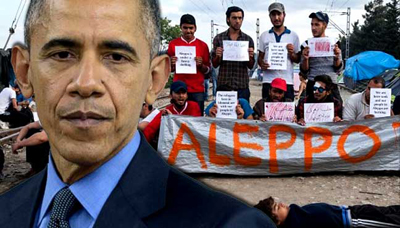
obamaGovernment forces launched a ferocious assault last Tuesday to recapture eastern Aleppo, killing 115 civilians so far. In fresh fighting on Sunday at least eight children died when rebel rocket fire hit their school in the government-controlled west.

Obama warned that Syria's second city was likely to fall, and that Russian and Iranian backing for Syrian leader Bashar al Assad had made the situation untenable for the opposition.

"I am not optimistic about the short-term prospects in Syria," he said Sunday at a summit of Pacific leaders in Lima.

"Once Russia and Iran made a decision to back Assad in a brutal air campaign... it was very hard to see a way in which even a trained and committed moderate opposition could hold its ground for long periods of time."

Obama earlier Sunday urged greater efforts to end the violence when he met Russian President Vladimir Putin at the Asia-Pacific Economic Cooperation forum.

But in Damascus, UN envoy Staffan de Mistura was rebuffed on a truce proposal that would allow the opposition to administer the city's rebel-held east.

"We are running out of time, we are running against time," de Mistura said after meeting Foreign Minister Walid Muallem.

Muallem said he had rejected the proposal, under which jihadist forces would leave and the government would recognise the opposition administration in the east which has been bombarded by air strikes, barrel bombs and artillery.

"How is it possible that the UN wants to reward terrorists?" he asked.

Aid agencies fear that instead of a humanitarian or a political initiative there will be "an acceleration of military activities" in eastern Aleppo and elsewhere, de Mistura told journalists.

"By Christmas... due to military intensification, you will have the virtual collapse of what is left in eastern Aleppo; you may have 200,000 people moving towards Turkey -- that would be a humanitarian catastrophe."

'War crimes'

On Sunday, rebels retaliated with a barrage of rockets into government-held western Aleppo, state media said, hitting a primary school and killing at least eight children.

Syrian television showed bloodied and weeping children being treated in hospital, and an AFP journalist saw pupils being rushed from the school after the attack.

But regime forces broke through into the city's northeastern area of Massaken Hanano, sparking fierce clashes, the Syrian Observatory for Human Rights said.

It also reported heavy fighting as the army sought to gain ground in two eastern neighbourhoods.

The Britain-based monitoring group said at least 19 civilians including five children were killed in the east on Sunday. That brought to 115 the number of civilians killed since the bombardment resumed.

UN chief Ban Ki-moon condemned the indiscriminate shelling, saying it had killed and maimed civilians, destroyed schools and left the city's east without functioning hospitals.

"The Secretary-General reminds all parties to the conflict that targeting civilians and civilian infrastructure is a war crime," his office said in a statement.

"Those responsible for these and other atrocities in Syria, whoever and wherever they are, must one day be brought to account."

On Monday the UN Security Council is scheduled to meet in New York to discuss humanitarian efforts in Syria. Last week it decided to extend for another year a probe into chemical attacks in the country and who is responsible.

The regime offensive on eastern Aleppo has forced hospitals and schools to close and destroyed facilities for hard-pressed rescue workers.

Shelling on Friday destroyed one of the last hospitals there and staff were also forced to evacuate the area's only children's hospital because of repeated attacks.

Russia, which intervened militarily last year, says it is not involved in the current assault on Aleppo, and is instead concentrating its firepower on opposition and jihadist forces in neighbouring Idlib province.

But Damascus and its allies have made clear they want rebels expelled from eastern Aleppo, which fell from regime control in mid-2012.

More than 250,000 people remain in eastern Aleppo, which has been sealed off since government forces surrounded it in mid-July. No aid has entered the east since then and the siege has created food and fuel shortages.

More than 300,000 people have been killed in Syria since the conflict began with anti-government protests in March 2011.

Comments

Add new comment

  • Coastaldigest.com reserves the right to delete or block any comments.
  • Coastaldigset.com is not responsible for its readers’ comments.
  • Comments that are abusive, incendiary or irrelevant are strictly prohibited.
  • Please use a genuine email ID and provide your name to avoid reject.
Agencies
August 4,2020

Washington, Aug 4: US President Donald Trump gave popular Chinese-owned video app TikTok six weeks to sell its US operations to an American company, saying Monday it would be "out of business" otherwise, and that the government wanted a financial benefit from the deal.

"It's got to be an American company... it's got to be owned here," Trump said. "We don't want to have any problem with security."

Trump said that Microsoft was in talks to buy TikTok, which has as many as one billion worldwide users who make quirky 60-second videos with its smartphone app.

But US officials say the app constitutes a national security risk because it could share millions of Americans' personal data with Chinese intelligence.

Trump gave the company's Chinese parent ByteDance until mid-September to strike a deal.

"I set a date of around September 15, at which point it's going to be out of business in the United States," he said.

Whatever the price is, he said, "the United States should get a very large percentage of that price because we're making it possible."

Trump compared the demand for a piece of the pie to a landlord demanding under-the-table "key money" from a new tenant, a practice widely illegal including in New York, where the billionaire president built his real estate empire.

"TikTok is a big success, but a big portion of it is in the country," he said. "I think it's very fair."

But Trump also threw a surprise new condition in any deal, saying the sale of TikTok's US business would have to result in a significant payout to the US Treasury for initiating it.

"A very substantial portion of that price is going to have to come into the Treasury of the United States, because we're making it possible for this deal to happen," Trump told reporters.

"They don't have any rights unless we give it to them," he said.

Sell or shut down

The pressure for a sale of TikTok's US and international business, based in Los Angeles, left the company and ByteDance facing tough decisions.

Trump has made TikTok the latest front in the ongoing political and trade battles between Washington and Beijing.

The app has been under formal investigation on US national security grounds because it collects large amounts of personal data on all its users and is legally bound to share that with authorities in Beijing if they demand it.

Both its huge user base and its algorithm for collecting data make it hugely valuable.

But being forced by the US government to sell at least its US business or be shut down -- and to then split the sale price with the US Treasury as Trump is demanding -- was an almost unheard-of tactic.

Shutting down could force users to switch to competitors, and many content creators are already encouraging followers to follow them on other social media platforms.

"The most obvious beneficiaries are Snapchat, Facebook and Twitter, with Snapchat likely being the biggest beneficiary," said investment analysts at Lightshed Partners.

Earlier Monday, ByteDance founder Zhang Yiming acknowledged the hefty pressure and said in a letter to staff, reported by Chinese media, that they were working around-the-clock "for the best outcome."

"We have always been committed to ensuring user data security, as well as the platform neutrality and transparency," Zhang said.

However, he said, the company faces "mounting complexities across the geopolitical landscape and significant external pressure."

He said the company must confront the challenge from the United States, though "without giving up exploring any possibilities."

According to Britain's The Sun newspaper Monday, as a possible consequence of the pressure, ByteDance is planning to relocate TikTok's global operations to Britain.

Pushing back

China's foreign ministry pushed back Monday, calling Washington hypocritical for demanding TikTok be sold.

"The US is using an abused concept of national security and, without providing any evidence, is making presumptions of guilt and issuing threats to relevant companies," said spokesman Wang Wenbin.

"This goes against the principle of market economy and exposes the hypocrisy and typical double standards of the US in upholding so-called fairness and freedom," he added.

stm88 info live rtp slot

slot auto scatter hitam

Comments

Add new comment

  • Coastaldigest.com reserves the right to delete or block any comments.
  • Coastaldigset.com is not responsible for its readers’ comments.
  • Comments that are abusive, incendiary or irrelevant are strictly prohibited.
  • Please use a genuine email ID and provide your name to avoid reject.
News Network
May 19,2020

May 19: A Chinese laboratory has been developing a drug it believes has the power to bring the coronavirus pandemic to a halt.

The outbreak first emerged in China late last year before spreading across the world, prompting an international race to find treatments and vaccines.

A drug being tested by scientists at China's prestigious Peking University could not only shorten the recovery time for those infected, but even offer short-term immunity from the virus, researchers say.

Sunney Xie, director of the university's Beijing Advanced Innovation Center for Genomics, told AFP that the drug has been successful at the animal testing stage.

"When we injected neutralising antibodies into infected mice, after five days the viral load was reduced by a factor of 2,500," said Xie.

"That means this potential drug has (a) therapeutic effect."

The drug uses neutralising antibodies -- produced by the human immune system to prevent the virus infecting cells -- which Xie's team isolated from the blood of 60 recovered patients.

A study on the team's research, published Sunday in the scientific journal Cell, suggests that using the antibodies provides a potential "cure" for the disease and shortens recovery time.

Xie said his team had been working "day and night" searching for the antibody.

"Our expertise is single-cell genomics rather than immunology or virology. When we realised that the single-cell genomic approach can effectively find the neutralising antibody we were thrilled."

He added that the drug should be ready for use later this year and in time for any potential winter outbreak of the virus, which has infected 4.8 million people around the world and killed more than 315,000.

"Planning for the clinical trial is underway," said Xie, adding it will be carried out in Australia and other countries since cases have dwindled in China, offering fewer human guinea pigs for testing.

"The hope is these neutralised antibodies can become a specialised drug that would stop the pandemic," he said.

China already has five potential coronavirus vaccines at the human trial stage, a health official said last week.

But the World Health Organization has warned that developing a vaccine could take 12 to 18 months.

Scientists have also pointed to the potential benefits of plasma -- a blood fluid -- from recovered individuals who have developed antibodies to the virus enabling the body's defences to attack it.

More than 700 patients have received plasma therapy in China, a process which authorities said showed "very good therapeutic effects".

"However, it (plasma) is limited in supply," Xie said, noting that the 14 neutralising antibodies used in their drug could be put into mass production quickly.

Using antibodies in drug treatments is not a new approach, and it has been successful in treating several other viruses such as HIV, Ebola and Middle East Respiratory Syndrome (MERS).

Xie said his researchers had "an early start" since the outbreak started in China before spreading to other countries.

Ebola drug Remdesivir was considered a hopeful early treatment for COVID-19 -- clinical trials in the US showed it shortened the recovery time in some patients by a third -- but the difference in mortality rate was not significant.

The new drug could even offer short-term protection against the virus.

The study showed that if the neutralising antibody was injected before the mice were infected with the virus, the mice stayed free of infection and no virus was detected.

This may offer temporary protection for medical workers for a few weeks, which Xie said they are hoping to "extend to a few months".

More than 100 vaccines for COVID-19 are in the works globally, but as the process of vaccine development is more demanding, Xie is hoping that the new drug could be a faster and more efficient way to stop the global march of the coronavirus.

"We would be able to stop the pandemic with an effective drug, even without a vaccine," he said.

Comments

Add new comment

  • Coastaldigest.com reserves the right to delete or block any comments.
  • Coastaldigset.com is not responsible for its readers’ comments.
  • Comments that are abusive, incendiary or irrelevant are strictly prohibited.
  • Please use a genuine email ID and provide your name to avoid reject.
News Network
March 5,2020

Washington, Feb 5: Experts warned a US government panel last night that India's Muslims face risks of expulsion and persecution under the country’s new Citizenship Amendment Act (CAA) which has triggered major protests.

The hearing held inside Congress was called by the US Commission on International Freedom, which has been denounced by the Indian government as biased.

Ashutosh Varshney, a prominent scholar of sectarian violence in India, told the panel that the law championed by prime minister Narendra Modi's government amounted to a move to narrow the democracy's historically inclusive and secular definition of citizenship.

"The threat is serious, and the implications quite horrendous," said Varshney, a professor at Brown University.

"Something deeply injurious to the Muslim minority can happen once their citizenship rights are taken away," he said.

Varshney warned that the law could ultimately lead to expulsion or detention -- but, even if not, contributes to marginalization.

"It creates an enabling atmosphere for violence once you say that a particular community is not fully Indian or its Indianness in grave doubt," he said.

India's parliament in December passed a law that fast-tracks citizenship for persecuted non-Muslim minorities from neighboring countries.

Responding to criticism at the time from the US commission, which advises but does not set policy, India's External Affairs Ministry said the law does not strip anyone's citizenship and "should be welcomed, not criticized, by those who are genuinely committed to religious freedom."

Fears are particularly acute in Assam, where a citizens' register finalized last year left 1.9 million people, many of them Muslims, facing possible statelessness.

Aman Wadud, a human rights lawyer from Assam who traveled to Washington for the hearing, said that many Indians lacked birth certificates or other documentation to prove citizenship and were only seeking "a dignified life."

The hearing did not exclusively focus on India, with commissioners and witnesses voicing grave concern over Myanmar's refusal to grant citizenship to the Rohingya, the mostly Muslim minority that has faced widespread violence.

Gayle Manchin, the vice chair of the commission, also voiced concern over Bahrain's stripping of citizenship from activists of the Shiite majority as well as a new digital ID system in Kenya that she said risks excluding minorities.

More than 40 people were killed last week in New Delhi in sectarian violence sparked by the citizenship law.

India on Tuesday lodged another protest after the UN human rights chief, Michele Bachelet, sought to join a lawsuit in India that challenges the citizenship law's constitutionality.

Comments

Add new comment

  • Coastaldigest.com reserves the right to delete or block any comments.
  • Coastaldigset.com is not responsible for its readers’ comments.
  • Comments that are abusive, incendiary or irrelevant are strictly prohibited.
  • Please use a genuine email ID and provide your name to avoid reject.