



Barack Obama Says He Would Have Beaten Donald Trump

December 27, 2016

Washington, Dec 27: President Barack Obama said in an interview released Monday that he could have beaten Republican presidential nominee Donald Trump "if I had run again."
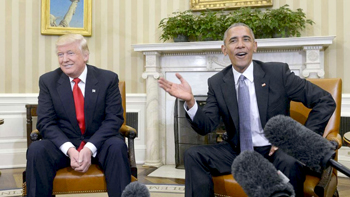
obamaIn his most pointed critique yet, Obama said Hillary Clinton's campaign acted too cautiously out of a mistaken belief that victory was all but certain.

"If you think you're winning, then you have a tendency, just like in sports, maybe to play it safer," Obama said in the interview with former adviser and longtime friend David Axelrod, a CNN analyst, for his "The Axe Files" podcast.

The president said Clinton "understandably . . . looked and said, well, given my opponent and the things he's saying and what he's doing, we should focus on that."

Trump took exception to this critique, tweeting out later in the day that "President Obama said that he thinks he would have won against me. He should say that but I say NO WAY! - jobs leaving, ISIS, OCare, etc."

Obama stressed his admiration for Clinton and said she had been the victim of unfair attacks. But, as he has in other exit interviews, Obama insisted that her defeat was not a rejection of the eight years of his presidency. To the contrary, he argued that he had put together a winning coalition that stretched across the country but that the Democratic Party and the Clinton campaign had failed to follow through on it.

"I am confident in this vision because I'm confident that if I - if I had run again and articulated it - I think I could've mobilized a majority of the American people to rally behind it," the president said.

"See, I think the issue was less that Democrats have somehow abandoned the white working class, I think that's nonsense," Obama said. "Look, the Affordable Care Act benefits a huge number of Trump voters. There are a lot of folks in places like West Virginia or Kentucky who didn't vote for Hillary, didn't vote for me, but are being helped by this . . . The problem is, is that we're not there on the ground communicating not only the dry policy aspects of this, but that we care about these communities, that we're bleeding for these communities."

Clinton spokesman Brian Fallon said via email that the campaign declined to comment.

Axelrod, in an interview with The Washington Post, said he believed Obama went further than he had before in critiquing Clinton's campaign.

"This was all in service of making the point that he believes that his progressive vision and the vision he ran on is still a majority view in this country," Axelrod said. "He chooses to be hopeful about the future."

Obama could not have run again; the 22nd Amendment of the Constitution states that "No person shall be elected to the office of the President more than twice."

Still, Obama's suggestion that he could have won if he ran stoked debate Monday among political observers.

Former House speaker Newt Gingrich, a Republican who has been an adviser to Trump, said in an interview that "Obama doesn't know and neither does anyone else. Obama would have increased the turnout in the African American community, but he also might have increased the repudiation of him among those who felt they were betrayed.

"All of the lies he told about Obamacare, 'keeping your doctor' . . . would have come back to haunt him. It would have been a totally different race."

Steve Hildebrand, a Democrat who oversaw Obama's 2008 campaign in battleground states, said the president had an ability to communicate with lower-income workers that Clinton lacked. He said he sent the Clinton campaign 15 emails in which he said he told them "you are not communicating with lower-income workers, you are not connecting with them."

In the podcast interview, Axelrod did not press Obama on many of the most controversial parts of his presidency, such as not taking action to prevent the deaths of hundreds of thousands of people in Syria.

The president, who has done relatively few interviews with mainstream media organizations, repeated his long-stated complaint that the media has filtered his message and that he is subject to unfair criticism by outlets such as Fox News.

Obama also blamed some of his problems during his presidency on Senate Majority Leader Mitch McConnell, R-Ky., a longtime adversary who famously said in 2010: "The single most important thing we want to achieve is for President Obama to be a one-term president."

McConnell failed in that goal, but Obama said the senator was successful in blocking many of his initiatives and setting the groundwork for Trump's victory.

McConnell's strategy from a "tactical perspective was pretty smart and well executed," the president said. The Republican leader found ways to "just throw sand in the gears" in a manner that fed into people's beliefs that things were going badly. Obama said that, as a result, Republicans blocked action that could have helped more people recover from the Great Recession.

The strategy, Obama maintained, was that "if we just say no, then that will puncture the balloon, that all this talk about hope and change and no red state and blue state is - is proven to be a mirage, a fantasy. And if we can - if we can puncture that vision, then we have a chance to win back seats in the House."

A McConnell spokesman did not respond to a request for comment.

Obama stressed that he doesn't plan to get involved in day-to-day responses to a Trump presidency, just as former president George W. Bush has remained mostly on the sidelines during the Obama years. But Obama made it clear that he will be more of an activist in the long run. He said he plans to help mobilize and train a younger generation of Democratic leaders and will speak out if his core beliefs are challenged. He also said he is working on writing a book.

His post-presidential "long-term interest," Obama said, is "to build that next generation of leadership; organizers, journalists, politicians. I see them in America, I see them around the world - 20-year-olds, 30-year-olds who are just full of talent, full of idealism. And the question is how do we link them up? How do we give them the tools for them to bring about progressive change? And I want to use my presidential center as a mechanism for developing that next generation of talent." He said he didn't want to be someone "who's just hanging around reliving old glories."

Obama in the interview also reflected on his years at college, particularly Columbia University, from which he graduated in 1983. He said he was rereading "old journals" and letters to girls that he was "courting," and found them unreadable. He found himself to be "wildly pretentious," recalling how he begged off going to parties so he could read the French philosopher Jean-Paul Sartre. The women on campus found him "too intense," he said.

Looking back, said the president of the United States, "I should've tried, like, you know, 'Wanna go to a movie?' "

Comments

Add new comment

  • Coastaldigest.com reserves the right to delete or block any comments.
  • Coastaldigset.com is not responsible for its readers’ comments.
  • Comments that are abusive, incendiary or irrelevant are strictly prohibited.
  • Please use a genuine email ID and provide your name to avoid reject.
News Network
June 16,2020

Beijing, Jun 16: The coronavirus situation in China's capital is "extremely severe", a city official warned Tuesday, as 27 new infections were reported from Beijing where a new cluster has sparked a huge trace-and-test programme.

The COVID-19 resurgence -- believed to have started at the sprawling Xinfadi wholesale food market in the capital -- has sparked alarm as China had largely brought its outbreak under control through mass testing and lockdowns imposed earlier in the year.

The new cases took the number of confirmed infections in Beijing over the past five days to 106, as authorities locked down almost 30 communities in the city and tested tens of thousands of people.

"The epidemic situation in the capital is extremely severe," Beijing city spokesman Xu Hejian warned at a press conference.

The World Health Organization had already expressed concern about the cluster, pointing to Beijing's size and connectivity.

Officials in the capital have said they will test stall owners and managers at all of the city's food markets, restaurants and government canteens.

Beijing's coronavirus testing capacity has been expanded to 90,000 a day, according to China's official news agency Xinhua.

On Tuesday, the capital's transport commission banned taxi- and ride-hailing services from driving out of the city, Xinhua reported, in another move to try and contain the new outbreak.

All indoor sports and entertainment venues in Beijing were ordered to shut on Monday, and some other cities across China warned they would quarantine those arriving from the capital.

The National Health Commission also reported four new domestic infections in Hebei province, which surrounds Beijing, and a case reported in southwestern Sichuan province was linked to the Beijing cluster.

Authorities were also racing to track people from Beijing who had travelled to other parts of China, and those who visited the capital have been encouraged to get tested.

Beijing spokesman Xu said: "High-risk people who have left Beijing must inform local authorities immediately."

Market inspections

Authorities shut down another market on Tuesday -- Tiantaohonglian in the central Xicheng district -- after one employee there was diagnosed with COVID-19, state broadcaster CCTV reported.

Seven residential estates surrounding that market were also locked down.

In total, Beijing officials said Tuesday they have disinfected 276 agricultural markets, closed 11 markets, and disinfected more than 33,000 food and beverage businesses in a bid to stamp out the new cluster.

Officials had warned Sunday that since May 30, 200,000 people had visited the Xinfadi market -- the original site of the new outbreak.

More than 8,000 workers from Xinfadi have been tested and sent to centralised quarantine facilities.

Until this recent outbreak, most of China's cases in recent months were nationals returning home as the pandemic spread to other countries.

China's Center for Disease Control and Prevention said Monday that the virus strain found in the Beijing outbreak was a "major epidemic strain in the European countries".

While the virus was detected on chopping boards used to handle imported salmon at Xinfadi, "it does not clearly or definitely indicate it's from imported seafood", Wu Zunyou, the body's chief epidemiologist, said in an interview with state broadcaster CCTV.

"Ever since new cases suddenly emerged in Beijing, we have tried to figure out the reasons for the outbreak since there were no COVID-19 cases found over the past two months," Wu Zunyou said.

"We came up with several possibilities, and the most likely one is that the carrier of the novel coronavirus comes from outside China or other parts of China and brought it here."

On Tuesday, another eight imported cases were reported.

Comments

Add new comment

  • Coastaldigest.com reserves the right to delete or block any comments.
  • Coastaldigset.com is not responsible for its readers’ comments.
  • Comments that are abusive, incendiary or irrelevant are strictly prohibited.
  • Please use a genuine email ID and provide your name to avoid reject.
Agencies
July 15,2020

Washington, Jul 15: The Trump administration has agreed to rescind its July 6 rule, which temporarily barred international students from staying in the United States unless they attend at least one in-person course, a federal district court judge said on Tuesday.

The U-turn by the Trump administration comes following a nationwide outrage against its July 6 order and a series of lawsuits filed by a large number of educational institutions, led by the prestigious Harvard University and Massachusetts Institute of Technology (MIT), seeking a permanent injunctive relief to bar the Department of Homeland Security (DHS) and the US Immigration and Customs Enforcement (ICE) from enforcing the federal guidelines barring international students attending colleges and universities offering only online courses from staying in the country.

As many as 17 US states and the District of Columbia, along with top American IT companies such as Google, Facebook and Microsoft, joined MIT and Harvard in the US District Court in Massachusetts against the DHS and the ICE in seeking an injunction to stop the entire rule from going into effect.

"I have been informed by the parties that they have come to a resolution. They will return to the status quo," Judge Allison Burroughs, the federal district judge in Boston, said in a surprise statement at the top of the hearing on the lawsuit.

The announcement comes as a big relief to international students, including those from India. In the 2018-2019 academic year, there were over 10 lakh international students in the US. According to a recent report of the Student and Exchange Visitor Program (SEVP), 1,94,556 Indian students were enrolled in various academic institutions in the US in January.

Judge Burroughs said the policy would apply nationwide.

"Both the policy directive and the frequently asked questions would not be enforced anyplace," she said, referring to the agreement between the US government and MIT and Harvard.

Congressman Brad Scneider said this is a great win for international students, colleges and common sense.

"The Administration needs to give us a plan to tackle our public health crisis - it can't be recklessly creating rules one day and rescinding them the next," he said in a tweet.

Last week, more than 136 Congressmen and 30 senators wrote to the Trump administration to rescind its order on international students.

"This is a major victory for the students, organisers and institutions of higher education in the #MA7 and all across the country that stood up and fought back against this racist and xenophobic rule," said Congresswoman Ayanna Pressley.

"Taking online classes shouldn't force international students out of our country," Congressman Mikie Sherrill said in a tweet.

In its July 6 notice, the ICE had said all student visa holders, whose university curricula were only offered online, "must depart the country or take other measures, such as transferring to a school with in-person instruction to remain in lawful status".

"If not, they may face immigration consequences, including but not limited to the initiation of removal proceedings," it had said.

In their lawsuit, the 17 states and the District of Columbia said for many international students, remote learning in the countries and communities they come from would impede their studies or be simply impossible.

The lawsuit alleged that the new rule imposes a significant economic harm by precluding thousands of international students from coming to and residing in the US and finding employment in fields such as science, technology, biotechnology, healthcare, business and finance, and education, and contributing to the overall economy.

In a separate filing, companies like Google, Facebook and Microsoft, along with the US Chamber of Commerce and other IT advocacy groups, asserted that the July 6 ICE directive will disrupt their recruiting plans, making it impossible to bring on board international students that businesses, including the amici, had planned to hire, and disturb the recruiting process on which the firms have relied on to identify and train their future employees.

The July 6 directive will make it impossible for a large number of international students to participate in the CPT and OPT programmes. The US will "nonsensically be sending...these graduates away to work for our global competitors and compete against us...instead of capitalising on the investment in their education here in the US", they said.

Comments

Add new comment

  • Coastaldigest.com reserves the right to delete or block any comments.
  • Coastaldigset.com is not responsible for its readers’ comments.
  • Comments that are abusive, incendiary or irrelevant are strictly prohibited.
  • Please use a genuine email ID and provide your name to avoid reject.
News Network
July 27,2020

Chengdu, China, Jul 27: The American flag was lowered at the United States consulate in Chengdu on Monday, days after Beijing ordered it to close in retaliation for the shuttering of the Chinese consulate in Houston.

Footage on state broadcaster CCTV from outside the consulate showed the flag being slowly lowered early Monday morning, after diplomatic tensions soared between the two powers with both alleging the other had endangered national security.

Relations deteriorated in recent weeks in a Cold War-style standoff, with the Chengdu mission Friday ordered to shut in retaliation for the forced closure of Beijing's consulate in Houston, Texas.

The deadline for the Americans to exit Chengdu has been unclear, but the Chinese consulate in Houston was given 72 hours to close after the original order was made.

On Saturday news agency reporters saw workers removing the US insignia from the front of the consulate.

Over the weekend, removals trucks entered the US consulate and cleaners were seen carting large black rubbish bags from the building.

Beijing says closing the Chengdu consulate was a "legitimate and necessary response to the unreasonable measures by the United States", and has alleged that staff at the diplomatic mission endangered China's security and interests.

Washington officials, meanwhile, said there had been unacceptable efforts by the Chinese consulate in Houston to steal US corporate secrets.

Comments

Add new comment

  • Coastaldigest.com reserves the right to delete or block any comments.
  • Coastaldigset.com is not responsible for its readers’ comments.
  • Comments that are abusive, incendiary or irrelevant are strictly prohibited.
  • Please use a genuine email ID and provide your name to avoid reject.