



Bees chase car for over 24 hours to rescue their queen

May 26, 2016

London, May 26: In an incredible ordeal, a 65-year-old grandmother was followed by a huge swarm of bees for more than 24 hours while driving her car home from a nature reserve in the UK, attempting to rescue their queen.
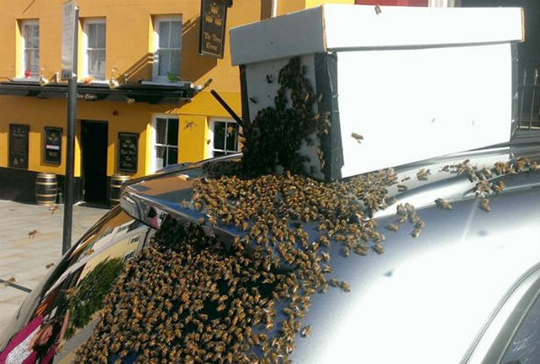
bees

Carol Howarth was amazed when a swarm of over 20,000 bees flew down onto her vehicle, covering the back end of the car.

The unusual incident happened shortly after she had parked her car in the town centre of Haverfordwest, West Wales, before going shopping at lunchtime last Sunday. A team of three beekeepers, a national park ranger and members of the public helped to capture and contain the swarm inside a cardboard box.

Howarth told the Telegraph that she had "never seen anything like it."

Pembrokeshire Coast National Park ranger Tom Moses raised the alarm when he spotted the swarm on the car.

Concerned that the insects might be destroyed with pesticide, Moses contacted two members of Pembrokeshire Beekeepers' Association, who came to help capture the swarm. "As I drove past I noticed this big brown splodge on the back of a car.

"I had seen swarms before settle on things like this but never one as large as this," Moses said.

After returning to her car, Howarth drove home believing the problem had been resolved, only to discover on Monday morning that the swarm had followed her and were again covering the car.

She was then forced to contact the beekeepers, who finally managed to remove the swarm for good.

"One theory was that the queen was trapped in my car and the swarm were following," Howarth said.

"But they couldn't find the queen anywhere so I've no idea if that was right. Apparently bees can swarm at this time of the year and it is a very strong instinct for them to follow the queen," she said.

"I still don't really understand why because they couldn't see the queen anywhere. Perhaps they just like the heat of my car," Howarth added.

Moses said members of colonies often follow their queen bee if she moves hives. And queens moves hives if the hives are disturbed — say, by humans. Or by the arrival of another queen bee.

Comments

Add new comment

  • Coastaldigest.com reserves the right to delete or block any comments.
  • Coastaldigset.com is not responsible for its readers’ comments.
  • Comments that are abusive, incendiary or irrelevant are strictly prohibited.
  • Please use a genuine email ID and provide your name to avoid reject.
Agencies
July 4,2020

Twitter has joined efforts to do away with racially loaded terms such as master, slave and blacklist from its coding language in the wake of the death of African-American George Floyd and ensuing Black Lives Matter protests.

The project started even before the current movement for racial justice escalated following the death of 46-year-old George Floyd in police custody in May.

The use of terms such as "master" and "slave" in programming language originated decades ago. While "master" is used to refer to the primary version of a code, "slave" refers to the replicas. Similarly, the term "Blacklist" is used to refer to items which are meant to be automatically denied.

The efforts to change these terms in favour of more inclusive language at Twitter were initiated by Regynald Augustin and Kevin Oliver and the microblogging platform is now backing their efforts.

"Inclusive language plays a critical role in fostering an environment where everyone belongs. At Twitter, the language we have been using in our code does not reflect our values as a company or represent the people we serve. We want to change that. #WordsMatter," Twitter's engineering team said in a post on Thursday.

As per the recommendations from the team, the term "whitelist" could be replaced by "allowlist" and "blacklist" by "denylist".

Similarly, "master/slave" could be replaced by "leader/follower", "primary/replica" or "primary/standby".

Twitter, however, is not the first to start a project to bring inclusivity in programming language.

According to a report in CNET, the team behind the Drupal online publishing software started using "primary/replica" in place of "master/slave" as early as in 2014.

The use of the terms "master/slave" was also dropped by developers of the Python programming language in 2018.

Now similar efforts are underway at Microsoft's Github and LinkedIn divisions as well, said the report.

Comments

Add new comment

  • Coastaldigest.com reserves the right to delete or block any comments.
  • Coastaldigset.com is not responsible for its readers’ comments.
  • Comments that are abusive, incendiary or irrelevant are strictly prohibited.
  • Please use a genuine email ID and provide your name to avoid reject.
News Network
May 7,2020

Toronto, May 7: Scientists have uncovered how bats can carry the MERS coronavirus without getting sick, shedding light on what triggers coronaviruses, including the one behind the COVID-19 pandemic, to jump to humans.

According to the study, published in the journal Scientific Reports, coronaviruses like the Middle East respiratory syndrome (MERS) virus, and the COVID19-causing SARS-CoV-2 virus, are thought to have originated in bats.

While these viruses can cause serious, and often fatal disease in people, bats seem unharmed, the researchers, including those from the University of Saskatchewan (USask) in Canada, said.

"The bats don't get rid of the virus and yet don't get sick. We wanted to understand why the MERS virus doesn't shut down the bat immune responses as it does in humans," said USask microbiologist Vikram Misra.

In the study, the scientists demonstrated that cells from an insect-eating brown bat can be persistently infected with MERS coronavirus for months, due to important adaptations from both the bat and the virus working together.

"Instead of killing bat cells as the virus does with human cells, the MERS coronavirus enters a long-term relationship with the host, maintained by the bat's unique 'super' immune system," said Misra, one of the study's co-authors.

"SARS-CoV-2 is thought to operate in the same way," he added.

Stresses on bats, such as wet markets, other diseases, and habitat loss, may have a role in coronavirus spilling over to other species, the study noted.

"When a bat experiences stress to their immune system, it disrupts this immune system-virus balance and allows the virus to multiply," Misra said.

The scientists, involved in the study, had earlier developed a potential treatment for MERS-CoV, and are currently working towards a vaccine against COVID-19.

While camels are the known intermediate hosts of MERS-CoV, they said bats are suspected to be the ancestral host.

There is no vaccine for either SARS-CoV-2 or MERS, the researchers noted.

Follow latest updates on the COVID-19 pandemic here

"We see that the MERS coronavirus can very quickly adapt itself to a particular niche, and although we do not completely understand what is going on, this demonstrates how coronaviruses are able to jump from species to species so effortlessly," said USask scientist Darryl Falzarano, who co-led the study.

According to Misra, coronaviruses rapidly adapt to the species they infect, but little is known on the molecular interactions of these viruses with their natural bat hosts.

An earlier study had shown that bat coronaviruses can persist in their natural bat host for at least four months of hibernation.

When exposed to the MERS virus, the researchers said, bat cells adapt, not by producing inflammation-causing proteins that are hallmarks of getting sick, but instead by maintaining a natural antiviral response.

On the contrary, they said this function shuts down in other species, including humans.

The MERS virus, the researchers said, also adapts to the bat host cells by very rapidly mutating one specific gene.

These adaptations, according to the study, result in the virus remaining long-term in the bat, but being rendered harmless until something like a disease, or other stressors, upsets this balance.

In future experiments, the scientists hope to understand how the bat-borne MERS virus adapts to infection and replication in human cells.

"This information may be critical for predicting the next bat virus that will cause a pandemic," Misra said.

Comments

Add new comment

  • Coastaldigest.com reserves the right to delete or block any comments.
  • Coastaldigset.com is not responsible for its readers’ comments.
  • Comments that are abusive, incendiary or irrelevant are strictly prohibited.
  • Please use a genuine email ID and provide your name to avoid reject.
Agencies
July 6,2020

The Covid-19 pandemic has made an unprecedented impact on the Indian businesses, particularly small and medium enterprises (SMEs) and startups. According to a joint survey by FICCI and Indian Angel Network (IAN), the pandemic has hit the businesses of around 70% startups.

With uncertainty in the business environment and an unexpected shift in priorities of the government as well as corporates, many startups are struggling to survive, it says.

In a nationwide survey on the 'Impact of Covid-19 on Indian Startups' involving 250 startups, 70% participants said their businesses had been impacted by Covid-19 and around 12% had shut operations.

The survey shows only 22% startups have cash reserves to meet the fixed cost expenses over the next 3-6 months, and 68% are reducing operational and administrative expenses.

Around 30% of the companies said they would retrench employees if the lockdown was extended too long. The 43% startups have already started 20-40% salary cuts over April-June.

Over 33% startups said investors had put the investment decision on hold and 10% said the deals had been scrapped. Only 8% startups had received funds as per the deals signed before Covid-19 outbreak, the survey revealed.

The reduced funding has forced startups to put a hold on business development and manufacturing activities, which has resulted in loss of projected orders.

The survey highlights the need of an urgent relief package for startups, including possible purchase orders from the government, tax relief and swifter tax refunds, and immediate fiscal support measures, including grants, soft loans and payroll grants.

Besides 250 startups, 61 incubators and investors also participated in the survey.

While 96% of investors accepted that their investments in startups had been impacted by Covid-19, 92% said their investments in startups would continue to be low over the next six months.

Around 59% investors said they would prefer to work with the existing portfolio firms in the coming months. Only 41% said they would consider new deals.

"A comparison of priority investment sectors before and during Covid-19 shows 35% investors are now looking at investments in healthcare startups, followed by EdTech, AI/Deep Tech, FinTech and Agri," said the survey.

Around 44% incubators surveyed said their day-to-day operations had been considerably hit by Covid-19. Most incubators are now supporting their portfolio firms by providing them virtual platforms to interact with mentors, investors and industries.

Dilip Chenoy, FICCI Secretary General, said, "The startup sector is stressed for survival at the moment. The investment sentiment is also subdued and is expected to remain so in the coming months. Lack of working capital and cash flows may lead to major layoffs over the next 3-6 months."

Indian startups needed an enabling ecosystem and flow of funds to continue operations, the survey said.

Padmaja Ruparel, President, Indian Angel Network & Co-Chair of FICCI Startup Committee, said, "In these uncertain times, as investors, we must play an important role to provide the Indian startups funding, mentoring and hand-holding support to stay afloat and come out at the other end of this crisis."

To that end, IAN recently announced a debt fund to help IAN portfolio companies raise working capital and ensure business continuity by partnering with debt providers.

This must be replicated on a wider scale, so a larger number of startups are provided the capital support to make it during these tough times, Ruparel said.

Comments

Add new comment

  • Coastaldigest.com reserves the right to delete or block any comments.
  • Coastaldigset.com is not responsible for its readers’ comments.
  • Comments that are abusive, incendiary or irrelevant are strictly prohibited.
  • Please use a genuine email ID and provide your name to avoid reject.