



Bees chase car for over 24 hours to rescue their queen

May 26, 2016

London, May 26: In an incredible ordeal, a 65-year-old grandmother was followed by a huge swarm of bees for more than 24 hours while driving her car home from a nature reserve in the UK, attempting to rescue their queen.
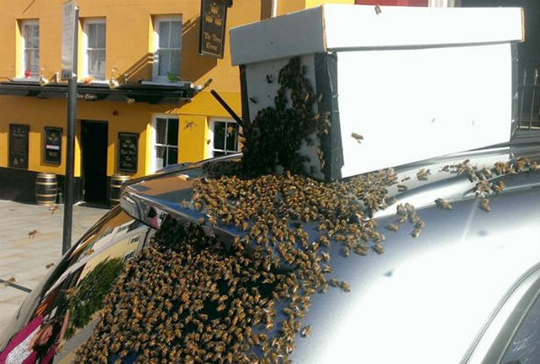
bees

Carol Howarth was amazed when a swarm of over 20,000 bees flew down onto her vehicle, covering the back end of the car.

The unusual incident happened shortly after she had parked her car in the town centre of Haverfordwest, West Wales, before going shopping at lunchtime last Sunday. A team of three beekeepers, a national park ranger and members of the public helped to capture and contain the swarm inside a cardboard box.

Howarth told the Telegraph that she had "never seen anything like it."

Pembrokeshire Coast National Park ranger Tom Moses raised the alarm when he spotted the swarm on the car.

Concerned that the insects might be destroyed with pesticide, Moses contacted two members of Pembrokeshire Beekeepers' Association, who came to help capture the swarm. "As I drove past I noticed this big brown splodge on the back of a car.

"I had seen swarms before settle on things like this but never one as large as this," Moses said.

After returning to her car, Howarth drove home believing the problem had been resolved, only to discover on Monday morning that the swarm had followed her and were again covering the car.

She was then forced to contact the beekeepers, who finally managed to remove the swarm for good.

"One theory was that the queen was trapped in my car and the swarm were following," Howarth said.

"But they couldn't find the queen anywhere so I've no idea if that was right. Apparently bees can swarm at this time of the year and it is a very strong instinct for them to follow the queen," she said.

"I still don't really understand why because they couldn't see the queen anywhere. Perhaps they just like the heat of my car," Howarth added.

Moses said members of colonies often follow their queen bee if she moves hives. And queens moves hives if the hives are disturbed — say, by humans. Or by the arrival of another queen bee.

Comments

Add new comment

  • Coastaldigest.com reserves the right to delete or block any comments.
  • Coastaldigset.com is not responsible for its readers’ comments.
  • Comments that are abusive, incendiary or irrelevant are strictly prohibited.
  • Please use a genuine email ID and provide your name to avoid reject.
Agencies
January 7,2020

Washington, Jan 7: Facebook will ban deepfake videos ahead of the US elections but the new policy will still allow heavily edited clips so long as they are parody or satire, the social media giant said Tuesday.

Deepfake videos are hyper-realistic doctored clips made using artificial intelligence or programs that have been designed to accurately fake real human movements.

In a blog published following a Washington Post report, Facebook said it would begin removing clips that were edited--beyond for clarity and quality--in ways that "aren't apparent to an average person" and could mislead people.

Clips would be removed if they were "the product of artificial intelligence or machine learning that merges, replaces or superimposes content onto a video, making it appear to be authentic," the statement from Facebook vice-president Monika Bickert said.

However, the statement added: "This policy does not extend to content that is parody or satire, or video that has been edited solely to omit or change the order of words."

US media noted the new guidelines would not cover videos such as the 2019 viral clip -- which was not a deepfake -- of House Speaker Nancy Pelosi that appeared to show her slurring her words.

Facebook also gave no indication on the number of people assigned to identify and take down the offending videos, but said videos failing to meet its usual guidelines would be removed, and those flagged clips would be reviewed by teams of third-party fact-checkers -- among them AFP.

The news agency has been paid by the social media giant to fact-check posts across 30 countries and 10 languages as part of a program starting in December 2016, and including more than 60 organisations.

Content labeled "false" is not always removed from newsfeeds but is downgraded so fewer people see it -- alongside a warning explaining why the post is misleading.

Comments

Add new comment

  • Coastaldigest.com reserves the right to delete or block any comments.
  • Coastaldigset.com is not responsible for its readers’ comments.
  • Comments that are abusive, incendiary or irrelevant are strictly prohibited.
  • Please use a genuine email ID and provide your name to avoid reject.
Agencies
June 26,2020

Facebook will introduce a new notification screen on its platform that will warn users if the article they are about to share is over 90 days old, the company announced on Thursday.

“We’re starting to globally roll out a notification screen that will let people know when news articles they are about to share are more than 90 days old,” Facebook wrote in a blog post.

The social media platform had previously introduced a context button in 2018 that provides information about the sources of articles in the News Feed. Building upon that, the new feature will inform users about the timeliness of the article.

“To ensure people have the context they need to make informed decisions about what to share on Facebook, the notification screen will appear when people click the share button on articles older than 90 days, but will allow people to continue sharing if they decide an article is still relevant,” Facebook said.

The social media giant stated that timeliness is important in understanding the context of an article and curbing the spread of misinformation on the platform.

“News publishers, in particular, have expressed concerns about older stories being shared on social media as current news, which can misconstrue the state of current events. Some news publishers have already taken steps to address this on their own websites by prominently labelling older articles to prevent outdated news from being used in misleading ways,” Facebook added.

Apart from this, the platform will also be testing a similar notification screen for information related to the global Covid-19 pandemic. The notification screen will provide information about the source of the link shared in a post if the link is related to information on Covid-19. It will also direct people to its previously introduced Covid-19 information centre for “authoritative” health information, it said.

Comments

Add new comment

  • Coastaldigest.com reserves the right to delete or block any comments.
  • Coastaldigset.com is not responsible for its readers’ comments.
  • Comments that are abusive, incendiary or irrelevant are strictly prohibited.
  • Please use a genuine email ID and provide your name to avoid reject.
Agencies
February 23,2020

Google has indexed invite links to private WhatsApp group chats, meaning anyone can join various private chat groups (including several porn-sharing groups) with a simple search.

According to a report in Motherboard, invitations to WhatsApp group chats were being indexed by Google.

The team found private groups using specific Google searches and even joined a group intended for NGOs accredited by the UN and had access to all the participants and their phone numbers.

Journalist Jordan Wildon said on Twitter that he discovered that WhatsApp's "Invite to Group Link" feature lets Google index groups, making them available across the internet since the links are being shared outside of WhatsApp's secure private messaging service.

"Your WhatsApp groups may not be as secure as you think they are," Wildon tweeted on Friday, adding that using particular Google searches, people can discover links to the chats.

According to app reverse-engineer Jane Wong, Google has around 470,000 results for a simple search of "chat.whatsapp.com", part of the URL that makes up invites to WhatsApp groups.

WhatsApp spokesperson Alison Bonny said: "Like all content that is shared in searchable public channels, invite links that are posted publicly on the internet can be found by other WhatsApp users."

"The links that users wish to share privately with people they know and trust should not be posted on a publicly accessible website," Bonny told The Verge.

Danny Sullivan, Google's public search liaison, tweeted: "Search engines like Google & others list pages from the open web. That's what's happening here. It's no different than any case where a site allows URLs to be publicly listed. We do offer tools allowing sites to block content being listed in our results."

Comments

Add new comment

  • Coastaldigest.com reserves the right to delete or block any comments.
  • Coastaldigset.com is not responsible for its readers’ comments.
  • Comments that are abusive, incendiary or irrelevant are strictly prohibited.
  • Please use a genuine email ID and provide your name to avoid reject.