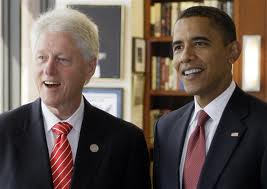
‘Bill Clinton dubbed Obama incompetent'

May 14, 2012

o

New York, May 14: Former US President Bill Clinton dubbed Barack Obama "incompetent" and pressed wife Hillary to quit her job as secretary of state to challenge the incumbent president in the primaries, a new book has claimed.

"The country needs you!" the former president had told Hillary Clinton, urging her to run this year, according to accounts of the conversation included in Edward Klein's new biography of Obama.

Obama, Bill Clinton had said, according to excerpts, "doesn't know how to be president" and is "incompetent".

The title of Klein's explosive, unauthorized biography of Obama, 'The Amateur', was taken directly from Bill Clinton's bombshell criticism of the president, the author said. "Barack Obama," Clinton said, "is an amateur." The withering criticism is incredible, given the fact that Bill Clinton is actively campaigning for Obama's re-election , the New York Post said.

According to the book, Bill Clinton unloaded on Obama and pressed Hillary to run against her boss during a gathering in the ex-president's home office in Chappaqua last August that included longtime friends.

"The economy's a mess, it's dead flat. America has lost its Triple-A rating . . . You know better than Obama does," Bill had said. Hillary resisted the entreaties, according to two of the guests interviewed. "Why risk everything now?" a sceptical Hillary said, emphasising that she wanted to leave a legacy as secretary of state.

The book's claims were shot down by spokesmen for the White House and the Clintons . Bill Clinton's spokesman said the excerpts were "completely false" . The White House spokesman accused Klein of making up facts to sell books.

Comments

Add new comment

  • Coastaldigest.com reserves the right to delete or block any comments.
  • Coastaldigset.com is not responsible for its readers’ comments.
  • Comments that are abusive, incendiary or irrelevant are strictly prohibited.
  • Please use a genuine email ID and provide your name to avoid reject.
Agencies
May 31,2020

Washington, May 31: US President Donald Trump said Saturday he will delay the G7 summit scheduled to take place in June and invite other countries -- including India and Russia -- to join the meeting.

"I don't feel that as a G7 it properly represents what's going on in the world. It's a very outdated group of countries," Trump told reporters on Air Force One.

He said he would like to invite Russia, South Korea, Australia and India to join an expanded summit in the fall.

It could happen in September, either before or after the UN General Assembly, Trump said, adding that "maybe I'll do it after the election."

Americans head to the polls in early November to choose a new president, with Trump keen for a return to normalcy after the coronavirus pandemic and a healthy economy as voters cast their ballots.

Describing the event as a "G-10 or G-11", Trump said he had "roughly" broached the topic with leaders of the four other countries.

Leaders from the Group of Seven, which the United States heads this year, had been scheduled to meet by videoconference in late June after COVID-19 scuttled plans to gather in-person at Camp David, the US presidential retreat outside Washington.

Trump created suspense last week, however, when he announced that he might hold the huge gathering in-person after all, "primarily at the White House" but also potentially parts of it at Camp David.

German Chancellor Angela Merkel became the first leader to decline the in-person invitation outright.

"Considering the overall pandemic situation, she cannot agree to her personal participation, to a journey to Washington," her spokesman said Saturday.

Her response followed ambivalent to positive reactions to the invitation from Britain, Canada and France.

The 65-year-old chancellor is the oldest G7 leader after Trump, who is 73. Japan's Shinzo Abe, also 65, is several months younger than Merkel. Their age puts them at higher risk from the coronavirus.

The G7 major advanced countries -- Britain, Canada, France, Germany, Italy, Japan and the United States -- hold annual meetings to discuss international economic coordination.

Russia was thrown out of what was the G8 in 2014 after it seized Ukraine's Black Sea peninsula of Crimea, an annexation never recognized by the international community.

The work of the G7 is now more important than ever as countries struggle to repair coronavirus-inflicted damage.

The White House had previously said the huge diplomatic gathering would be a "show of strength" when world economies are gradually reemerging from shutdowns.

The United States is the worst-hit country for COVID-19 infections, recording more than 1.7 million cases and over 103,680 deaths.

Comments

Add new comment

  • Coastaldigest.com reserves the right to delete or block any comments.
  • Coastaldigset.com is not responsible for its readers’ comments.
  • Comments that are abusive, incendiary or irrelevant are strictly prohibited.
  • Please use a genuine email ID and provide your name to avoid reject.
News Network
February 28,2020

Tehran, Feb 28: The coronavirus epidemic in Iran has cost 26 lives, the health ministry announced Thursday, with a vice president becoming the latest top official to be infected as the spread appeared to accelerate.

Health ministry spokesman Kianoush Jahanpour told a news conference that the tally of infections had risen to 245 with 106 more cases confirmed -- the highest number for a single day since Iran announced its first infections on February 19.

The Islamic republic has the highest death toll from the virus outside China, where COVID-19 first emerged.

Among the latest coronavirus sufferers is one of Iran's seven vice presidents, Massoumeh Ebtekar, who oversees women's affairs.

Ebtekar, a former spokeswoman for students who took 52 Americans hostage at the US embassy in Tehran in 1979, is being treated at home and members of her team have been tested, state news agency IRNA reported.

Mojtaba Zolnour, head of parliament's national security and foreign affairs committee, also contracted the virus, appearing in a video posted by Fars news agency saying he was in self-quarantine.

The cleric is a deputy for the Shiite holy city of Qom in central Iran where the country's first cases were detected.

According to media reports, among the deceased in Qom on Thursday was theologian Hadi Khroroshahi, who in 1981 was named Iran's first ambassador to the Vatican.

The announcement by Zolnour comes two days after another top official, deputy health minister Iraj Harirchi, head of the government's coronavirus task force, said he too had contracted the virus.

On Wednesday, Iranian authorities announced domestic travel restrictions for people with confirmed or suspected infections.

They also placed curbs on access to major Shiite pilgrimage sites, including the Imam Reza shrine in second city Mashhad and the Fatima Masumeh shrine in Qom.

Visitors to the shrines will be allowed to visit on condition they are provided "with hand-washing liquids, proper (health) information, masks", Health Minister Saeed Namaki said.

They must "not gather together in groups but just pray and leave", he said.

In a rare move, authorities announced the cancellation of the main Friday weekly prayers in Tehran, Qom and Mashhad as well as in the capitals of 22 of Iran's 31 provinces and other infected areas.

"All of these decisions are temporary and if the situation changes, we might intensify or ease them," Namaki said.

Comments

Add new comment

  • Coastaldigest.com reserves the right to delete or block any comments.
  • Coastaldigset.com is not responsible for its readers’ comments.
  • Comments that are abusive, incendiary or irrelevant are strictly prohibited.
  • Please use a genuine email ID and provide your name to avoid reject.
News Network
June 4,2020

Jun 4: A malaria drug President Donald Trump took to try to prevent COVID-19 proved ineffective for that in the first large, high-quality study to test it in people in close contact with someone with the disease.

Results published Wednesday by the New England Journal of Medicine show that hydroxychloroquine was no better than placebo pills at preventing illness from the coronavirus.

The drug did not seem to cause serious harm, though -- about 40% on it had side effects, mostly mild stomach problems.

 “We were disappointed. We would have liked for this to work,” said the study leader, Dr. David Boulware, an infectious disease specialist at the University of Minnesota.

“But our objective was to answer the question and to conduct a high-quality study,” because the evidence on the drug so far has been inconclusive, he said.

Hydroxychloroquine and a similar drug, chloroquine, have been the subject of much debate since Trump started promoting them in March.

Hydroxychloroquine has long been used for malaria, lupus, and rheumatoid arthritis, but no large studies have shown it or chloroquine to be safe or effective for much sicker patients with coronavirus, and some studies have suggested the drugs may do harm.

Trump took a two-week course of hydroxychloroquine, along with zinc and Vitamin D, after two staffers tested positive for COVID-19, and had no ill effects, according to results of his latest physical released by his doctor Wednesday.

Federal regulators have warned against hydroxychloroquine's use except in hospitals and formal studies because of the risk of side effects, especially heart rhythm problems.

Boulware's study involved 821 people in the United States and Canada living with someone diagnosed with COVID-19 or at high risk of getting it because of their job -- doctors, nurses, ambulance workers who had significant exposure to a sick patient while not wearing full protective gear.

They were randomly assigned to get either the nutrient folate as a placebo or hydroxychloroquine for five days, starting within four days of their exposure. Neither they nor others involved in the research knew who was getting which pills.

After 14 days in the study, 12 per cent on the drug developed COVID-19 symptoms versus 14 per cent in the placebo group, but the difference is so small it could have occurred by chance, Boulware said.

“There's basically no effect. It does not prevent infection,” he said of the drug. Even if it were to give some slim advantage, “we'd want a much larger effect” to justify its use and risk of side effects for preventing illness, he said.

Results were no different among a subgroup of participants who were taking zinc or vitamin C, which some people believe might help make hydroxychloroquine more effective or fight the coronavirus.

There are some big caveats: The study enrolled people through the Internet and social media, relying on them to report their own symptoms rather than having them tracked in a formal way by doctors.

Participants were not all tested for the coronavirus but were diagnosed as COVID-19 cases based on symptoms in many cases. And not all took their medicines as directed.

The results “are more provocative than definitive,” and the drug may yet have prevention benefits if tried sooner or in a different way, Dr. Myron Cohen of the University of North Carolina at Chapel Hill wrote in a commentary in the journal.

Others were glad to see a study that had a comparison group and good scientific methods after so many weaker reports on hydroxychloroquine.

“This fits with everything else we've seen so far which suggests that it's not beneficial," said Dr. Peter Bach, director of a health policy center at Memorial Sloan Kettering Cancer Center in New York.

This study was in younger relatively healthy people, but the results “would make me very discouraged about trying to use this in older people” who are most vulnerable to serious illness from the coronavirus, Bach said.

“If it does work, it doesn't work very well.” Dr. Dan Culver, a lung specialist at the Cleveland Clinic, said there's still a chance that giving the drug sooner than four days after someone's exposure to the virus may help prevent illness.

But the study “takes 'home run' off the table” as far as hopes for the drug, he said.

The study was mostly funded by David Baszucki, founder of Roblox, a California-based game software company, and other private donors and the Minnesota university.

Boulware also is leading a study testing hydroxychloroquine for treating COVID-19. The study is finished and results are being analyzed now.

On Tuesday, the journal Lancet posted an “expression of concern” about a study it published earlier this month of nearly 15,000 COVID-19 patients on the malaria drugs that tied their use to a higher risk of dying in the hospital or developing a heartbeat problem.

Scientists have raised serious questions about the database used for that study, and its authors have launched an independent audit.

That work had a big impact: the World Health Organization suspended use of hydroxychloroquine in a study it is leading, and French officials stopped the drug's use in hospitals. On Wednesday, the WHO said experts who reviewed safety information decided that its study could resume.


Comments

Add new comment

  • Coastaldigest.com reserves the right to delete or block any comments.
  • Coastaldigset.com is not responsible for its readers’ comments.
  • Comments that are abusive, incendiary or irrelevant are strictly prohibited.
  • Please use a genuine email ID and provide your name to avoid reject.