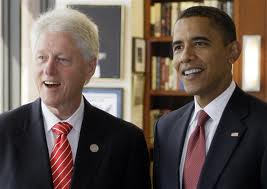
‘Bill Clinton dubbed Obama incompetent'

May 14, 2012

o

New York, May 14: Former US President Bill Clinton dubbed Barack Obama "incompetent" and pressed wife Hillary to quit her job as secretary of state to challenge the incumbent president in the primaries, a new book has claimed.

"The country needs you!" the former president had told Hillary Clinton, urging her to run this year, according to accounts of the conversation included in Edward Klein's new biography of Obama.

Obama, Bill Clinton had said, according to excerpts, "doesn't know how to be president" and is "incompetent".

The title of Klein's explosive, unauthorized biography of Obama, 'The Amateur', was taken directly from Bill Clinton's bombshell criticism of the president, the author said. "Barack Obama," Clinton said, "is an amateur." The withering criticism is incredible, given the fact that Bill Clinton is actively campaigning for Obama's re-election , the New York Post said.

According to the book, Bill Clinton unloaded on Obama and pressed Hillary to run against her boss during a gathering in the ex-president's home office in Chappaqua last August that included longtime friends.

"The economy's a mess, it's dead flat. America has lost its Triple-A rating . . . You know better than Obama does," Bill had said. Hillary resisted the entreaties, according to two of the guests interviewed. "Why risk everything now?" a sceptical Hillary said, emphasising that she wanted to leave a legacy as secretary of state.

The book's claims were shot down by spokesmen for the White House and the Clintons . Bill Clinton's spokesman said the excerpts were "completely false" . The White House spokesman accused Klein of making up facts to sell books.

Comments

Add new comment

  • Coastaldigest.com reserves the right to delete or block any comments.
  • Coastaldigset.com is not responsible for its readers’ comments.
  • Comments that are abusive, incendiary or irrelevant are strictly prohibited.
  • Please use a genuine email ID and provide your name to avoid reject.
News Network
May 8,2020

May 8: Thousands of migrants have been stranded “all over the world” where they face a heightened risk of COVID-19 infection, the head of the UN migration agency International Organization for Migration (IOM) has said.

IOM Director-General António Vitorino said that more onerous health-related travel restrictions might discriminate disproportionately against migrant workers in future.

“Health is the new wealth,” Vitorino said, citing proposals by some countries to introduce the so-called immunity passports and use mobile phone apps designed to prevent the spread of the new coronavirus.

“In lots of countries in the world, we already have a system of screening checks to identify the health of migrants, above all malaria, tuberculosis… HIV-AIDS, and now I believe that there will be increased demands in health controls for regular migrants,” he said on Thursday.

Travel restrictions to try to limit the spread of the pandemic has left people on the move more vulnerable than ever and unable to work to support themselves, Vitorino told journalists via videoconference.

“There are thousands of stranded migrants all over the world.

 “In South-East Asia, in East Africa, in Latin America, because of the closing of the borders and with the travel restrictions, lots of migrants who were on the move; some of them wanted to return precisely because of the pandemic,” he said.

They are blocked, some in large groups, some in small, in the border areas, in very difficult conditions without access to minimal care, especially health screening, Vitorino said.

“We have been asking the governments to allow the humanitarian workers and the health workers to have access to (them),” he said.

Turning to Venezuelan migrants, who are believed to number around five million amidst a worsening economic crisis in the country, the IOM chief said “thousands… have lost their jobs in countries like Ecuador and Colombia and are returning back to Venezuela in large crowds without any health screening and being quarantined when they go back”.

In a statement, the IOM highlighted the plight of migrants left stranded in the desert in west, central and eastern Africa, either after having been deported without the due process, or abandoned by the smugglers.

The IOM’s immediate priorities for migrants include ensuring that they have access to healthcare and other basic social welfare assistance in their host country.

Among the UN agency’s other immediate concerns is preventing the spread of new coronavirus infection in more than 1,100 camps that it manages across the world.

They include the Cox’s Bazar complex in Bangladesh, home to around one million mainly ethnic Rohingya from Myanmar, the majority having fled persecution.

So far, no cases of infection have been reported there, the IOM chief said, adding that preventative measures have been communicated to the hundreds of thousands of camp residents, while medical capacity has been boosted.

Beyond the immediate health threat of COVID-19 infection, migrants also face growing stigmatization from which they need protection, Vitorino said.

Allowing hate speech and xenophobic narratives to thrive unchallenged also threatens to undermine the public health response to COVID-19, he said, before noting that migrant workers make up a significant percentage of the health sector in many developed countries including the UK, the US and Switzerland.

Populist narratives targeting migrants as carriers of disease could also destabilise national security through social upheaval and countries’ post-COVID economic recovery by removing critical workers in agriculture and service industries, he said.

Remittances have already seen a 30 per cent drop during the pandemic, Vitorino said, citing the World Bank data, meaning that some USD 20 billion has not been sent home to families in countries where up to 15 per cent of their gross domestic product comes from pay packets earned abroad.

Vitorino, in a plea, urged to give the health of migrants as much attention as that of the host populations in all countries.

“It is quite clear that health is the new wealth and that health concerns will be introduced in the mobility systems - not just for migration - but as a whole; where travelling for business or professional reasons, health will be the new gamechanger in town.

“If the current pandemic leads to a two or even three-tier mobility system, then we will have to try to solve the problem – the problem of the pandemic - but at the same time we have created a new problem of deepening the inequalities,” he said.


Comments

Add new comment

  • Coastaldigest.com reserves the right to delete or block any comments.
  • Coastaldigset.com is not responsible for its readers’ comments.
  • Comments that are abusive, incendiary or irrelevant are strictly prohibited.
  • Please use a genuine email ID and provide your name to avoid reject.
News Network
May 14,2020

May 14: The UN’s children agency has warned that an additional 6,000 children could die daily from preventable causes over the next six months as the COVID-19 pandemic weakens the health systems and disrupts routine services, the first time that the number of children dying before their fifth birthday could increase worldwide in decades.

As the coronavirus outbreak enters its fifth month, the UN Children’s Fund (UNICEF) requested USD 1.6 billion to support its humanitarian response for children impacted by the pandemic.

The health crisis is “quickly becoming a child rights crisis. And without urgent action, a further 6,000 under-fives could die each day,” it said.

With a dramatic increase in the costs of supplies, shipment and care, the agency appeal is up from a USD 651.6 million request made in late March – reflecting the devastating socioeconomic consequences of the disease and families’ rising needs.

"Schools are closed, parents are out of work and families are under strain," UNICEF Executive Director Henrietta Fore said on Tuesday.

 “As we reimagine what a post-COVID world would look like, these funds will help us respond to the crisis, recover from its aftermath, and protect children from its knock-on effects.”

The estimate of the 6,000 additional deaths from preventable causes over the next six months is based on an analysis by researchers from the Johns Hopkins Bloomberg School of Public Health, published on Wednesday in the Lancet Global Health Journal.

UNICEF said it was based on the worst of three scenarios analysing 118 low and middle-income countries, estimating that an additional 1.2 million deaths could occur in just the next six months, due to reductions in routine health coverage, and an increase in so-called child wasting.

Around 56,700 more maternal deaths could also occur in just six months, in addition to the 144,000 likely deaths across the same group of countries. The worst case scenario, of children dying before their fifth birthdays, would represent an increase "for the first time in decades,” Fore said.

"We must not let mothers and children become collateral damage in the fight against the virus. And we must not let decades of progress on reducing preventable child and maternal deaths, be lost,” she said.

Access to essential services, like routine immunisation, has already been compromised for hundreds of millions of children and threatens a significant increase in child mortality.

According to a UNICEF analysis, some 77 per cent of children under the age of 18 worldwide are living in one of 132 countries with COVID-19 movement restrictions.

The UN agency also spotlighted that the mental health and psychosocial impact of restricted movement, school closures and subsequent isolation are likely to intensify already high levels of stress, especially for vulnerable youth.

At the same time, they maintained that children living under restricted movement and socio-economic decline are in greater jeopardy of violence and neglect. Girls and women are at increased risk of sexual and gender-based violence.

The UNICEF pointed out that in many cases, refugee, migrant and internally displaced children are experiencing reduced access to protection and services while being increasingly exposed to xenophobia and discrimination.

“We have seen what the pandemic is doing to countries with developed health systems and we are concerned about what it would do to countries with weaker systems and fewer available resources,” Fore said.

In countries suffering from humanitarian crises, UNICEF is working to prevent transmission and mitigate the collateral impacts on children, women and vulnerable populations – with a special focus on access to health, nutrition, water and sanitation, education and protection.

To date, the UN agency said it has received USD 215 million to support its pandemic response, and additional funding will help build upon already-achieved results.

Within its response, UNICEF has reached more than 1.67 billion people with COVID-19 prevention messaging around hand washing and cough and sneeze hygiene; over 12 million with critical water, sanitation and hygiene supplies; and nearly 80 million children with distance or home-based learning.

The UN agency has also shipped to 52 countries, more than 6.6 million gloves, 1.3 million surgical masks, 428,000 N95 respirators and 34,500 COVID-19 diagnostic tests, among other items.

Comments

Add new comment

  • Coastaldigest.com reserves the right to delete or block any comments.
  • Coastaldigset.com is not responsible for its readers’ comments.
  • Comments that are abusive, incendiary or irrelevant are strictly prohibited.
  • Please use a genuine email ID and provide your name to avoid reject.
News Network
May 21,2020

Canberra, May 21: Australian Prime Minister Scott Morrison and his Indian counterpart, Narendra Modi, are looking forward to deepening the countries' strategic relationship, with both sides expected to sign a range of pacts from defence to trade in strategic sectors amid heightened tensions with China over Beijing's response to coronavirus pandemic.

During a virtual summit, scheduled to take place on June 4, both leaders are expected to ramp up efforts to diversify Australia's export markets and find trusted suppliers of vital products and components, a local newspaper, The Australian reported on Tuesday.

The new agreements will focus on reliable supply chains in key strategic sectors, including medical goods, technology and critical minerals, amid heightened tensions with China over Beijing's response to coronavirus pandemic.

The leaders will seal a new defence agreement allowing reciprocal access to bases and co-operation on military technology projects, while a new education partnership will be on the table to help overcome Australian university reliance on Chinese students.

The talks in terms of strategic convergence, now have greater significance as COVID-19 exacerbates the strategic contest between the US and China, and forces like-minded countries to seek out reliable partners.

Australian farmers could also benefit, with talks underway on expanding agricultural exports to India, including barley, as China throws up new trade barriers, media reports stated.

The virtual summit follows the cancellation of Morrison's planned state visit to India in January due to the bushfires.

Morrison said last year, ahead of his planned visit, that India was "a natural partner for Australia", referring to the countries' "shared values" -- a point of differentiation with China.

Former Department of Foreign Affairs and Trade secretary Peter Varghese, who wrote a landmark report on the bilateral relationship in 2018, was quoted by the newspaper as saying that India would be even more important to Australia in the post-COVID world. "If one of the lessons from COVID is that countries need to spread their risk, then finding new markets or building up existing markets is a crucial part of that," he added.

Varghese noted that India, a member of the Quadrilateral Security Dialogue along with Australia, Japan and the US, was a vital strategic partner to Australia in helping "constrain China's ambitions to be the predominant power".

"That shared objective between Australia and India of not wanting to see the region dominated by China is a key component of building up our geopolitical relationship," he told The Australian.

The summit also follows recent talks between Australian Foreign Minister Marise Payne and Indian counterpart Subrahmanyam Jaishankar on the pandemic response and Australia's call for an independent inquiry, which was overwhelmingly backed at the World Health Assembly on Tuesday.

Australia wants to support India to develop a domestic critical minerals processing industry, which would provide Western nations with an alternative to sourcing the materials from China.

Meanwhile, India has strong expertise as a manufacturer of drugs and medical equipment, while Australia is a centre of biomedical research, opening the possibility for closer co-operation in the key sector, the media reported further.

Comments

Add new comment

  • Coastaldigest.com reserves the right to delete or block any comments.
  • Coastaldigset.com is not responsible for its readers’ comments.
  • Comments that are abusive, incendiary or irrelevant are strictly prohibited.
  • Please use a genuine email ID and provide your name to avoid reject.