



BJP President Amit Shah Charge-Sheeted For April Speech

September 10, 2014

Muzaffarnagar, Sep 10: BJP president Amit Shah has been accused of delivering a hate speech in the run up to the national elections by the police in Muzaffarnagar, which was devastated by communal violence last year.
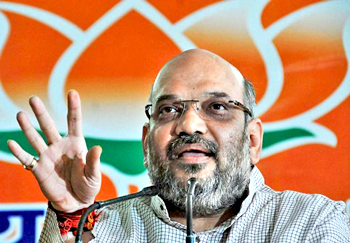
Amit ShahThe local police in this part of Western Uttar Pradesh, a four-hour drive from Delhi, has chargesheeted Mr Shah based on a video clip of a speech he delivered in April. A local court will now review the charge-sheet, which outlines the police's alleged evidence against the politician.

On Saturday, important by-elections are being held in the state.

The BJP's state unit leaders have been accused of trying to polarize voters on religious line by repeatedly warning against the dangers of "love jihad" - a term used by right-wing groups for what they describe as an Islamist strategy to convert Hindu women through seduction, marriage and money.

Mr Shah was named president of the BJP in July; earlier this year, he masterminded the party's strongest showing in Uttar Pradesh, helping to propel the party to an absolute majority of its own in the parliamentary election.

Mr Shah's political rivals accuse him of using communal tension to electoral advantage in Uttar Pradesh, a charge he has denied. But during the national election campaign, the 53-year-old was banned by the Election Commission from holding rallies and delivering speeches after it found him guilty of delivering "hate speeches" designed to promote "hatred and ill will" between religions. The ban was lifted after Mr Shah vowed in writing not to use abusive or derogatory language.

Mr Shah also faces murder charges in Gujarat, where he was Home Minister for seven years when Mr Modi was chief minister. Mr sHahg resigned from the cabinet after his 2010 arrest; he was released on bail. He has denied that he ordered the state police to kill Sohrabuddin Sheikh, his wife and a witness - top cops had described the group as terrorists on a mission to assassinate Mr Modi.

Comments

Add new comment

  • Coastaldigest.com reserves the right to delete or block any comments.
  • Coastaldigset.com is not responsible for its readers’ comments.
  • Comments that are abusive, incendiary or irrelevant are strictly prohibited.
  • Please use a genuine email ID and provide your name to avoid reject.
News Network
April 23,2020

Washington, Apr 23: Air pollution over northern India has plummeted to a 20-year-low for this time of the year, according to satellite data published by US space agency National Aeronautics and Space Administration (NASA).
The US space agency's satellite sensors observed aerosol levels at a 20-year low post the countrywide lockdown, implemented to slow the spread of the novel coronavirus.

"We knew we would see changes in atmospheric composition in many places during the lockdown," said Pawan Gupta, a Universities Space Research Association (USRA) scientist at NASA''s Marshall Space Flight Center. "But I have never seen aerosol values so low in the Indo-Gangetic Plain at this time of year," added Mr Gupta.

Acting Assistant Secretary of State for South and Central Asia Alice G Wells tweeted, "These images from NASA were taken each spring starting in 2016 and show a 20-year low in airborne particle levels over India. When India and the world are ready to work and travel again, let's not forget that collaborative action can result in cleaner air."

The data published with maps show aerosol optical depth (AOD) in 2020 compared to the average for 2016-2019. Aerosol optical depth is a measure of how light is absorbed or reflected by airborne particles as it travels through the atmosphere.

If aerosols are concentrated near the surface, an optical depth of 1 or above indicates very hazy conditions. An optical depth, or thickness, of less than 0.1 over the entire atmospheric vertical column is considered "clean." The data were retrieved by the Moderate Resolution Imaging Spectroradiometer (MODIS) on NASA's Terra satellite.

In the first few days of the lockdown, it was difficult to observe a change in the pollution signature. "We saw an aerosol decrease in the first week of the shutdown, but that was due to a combination of rain and the lockdown," said Mr Gupta.

Around March 27, heavy rain poured over vast areas of northern India and helped clear the air of aerosols. Aerosol concentrations usually increase again after such heavy precipitation.

"After the rainfall, I was really impressed that aerosol levels did not go up and return to normal. We saw a gradual decrease and things have been staying at the level we might expect without anthropogenic emissions," Mr Gupta said.

On March 25, the Indian government placed its 1.3 billion citizens under a strict lockdown to reduce the spread of COVID-19. The countrywide mandate decreased activity at factories and severely reduced car, bus, truck and airplane traffic. Every year, aerosols from anthropogenic (human-made) sources contribute to unhealthy levels of air pollution in many Indian cities.

Aerosols are tiny solid and liquid particles suspended in the air that reduce visibility and can damage the human lungs and heart.

In southern India though, the story is a little hazier. Satellite data show aerosol levels have not yet decreased to the same extent. In fact, levels seem to be slightly higher than in the past four years. The reasons are unclear but could be related to recent weather patterns, agricultural fires, winds or other factors.

"This a model scientific experiment," Robert Levy, program leader for NASA's MODIS aerosol products, said about the lockdown and its effects on pollution.

"We have a unique opportunity to learn how the atmosphere reacts to sharp and sudden reductions in emissions from certain sectors. This can help us separate how natural and human sources of aerosols affect the atmosphere," Mr Levy added.

Comments

Add new comment

  • Coastaldigest.com reserves the right to delete or block any comments.
  • Coastaldigset.com is not responsible for its readers’ comments.
  • Comments that are abusive, incendiary or irrelevant are strictly prohibited.
  • Please use a genuine email ID and provide your name to avoid reject.
Agencies
July 15,2020

New Delhi, Jul 15: Air India has started the process of identifying employees, based on various factors like efficiency, health and redundancy, who will be sent on compulsory leave without pay (LWP) for up to five years, according to an official order.

The airline's board of directors have authorised its Chairman and Managing Director Rajiv Bansal to send employees on LWP "for six months or for a period of two years extendable upto five years, depending upon the following factors - suitability, efficiency, competence, quality of performance, health of the employee, instance of non-availability of the employee for duty in the past as a result of ill health or otherwise and redundancy", the order said on Tuesday.

The departmental heads in the headquarter as well as regional directors are required to assess each employee "on the above mentioned factors and identify the cases where option of compulsory LWP can be exercised", stated the order dated July 14.

"Names of such employees need to be forwarded to the General Manager (Personnel) in headquarter for obtaining necessary approval of CMD," the order added.

In response to queries regarding this matter, Air India spokesperson said,"We would not like to make any comment on the issue."

Aviation sector has been significantly impacted due to the travel restrictions imposed in India and other countries due to the coronavirus pandemic. All airlines in India have taken cost-cutting measures such as pay cuts, LWP and firings of employees in order to conserve cash flow.

For example, GoAir has put most of its employees on compulsory LWP since April.

India resumed domestic passenger flights from May 25 after a gap of two months due to the coronavirus pandemic.

However, the airlines have been allowed to operate only a maximum of 45 per cent of their pre-COVID domestic flights. Occupancy rate in Indian domestic flights has been around 50-60 per cent since May 25.

Scheduled international passenger flights continue to remain suspended in India since March 23.

The passenger demand for air travel will contract by 49 per cent in 2020 for Indian carriers in comparison to 2019 due to COVID-19 crisis, said global airlines body IATA on Monday.

Comments

Add new comment

  • Coastaldigest.com reserves the right to delete or block any comments.
  • Coastaldigset.com is not responsible for its readers’ comments.
  • Comments that are abusive, incendiary or irrelevant are strictly prohibited.
  • Please use a genuine email ID and provide your name to avoid reject.
News Network
March 27,2020

Mumbai, Mar 27: Reserve Bank of India (RBI) Governor Shaktikanta Das on Friday said that Monetary Policy Committee (MPC) has taken note of the global economic activity coming to a near standstill due to the coronavirus pandemic and added that large parts of the world could slip into recession in the coming days to the coronavirus crisis.
"The MPC noted that global economic activity has come to a near stand-still as COVID-19 related lockdowns and social distancing are imposed across a widening swath of affected countries. Expectations of a shallow recovery in 2020, from 2019's decade low in global growth, have been dashed," Das said.
"The outlook is now heavily contingent upon the intensity, spread and duration of the pandemic. There is a rising probability that large parts of the world will slip into recession," he added.
The RBI Governor further added that "the implied GDP growth of 4.7 per cent in Quarter 4 of 2019-20, in the second advance estimates of the National Statistics Office which was released in February 2020, within the annual estimate of 5 per cent for the year as a whole is now at risk."
As per the outlook for the year 2020-21, Das said, "Apart from continuing resilience of agriculture and allied activities most other sectors of the economy will be adversely impacted by the pandemic depending upon, its intensity, spread and duration."
Das also announced a reduction in the repo and reverse repo rates for banks.
"The repo rate has been reduced by 75 basis points to 4.4 per cent. The reserve repo rate has been reduced by 90 basis points to 4 per cent," Das said addressing the media.
The decision for "a sizeable reduction" in the policy repo rate, according to the RBI Governor was taken to "revive growth and mitigate the impact of COVID-19 and ensure financial stability." 

Comments

Add new comment

  • Coastaldigest.com reserves the right to delete or block any comments.
  • Coastaldigset.com is not responsible for its readers’ comments.
  • Comments that are abusive, incendiary or irrelevant are strictly prohibited.
  • Please use a genuine email ID and provide your name to avoid reject.