



BJP well on top in both Maharashtra, Haryana, say exit polls

October 16, 2014

New Delhi/Mumbai/Chandigarh, Oct 16: The BJP was within striking distance of power in both Haryana and Maharashtra, exit polls said Wednesday at the end of keenly fought assembly elections that pitted Prime Minister Narendra Modi's party against all key players in the two states.polls
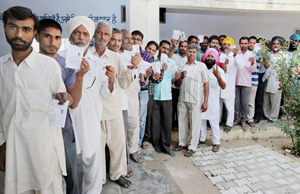
Various exit polls gave the Bharatiya Janata Party a margin of 42-54 seats in the 90-member Haryana assembly and 124-151 seats in the 288-strong Maharashtra legislature.

The Congress, which had ruled Haryana for the last 10 years, was predicted to end up with just 10-18 seats. In Maharashtra, the exit polls gave the Shiv Sena, the BJP's former ally for 25 years, 51-77 seats, Congress 27-48 seats and Nationalist Congress Party 28-41 seats. The last two had ruled the state for three terms since 1999 before their alliance ended last month.

While some exit polls predicted BJP getting a majority in the two states, others projected it as the single largest party, a few seats short of a simple majority.

The bitter battle for Maharashtra ended Wednesday evening with over 64 percent of the 8.35 crore electorate voting. Polling also took place for the Beed Lok Sabha seat where a bypoll was necessitated following the death in June of central minister Gopinath Munde.

Sena youth leader Aditya Thackeray asserted that not only would his party form the government, but its president (his father) Uddhav Thackeray would be the next chief minister.

On the other hand, senior BJP leader and MP Poonam Mahajan confidently declared that "the people would support the vision of development propounded by Prime Minister Narendra Modi".

Stray incidents of violence marred an otherwise peaceful election. In Gadchiroli district, Maoists attempted to disrupt the polls by firing at a polling booth but security personnel returned fire and voting continued peacefully. Some incidents were also reported from Yavatmal, Thane and Mumbai.

Mumbai saw celebrities, including industrialists, Bollywood stars, television actors and cricketers, queueing up to vote and urging people to follow suit.

Among those seen were industrialists Anil Ambani and Adi Godrej, and film personalities Rekha, Shah Rukh Khan, Salman Khan, Sohail Khan, Jaya and Abhishek Bachchan, Javed Akhtar, Gulzar, Sonali Bendre, Anupam Kher, Hema Malini, Amol Palekar, Aamir Khan, Kiran Rao-Khan, Esha Deol, Nana Patekar, Prem Chopra, Govinda, Akshay Kumar, John Abraham, Rishi Kapoor and family, and Jeetendra and his family.

A total of 4,119 candidates were in the fray in the elections that saw Maharashtra's two main coalitions -- the BJP-Shiv Sena combine and the NCP-Congress alliance -- collapse, making the contest wide open but with advantage to BJP.

Prime Minister Narendra Modi led the BJP's campaign, addressing scores of heavily attended rallies and prompting a verbal assault from Shiv Sena. The Maharashtra Navnirman Sena (MNS) was also a key contender but surveys indicate it seemed to barely make an impact.

During the campaign, other parties attacked the BJP more than any other, making it a de facto BJP-versus-rest battle.

In Haryana, the voters Wednesday set a new record with over 75.5 percent of the 1.63 crore electorate exercising their franchise, perking up the BJP's hopes to come to power on its own.

This is the highest voting in Haryana assembly polls since 1967, chief electoral officer Shrikant Walgad said.The previous record of maximum polling was 72.65 percent in 1967. In 2009, Haryana recorded nearly 72.29 percent voting.

The BJP was confident of victory. "The BJP is all set to form the next government in Haryana on its own. We will get a clear majority and end scams and corruption," party leader Abhimanyu said.

Chief Minister Bhupinder Singh Hooda was not willing to give up easily, saying the "response of the voters" showed the Congress will form the government for a third term.

INLD leader Abhay Chautala claimed the heavy turnout was an indication that his party would form the next government.

Minor clashes at about 10 places marred the otherwise peaceful polling. Exit polls were unanimous in their prediction about major gains for BJP. Here is a state-wise prediction of some exit polls.

Maharashtra:

India TV C-Voter - BJP (124-134 seats), Shiv Sena (51-61), NCP (31-41), Congress (38-48), MNS (9-15).

Today's Chanakya - BJP 151 (+/- 9), Shiv Sena 71 (+/- 9), Congress 27 (+/-5), NCP 28 (+/- 5), MNS and others 11 (+/- 5).

ABP News-Nielsen - BJP+ (127 seats), Shiv Sena (77), Congress (40), NCP (34) and MNS (5).

C-voter poll - BJP (129), Congress (43), Shiv Sena (56), NCP (36).

Haryana:

India TV- C Voter - BJP (42-48), INLD (20-26), Congress (12-18).

ABP-Nielsen poll - BJP (54), Congress (10) and the INLD (22).

Today's Chanakya - BJP 52 (+/-7), INLD 23 (+/-7), Congress 10 (+/-5) and others five (+/-3).

Comments

Add new comment

  • Coastaldigest.com reserves the right to delete or block any comments.
  • Coastaldigset.com is not responsible for its readers’ comments.
  • Comments that are abusive, incendiary or irrelevant are strictly prohibited.
  • Please use a genuine email ID and provide your name to avoid reject.
News Network
March 25,2020

Mumbai, Mar 25: Maharashtra Health Minister Rajesh Tope on Wednesday confirmed that five people from a family in Sangli and four others from Mumbai tested positive for coronavirus, taking the total count to 116, which is the highest in any state of the country.
"The current count of COVID19 patients in the state of Maharashtra is 116. In Sangli, 5 people from one family are identified as positive due to contacts and 4 people from Mumbai are identified as positive due to travel history or contacts," Tope tweeted.
The state Health Minister informed that out of 116 people, 14 people have recovered and are in the process of being discharged from the hospitals.
"14 people from these have been recovered and are in the process of being discharged from the hospitals," he said in another tweet.
Meanwhile, the Sangli district administration in Maharashtra has released contact numbers for citizens to get home delivery of essential items during the 21-day lockdown to prevent the spread of coronavirus.
The police personnel and district administration will be in charge of facilitating delivery for the essential commodities during the lockdown.
The Indian Council of Medical Research (ICMR) on Wednesday confirmed 539 positive cases of coronavirus in the country.
Prime Minister Narendra Modi had on Tuesday announced a 21-day lockdown in the entire country effective from midnight to deal with the spread of coronavirus, saying that "social distancing" is the only option to deal with the disease, which spreads rapidly.

Comments

Add new comment

  • Coastaldigest.com reserves the right to delete or block any comments.
  • Coastaldigset.com is not responsible for its readers’ comments.
  • Comments that are abusive, incendiary or irrelevant are strictly prohibited.
  • Please use a genuine email ID and provide your name to avoid reject.
News Network
April 24,2020

New Delhi, Apr 24: The trajectory of COVID-19 cases could have plateaued and might even fall for some weeks after the lockdown is lifted but India is likely to see a second wave in late July or August with a surge in the number of cases during the monsoon, say scientists.

The timing of the peak will depend on how India is able to control physical distancing and on the level of infection spreads after restrictions are relaxed, they said.

It looks apparent that the trajectory of daily new cases has reached a plateau and eventually it will take a downward fall, maybe for some weeks or even months, Samit Bhattacharya, associate professor at the Department of Mathematics, Shiv Nadar University, said.

Still, we may get a surge of new cases of the same coronavirus and this will be considered a second wave, Bhattacharya explained.

The second epidemic may come back in late July or August in the monsoon, although the peak timing will depend on how we control social distancing during that time, he said.

Rajesh Sundaresan, professor at Bengaluru's Indian Institute of Science (IISc), agreed.

“Once we return to normal activity levels, there is a chance that infection may begin to rise again. China is seeing this to some extent post easing of some restrictions on travel,” Sundaresan, corresponding author of a working paper by researchers at IISc and the Tata Institute of Fundamental Research (TIFR) in Mumbai, said.

On March 25, when the number of coronavirus cases was 618 with 13 deaths, the government announced a nationwide lockdown that was later extended to May 3.

On Friday, the death toll due to COVID-19 rose to 718 and the number of cases to 23,077, according to the Union Health Ministry.

In good news, officials said this week that the doubling rate of cases has slowed down in the period, going from 3.4 days before lockdown to 7.5 days, with 18 states doing better than the national average. The recovery rate has also almost doubled in the last 10 days.

"Looking at the new cases in the past few days, it seems the growth of new daily infection is much slower than earlier. This apparently indicates that we might have reached at the plateau of the growth curve, Bhattacharya said.

He noted that recent studies in China and Europe observed that the infection might relapse in those people who have already recovered from earlier phases.

So, there is no evidence that the earlier infection may help acquire immunity against the second infection. And in that way, the entire population may be vulnerable to the second wave to some extent, said the scientist.

In their study unveiled this week, IISc and TIFR researchers analysed the impact of strategies such as case isolation, home quarantine, social distancing and various post-lockdown restrictions on COVID-19 that might remain in force for some time.

The study modelled on Bengaluru and Mumbai suggests the infection is likely to have a second wave and the public health threat will remain, unless steps are taken to aggressively trace, localise, isolate the cases, and prevent influx of new infections.

The new levels and the peaking times for healthcare demand depend on the levels of infection spreads in each city at the time of relaxation of restrictions, they said.

The lockdown is currently upon us. It has given us valuable time. Let us test, trace, quarantine, isolate, practice better hygiene, search for a vaccine, etc. We should do these anyway, and these are being done. When and how to lift the lockdown is going to be a difficult decision to make, said Sundaresan.

It's clear that it's going to be phased. What our team is focusing on is to come up with tools to help the decision makers assess the public health impact of various choices, he said.

According to the experts, infectious diseases spread via contact between infectious and susceptible people. In the absence of any control measures, an outbreak will grow as long as the average number of people infected by each infectious person is more than one.

Once enough people are immune there will be fewer people susceptible to the infection and the outbreak will die.

However, when an outbreak is brought under control by social distancing and other interventions, it is possible only a small proportion of the population will have been infected and gained immunity, they said.

This means enough susceptible people may remain to fuel a second wave if controls are relaxed and infection is reintroduced.

Until the vaccine comes on the market, we have to remain alert Once sporadic cases occur here and there in the country, we immediately need to implement quarantine or social distancing locally for the people in that region, and also need to perform tests to identify positive cases irrespective of showing symptoms, Bhattacharya explained.

Note that these monsoon months are also flu season in many places of India. So, we should not ignore the early signs of the flu symptoms. Irrespective of symptoms, we need to increase tests in the hotspots to identify people and contain the surge, he said.

Sundaresan added that the timeline for a second wave will depend on a lot of circumstances which may change as the time passes.

Significant testing may have been underway, there may be behavioural changes with people becoming more careful about their hygiene, wearing masks may become more common, etc. All these responses may help restrict the second wave, he said.

A study published in The Lancet journal earlier this month modelled the potential adverse consequences of premature relaxation of interventions, and found it might lead to a second wave of infections.

The finding is critical to governments globally, because it warns against premature relaxation of strict interventions, the researchers said.

While interventions to control the spread of SARS-CoV-2 are in place, countries will need to work toward returning to normalcy; thus, knowledge of the effect of each intervention is urgently required, they said in the study.

According to a recent analysis by the Harvard Chan School of Public Health, the best strategy to ease the critical care burden and loss of life from COVID-19 might be on-again, off-again social distancing.

In the absence of such interventions, surveillance and intermittent distancing may need to be maintained into 2022, which would present a substantial social and economic burden, the researchers wrote.p

Comments

Add new comment

  • Coastaldigest.com reserves the right to delete or block any comments.
  • Coastaldigset.com is not responsible for its readers’ comments.
  • Comments that are abusive, incendiary or irrelevant are strictly prohibited.
  • Please use a genuine email ID and provide your name to avoid reject.
News Network
February 28,2020

Thane, Feb 28: Former BJP MLA Narendra Mehta was on Friday charged for allegedly  raping and harassing a woman corporator in Bhayandar, which is in the Thane district near Mumbai, on Friday, police said.

His associate Sanjay Tharthare has also been charged in the case, they said.

The district rural police lodged an FIR against Narendra Mehta, who resigned from the BJP three days ago, and his associate, an official from the Mira-Bhayandar police station said.

No arrest has been made till now.

A video of the corporator purportedly speaking about the alleged harassment and abuse she suffered at the hands of Narendra Mehta went viral on social media two days ago, the official said.

The corporator has alleged that the abuse is going on since 1999 and her family is facing threats from him, he added.

Narendra Mehta and Sanjay Tharthare were charged under relevant section of the Indian Penal Code for rape and other relevant provisions of the Scheduled Castes and Scheduled Tribes (Prevention of Atrocities) Act, 1989, he said.

Meanwhile, Shiv Sena MLA Pratap Sarnaik demanded the immediate arrest of Narendra Mehta, saying it is a "tragedy" that the BJP, which raises the issue of women's safety in the state, has not taken any action against its leader.

"Law and order issue will arise if such a person (facing rape and harassment charges) roams freely. He should be arrested as soon as possible," Mr Sarnaik said.

The Thane legislator also termed Narendra Mehta as "Marathi-hater" and alleged that he had once questioned Chief Minister Uddhav Thackeray's culture.

"I wonder why the BJP did not take strict action against Mehta, it needs to introspect," Mr Sarnaik said.

Comments

Add new comment

  • Coastaldigest.com reserves the right to delete or block any comments.
  • Coastaldigset.com is not responsible for its readers’ comments.
  • Comments that are abusive, incendiary or irrelevant are strictly prohibited.
  • Please use a genuine email ID and provide your name to avoid reject.