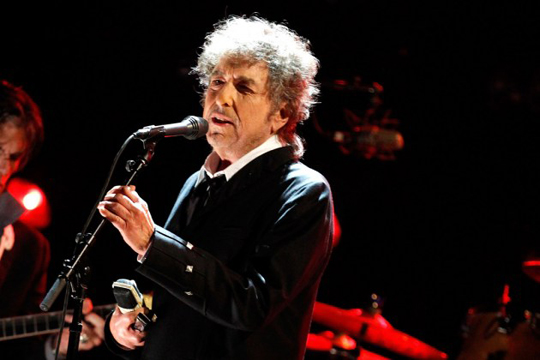
Bob Dylan accepts Nobel, says it left him 'speechless'

October 29, 2016

London, Oct 29: Bob Dylan has finally accepted his Nobel prize for literature, the Swedish Academy that awards it has said, breaking his silence on the win that he said left him "speechless". Asked "if I accept the prize? Of course", the US singer-songwriter said in a call to the academy this week, around a fortnight after he was named laureate on October 13.

bob

"The news about the Nobel Prize left me speechless," he told the academy's permanent secretary, Sara Danius. "I appreciate the honour so much." Dylan had not responded to repeated phone calls made by the academy following the prize announcement, nor had he made any public statement, prompting one academy member to call him "impolite and arrogant".

The academy said yesterday that it had not yet been decided yet if Dylan would visit Stockholm to pick up his award. Sweden's King Carl XVI Gustaf usually hands out prizes and cheques to all the Nobel winners at a banquet on December 10.

Asked in an interview with Britain's Daily Telegraph newspaper published late yesterday if he would turn up, he said: "Absolutely. If it's at all possible." Dylan told the paper that the award was "amazing, incredible", saying: "It's hard to believe."

He added: "Whoever dreams about something like that?" Asked why he did not respond to the academy's calls, Dylan said: "Well, I'm right here." Dylan, whose lyrics have influenced generations of fans, is the first songwriter to win the literature prize.

Comments

Add new comment

  • Coastaldigest.com reserves the right to delete or block any comments.
  • Coastaldigset.com is not responsible for its readers’ comments.
  • Comments that are abusive, incendiary or irrelevant are strictly prohibited.
  • Please use a genuine email ID and provide your name to avoid reject.
News Network
May 25,2020

Islamabad/Dhaka, May 25: The coronavirus pandemic and lockdowns coupled with travel restrictions and social distancing norms have muted the Eid celebrations in Pakistan and Bangladesh as worshippers in the two Muslim-majority countries marked the end of Ramzan in strictly-regulated prayer congregations.

A large number of people in the two countries were forced to stay indoors on the occasion of Eid al-Fitr, marking the end of the fasting month of Ramzan, due to the fears of contracting the novel coronavirus which has killed nearly 3.5 lakh people and infected over 5.4 million across the world.

In Pakistan, the government has issued strict instructions to observe social distancing while offering Eid prayers and asked people to avoid visiting relatives and hosting parties.

As the railways remained closed, many people could not travel to their hometowns for the most important festival.

Eid congregations were held at open places, mosques and Eidgahs in all major cities and towns while following strict standard operating procedures (SOPs) of social distancing and other precautionary measures. But in some areas, the people did not adhere to the SOPs and were seen thronging to their favourite shops to celebrate Eid.

Pakistan Prime Minister's Special Assistant on Health Zafar Mirza on Friday said the deadly infection would continue to multiply if precautions are not taken.

Earlier this month, the government announced the lifting of the countrywide lockdown imposed to curb the spread of the COVID-19 in phases, even as infections continued to rise in the country.

Pakistan's coronavirus cases on Monday reached 56,349 with 1,748 new patients while the death toll climbed to 1,167 after 34 people lost their lives in the last 24 hours.

The trajectory showed that the number was steadily going up with authorities fearing a rise in cases in the wake of the easing of lockdown before Eid.

But Prime Minister Imran Khan cited the economic havoc the virus restrictions had wreaked on citizens as the reason behind the decision to ease the restrictions.

He urged Pakistanis to forgo the traditional Eid festivity in view of the hundreds of fatalities caused by the coronavirus and the lives lost in Friday's plane crash in Karachi.

Ninety-seven people, including nine children, were killed and two passengers miraculously survived a fiery crash when a Pakistan International Airlines plane with 99 travellers on board plunged into a densely populated residential area near the Jinnah International Airport.

Most of the victims were travelling home to celebrate Eid.

In Bangladesh, millions of Muslims joined the strictly-regulated prayer congregations across the country.

Thousands of worshippers attended the prayer services at the Baitul Mukarram National Mosque in Dhaka while following the health and social distancing protocols to limit the spread of the coronavirus, bdnews24.com reported.

Despite the government directive for children and senior citizens not to participate in Eid prayers, many children and people aged over 60 attended the Eid prayers. Although social distancing rules were maintained to a large extent, people were seen flouting the norms, the report said.

As per the government order, no Eid congregation will be held in an open space, but people can perform the Eid prayers in mosques. However, everyone coming to the mosques for prayer must wear a mask, follow social distancing and other hygiene rules, said Islamic Foundation Secretary Kazi Nurul Islam.

On Sunday, Bangladesh reported 28 new fatalities, the highest single-day increase, bringing the death toll to 480.

The number of coronavirus cases in the country rose to 33,610 after 1,532 people tested positive on Sunday.

Comments

Add new comment

  • Coastaldigest.com reserves the right to delete or block any comments.
  • Coastaldigset.com is not responsible for its readers’ comments.
  • Comments that are abusive, incendiary or irrelevant are strictly prohibited.
  • Please use a genuine email ID and provide your name to avoid reject.
Agencies
August 7,2020

Russia boasts that it's about to become the first country to approve a Covid-19 vaccine, with mass vaccinations planned as early as October using shots that are yet to complete clinical trials -- and scientists worldwide are sounding the alarm that the headlong rush could backfire.

Moscow sees a Sputnik-like propaganda victory, recalling the Soviet Union's launch of the world's first satellite in 1957.

But the experimental Covid-19 shots began first-in-human testing on a few dozen people less than two months ago, and there's no published scientific evidence yet backing Russia's late entry to the global vaccine race, much less explaining why it should be considered a front-runner.

“I'm worried that Russia is cutting corners so that the vaccine that will come out may be not just ineffective, but also unsafe,” said Lawrence Gostin, a global public health law expert at Georgetown University. “It doesn't work that way... Trials come first. That's really important.”

According to Kirill Dmitriev, head of Russia's Direct Investment Fund that bankrolled the effort, a vaccine developed by the Gamaleya research institute in Moscow may be approved in days, before scientists complete what's called a Phase 3 study.

That final-stage study, usually involving tens of thousands of people, is the only way to prove if an experimental vaccine is safe and really works.

Health Minister Mikhail Murashko said members of “risk groups,” such as medical workers, may be offered the vaccine this month.

He didn't clarify whether they would be part of the Phase 3 study that is said to be completed after the vaccine receives “conditional approval.”

Deputy Prime Minister Tatyana Golikova promised to start “industrial production” in September, and Murashko said mass vaccination may begin as early as October.

Dr Anthony Fauci, the top US infectious disease specialist, questioned the fast-track approach last week.

“I do hope that the Chinese and the Russians are actually testing a vaccine before they are administering the vaccine to anyone, because claims of having a vaccine ready to distribute before you do testing I think is problematic at best," he said.

Questions about this vaccine candidate come after the US, Britain and Canada last month accused Russia of using hackers to steal vaccine research from Western labs.

Delivering a vaccine first is a matter of national prestige for the Kremlin as it tries to assert the image of Russia as a global power capable of competing with the US and China.

The notion of being “the first in the world” dominated state news coverage of the effort, with government officials praising reports of the first-step testing.

In April, President Vladimir Putin ordered state officials to shorten the time of clinical trials for a variety of drugs, including potential coronavirus vaccines.

According to Russia's Association of Clinical Trials Organizations, the order set “an unattainable bar” for scientists who, as a result, "joined in on the mad race, hoping to please those at power.”

The association first raised concern in late May, when professor Alexander Gintsburg, head of the Gamaleya institute, said he and other researchers tried the vaccine on themselves.

The move was a “crude violation of the very foundations of clinical research, Russian law and universally accepted international regulations" the group said in an open letter to the government, urging scientists and health officials to adhere to clinical research standards.

But a month later, the Health Ministry authorized clinical trials of the Gamaleya product, with what appeared to be another ethical issue.

Human studies started June 17 among 76 volunteers. Half were injected with a vaccine in liquid form and the other half with a vaccine that came as soluble powder.

Some in the first half were recruited from the military, which raised concerns that servicemen may have been pressured to participate.

Some experts said their desire to perform well would affect the findings. “It's no coincidence media reports we see about the trials among the military said no one had any side effects, while the (other group) reported some," said Vasily Vlassov, a public health expert with Moscow's Higher School of Economics.

As the trials were declared completed and looming regulatory approval was announced last week, questions arose about the vaccine's safety and effectiveness.

Government assurances the drug produced the desired immune response and caused no significant side effects were hardly convincing without published scientific data describing the findings.

The World Health Organization said all vaccine candidates should go through full stages of testing before being rolled out.

“There are established practices and there are guidelines out,” WHO spokesman Christian Lindmeier said Tuesday.

“Between finding or having a clue of maybe having a vaccine that works, and having gone through all the stages, is a big difference.”

Offering an unsafe compound to medical workers on the front lines of the outbreak could make things worse, Georgetown's Gostin said, adding: “What if the vaccine started killing them or making them very ill?”

Vaccines that are not properly tested can cause harm in many ways — from a negative impact on health to creating a false sense of security or undermining trust in vaccinations, said Thomas Bollyky, director of the global health program at the Council on Foreign Relations. 

Comments

Add new comment

  • Coastaldigest.com reserves the right to delete or block any comments.
  • Coastaldigset.com is not responsible for its readers’ comments.
  • Comments that are abusive, incendiary or irrelevant are strictly prohibited.
  • Please use a genuine email ID and provide your name to avoid reject.
News Network
July 1,2020

Melbourne, July 1: Authorities will lock down around 300,000 people in suburbs north of Melbourne for a month from late on Wednesday to contain the risk of infection after two weeks of double-digit rises in new coronavirus cases in Australia's second-most populous state.

Australia has fared better than many countries in the pandemic, with around 7,830 cases and 104 deaths, but the recent surge has stoked fears of a second wave of COVID-19, echoing concerns expressed in other countries.

Globally, coronavirus cases exceeded 10 million on Sunday, a major milestone in the spread of a disease that has killed more than half a million people in seven months.

From midnight, more than 30 suburbs in Australia's second-biggest city will return to stage three restrictions, the third-strictest level in curbs to control the pandemic. That means residents will be confined to home except for grocery shopping, health appointments, work or caregiving, and exercise.

The restrictions will be accompanied by a testing blitz that authorities hope will extend to half the population of the area affected, and for which borders will be patrolled, authorities said. The measures come as curbs ease across the rest of the state of Victoria, with restaurants, gyms and cinemas reopening in recent weeks.

Victoria recorded 73 fresh cases on Tuesday from 20,682 tests, following an increase of 75 cases on Monday. State premier Daniel Andrews warned on Wednesday that the return of broader restrictions across city remained a possibility.

"If we all stick together these next four weeks, we can regain control of that community transmission ... across metropolitan Melbourne," Andrews said at a briefing. "Ultimately if I didn't shut down those postcodes I'd be shutting down all postcodes. We want to avoid that."

Victoria's spike in cases has been linked to staff members at hotels housing returned travellers for which quarantine protocols were not strictly followed. Victorian state authorities have announced an investigation into the matter.

Some other Australian states and territories are preparing to open borders, but applying limits and quarantine measures to citizens of Victoria as the school holiday season gets under way.

South Australia, the country's fifth most populous state, has had just three new cases in the past month. But citing the spike in coronavirus infections, on Tuesday it cancelled its scheduled reopening to other parts of the nation.

New South Wales (NSW), Australia's most populous state, has stopped short of closing its borders to all Victorians, but those holidaying from hotspot areas - not permitted under NSW rules - can be handed a fine of A$11,000 ($7,596) or jailed if they are detected, state authorities said.

The delays reopening internal borders cast doubts over a federal plan to set up "travel bubble" with neighbouring New Zealand that would allow movement between the two countries.

Comments

Add new comment

  • Coastaldigest.com reserves the right to delete or block any comments.
  • Coastaldigset.com is not responsible for its readers’ comments.
  • Comments that are abusive, incendiary or irrelevant are strictly prohibited.
  • Please use a genuine email ID and provide your name to avoid reject.