



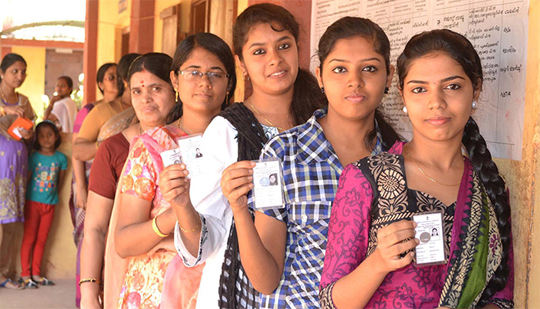
Brisk polling in Maha; celebrities cast vote

October 15, 2014

Mah Polling

Mumbai, Oct 15: Polling began on a brisk note in Maharashtra this morning, where 7.31 per cent of the over 8.35 crore voters exercised their franchise in the first two hours.

A policeman on election duty was killed after being struck by lightning in Avdeghat polling station of Savner constituency in Vidarbha, where polling in some parts was marred by rains.

The estimated polling in some districts was: Aurangabad 10 per cent, Beed 9, Solapur 8, Kolhapur 10, Hingoli 8.5, Osmanabad 9, Nashik 7, and Parbhani 7.5 per cent.

Among the early voters were former chief minister Prithviraj Chavan, who cast his vote in Karad in western Maharashtra, from where he is a candidate, former Deputy Chief Minister Ajit Pawar in Baramati, former Union Home Minister Sushilkumar Shinde in Solapur, Leader of Opposition in Council Vinod Tawde in Mumbai and NCP MP Supriya Sule and her mother Pratibha Pawar.

State BJP president Devendra Fadnavis, a front runner for chief ministerial post in case BJP comes to power, also cast his vote.

Asked if his party Shiv Sena will have a post-poll alliance with BJP or any other party, former Lok Sabha Speaker Manohar Joshi, who cast his vote in Mumbai, said, "Sena President Uddhav Thackeray is the ultimate authority on this issue."

Among Bollywood personalities who went to polling booths in Mumbai early today were actress Rekha, Jaya Bachchan, Abhishek Bachchan, Amol Palekar and actor Atul Kulkarni. Cricket icon Sachin Tendulkar also cast his vote.

Voters will decide the fate of 4,119 candidates in the fray in 288 seats. Polling began at 7 AM and will conclude at 6 PM. Counting of votes will be held on October 19.

The voting is being held to elect the 13th Assembly in the state. While Congress leaders voiced confidence that people will again favour the party, BJP claimed that it was a vote for change and that 'Modi effect' will be visible in the election result.

Sharad Pawar's NCP claimed that the BJP had not lived up to the expectations of the people after the mandate it got in Lok Sabh election and it will face the repercussions in Maharashtra.

"I am confident that people will choose Congress this time also for the work done in last 15 years," Prithviraj Chavan said after casting his vote in Karad.

"There has been a change in the government at the Centre, major alliances have ended, and ll political parties are taking their chances in this poll," he said.

I&B Minister Prakash Javadekar, who cast his vote in Pune, said, "People are voting for change, good governance and decisive government which Narendra Modi has offered."

"People are voting in this poll with even more enthusiasm than they did in the Lok Sabha poll. If the Lok Sabha polls were Dhoom, the Assembly polls are Dhoom 2, the sequel," he said. Evading queries on possible post-poll alliance, BJP leaders claimed that the party will get complete majority

"I am sure people of Maharashtra will ensure a BJP government comes to power in the state," Fadnavis said after casting his vote in Nagpur. Former chief minister Ashok Chavan cast his vote in Nanded. His wife Ameeta is Congress candidate from Bhokar in the district.

Technical problems in EVMs were reported from some polling booths in Nagpur city and Wardha district of in Vidarbha, and Sewree in Mumbai. Voters in a Nashik booth also complained that the voter rolls were not in order.

NCP chief Sharad Pawar cast his vote in Mumbai, which recorded a dismal 5.50 per cent, while adjoining Thane recorded 5.78 polling percentage in first two hours.

"There has always been a fair and transparent election in Maharashtra. I would request people to come out in good numbers. Your single vote can make a big difference. I believe our numbers will increase," Pawar's daughter Supriya Sule said.

Out of the total 8,35,38,114 voters in the state, 4,40,26,401 are men and 3,93,63,011 are women. There are 984 voters in the "others" category. The number of service voters is 147,718.

Of the 4119 candidates in the electoral fray, 3843 are male and 276 women. Of the 288 constituencies, including 36 constituencies in Mumbai, 234 are general, 29 reserved for scheduled castes and 25 for scheduled tribes.

There are 83 constituencies having more than 15 candidates and a constituency where there are more than 32 candidates.

While Nanded South has the maximum 39 candidates, Akole and Guhagar have the minimum number at five candidates each.

BJP has fielded 280, BSP 260, CPI 34, CPM 19, Congress 287, NCP 278, Shiv Sena 282 and MNS has fielded 219.

Registered parties other than recognised state and national parties have fielded 761 candidates. There are 1699 independents also in the poll arena.

Chinchwad in Pune district, with 4,84,080 voters, is the largest constituency, while Wadala in Mumbai, with 1,96,859 voters is the smallest.

The Election Commission has deputed 135 general observers, 112 expenditure observers, five police observers and 18 awareness observers, the officials said.

Altogether 5,84,617 polling personnel have been deployed. The number of polling stations is 91,376.

The high-octane campaign for Maharashtra Assembly election ended on October 13 with the state witnessing a five-cornered contest for the Assembly.

In Pune, a moderate turn out was witnessed in the early hours of polling which began peacefully in the 21 assembly constituencies in the district.

A BJP spokesman said two complaints of bogus voting in Kothrud area of Pune were registered with the election officers. Some voters in the city also complained of instant erasing of the indelible ink used to mark the voters.

An estimated nine per cent voters cast their votes in the first two hours of polling which was progressing peacefully, officials said.'

Comments

Add new comment

  • Coastaldigest.com reserves the right to delete or block any comments.
  • Coastaldigset.com is not responsible for its readers’ comments.
  • Comments that are abusive, incendiary or irrelevant are strictly prohibited.
  • Please use a genuine email ID and provide your name to avoid reject.
News Network
March 26,2020

New Delhi, Mar 26: Finance Minister Nirmala Sitharaman on Thursday announced a Rs 50 lakh insurance cover for healthcare workers who are at the forefront of dealing with coronavirus pandemic.

Sitharaman said the government has finalised an economic stimulus package to deal with the impact of 21-day countrywide lockdown to prevent spread of the virus.

“It’s only 36 hours since the lockdown has been imposed. Now we have come with a package which immediately take care of the welfare concerns of the poor and suffering workers and those who need immediate help,” Sitharaman said.

She also said that 80 crore poor people, nearly two thirds of the population  will get five kg of rice or wheat per month for three months, in addition to the 5 kg they already receive, for free."

The rationcard holders can take the foodgrains and pulses from the Public Distribution System (PDS) in two installments, she added.

"This measure will ensure no gareeb (poor) remains hungry," Sitharaman said.

The package will include cash transfer and food subsidy, she said.

"Farmers who currently receive Rs 6,000 annually, will be given the first installment of the next financial year immediately. 8.7 crore farmers will benefit from it," said Sitharaman.

As many of 20.5 crore women Jan Dhan Account holders will get Rs 500 per month for next three months to run their households.

For poor senior citizens, widow and disabled will get an ex-gratia of Rs 1,000.

Also, the daily wage under MNREGA has been increased to Rs 202 a day from Rs 182 to benefit 5 crore workers.

The minister said the government will front-load Rs 2,000 payment to farmers in the first week of April under the existing PM Kishan Yojana to benefit 8.69 crore farmers.

Also, the beneficiaries of Ujjwala LPG scheme will get free cooking gas for the next three months, she said.

This forms part of the Rs 1.70 lakh crore Gramin Kalyan Package.

Prime Minister Narendra Modi last week had constituted a task force headed by the Finance Minister to work out package for economy hit by coronavirus.

Comments

Add new comment

  • Coastaldigest.com reserves the right to delete or block any comments.
  • Coastaldigset.com is not responsible for its readers’ comments.
  • Comments that are abusive, incendiary or irrelevant are strictly prohibited.
  • Please use a genuine email ID and provide your name to avoid reject.
News Network
May 14,2020

London, May 14: Fugitive liquor baron Vijay Mallya on Thursday urged the Central government to accept his offer to repay 100 per cent of his loan dues and close the case against him.

While congratulating the Centre for introducing Rs 20 lakh crore relief package to boost the economy amid the coronavirus lockdown, Mallya, lamented that his repeated attempts to pay back his dues have been ignored by the Indian government.

"Congratulations to the Government for a Covid 19 relief package. They can print as much currency as they want BUT should a small contributor like me who offers 100% payback of State-owned Bank loans be constantly ignored? Please take my money unconditionally and close," he tweeted.

Earlier this month, Mallya had sought permission to appeal against a ruling ordering his extradition to India in Britain's highest court the UK Supreme Court.

The application comes two weeks after the High Court in London - the UK's second-highest court - dismissed Mallya's appeal against a lower court ruling that he be sent to India to face charges of defrauding a consortium of Indian banks of more than Rs 9,000 crores relating to the collapse of Kingfisher Airlines in 2012.

Comments

Add new comment

  • Coastaldigest.com reserves the right to delete or block any comments.
  • Coastaldigset.com is not responsible for its readers’ comments.
  • Comments that are abusive, incendiary or irrelevant are strictly prohibited.
  • Please use a genuine email ID and provide your name to avoid reject.
News Network
April 24,2020

New Delhi, Apr 24: The trajectory of COVID-19 cases could have plateaued and might even fall for some weeks after the lockdown is lifted but India is likely to see a second wave in late July or August with a surge in the number of cases during the monsoon, say scientists.

The timing of the peak will depend on how India is able to control physical distancing and on the level of infection spreads after restrictions are relaxed, they said.

It looks apparent that the trajectory of daily new cases has reached a plateau and eventually it will take a downward fall, maybe for some weeks or even months, Samit Bhattacharya, associate professor at the Department of Mathematics, Shiv Nadar University, said.

Still, we may get a surge of new cases of the same coronavirus and this will be considered a second wave, Bhattacharya explained.

The second epidemic may come back in late July or August in the monsoon, although the peak timing will depend on how we control social distancing during that time, he said.

Rajesh Sundaresan, professor at Bengaluru's Indian Institute of Science (IISc), agreed.

“Once we return to normal activity levels, there is a chance that infection may begin to rise again. China is seeing this to some extent post easing of some restrictions on travel,” Sundaresan, corresponding author of a working paper by researchers at IISc and the Tata Institute of Fundamental Research (TIFR) in Mumbai, said.

On March 25, when the number of coronavirus cases was 618 with 13 deaths, the government announced a nationwide lockdown that was later extended to May 3.

On Friday, the death toll due to COVID-19 rose to 718 and the number of cases to 23,077, according to the Union Health Ministry.

In good news, officials said this week that the doubling rate of cases has slowed down in the period, going from 3.4 days before lockdown to 7.5 days, with 18 states doing better than the national average. The recovery rate has also almost doubled in the last 10 days.

"Looking at the new cases in the past few days, it seems the growth of new daily infection is much slower than earlier. This apparently indicates that we might have reached at the plateau of the growth curve, Bhattacharya said.

He noted that recent studies in China and Europe observed that the infection might relapse in those people who have already recovered from earlier phases.

So, there is no evidence that the earlier infection may help acquire immunity against the second infection. And in that way, the entire population may be vulnerable to the second wave to some extent, said the scientist.

In their study unveiled this week, IISc and TIFR researchers analysed the impact of strategies such as case isolation, home quarantine, social distancing and various post-lockdown restrictions on COVID-19 that might remain in force for some time.

The study modelled on Bengaluru and Mumbai suggests the infection is likely to have a second wave and the public health threat will remain, unless steps are taken to aggressively trace, localise, isolate the cases, and prevent influx of new infections.

The new levels and the peaking times for healthcare demand depend on the levels of infection spreads in each city at the time of relaxation of restrictions, they said.

The lockdown is currently upon us. It has given us valuable time. Let us test, trace, quarantine, isolate, practice better hygiene, search for a vaccine, etc. We should do these anyway, and these are being done. When and how to lift the lockdown is going to be a difficult decision to make, said Sundaresan.

It's clear that it's going to be phased. What our team is focusing on is to come up with tools to help the decision makers assess the public health impact of various choices, he said.

According to the experts, infectious diseases spread via contact between infectious and susceptible people. In the absence of any control measures, an outbreak will grow as long as the average number of people infected by each infectious person is more than one.

Once enough people are immune there will be fewer people susceptible to the infection and the outbreak will die.

However, when an outbreak is brought under control by social distancing and other interventions, it is possible only a small proportion of the population will have been infected and gained immunity, they said.

This means enough susceptible people may remain to fuel a second wave if controls are relaxed and infection is reintroduced.

Until the vaccine comes on the market, we have to remain alert Once sporadic cases occur here and there in the country, we immediately need to implement quarantine or social distancing locally for the people in that region, and also need to perform tests to identify positive cases irrespective of showing symptoms, Bhattacharya explained.

Note that these monsoon months are also flu season in many places of India. So, we should not ignore the early signs of the flu symptoms. Irrespective of symptoms, we need to increase tests in the hotspots to identify people and contain the surge, he said.

Sundaresan added that the timeline for a second wave will depend on a lot of circumstances which may change as the time passes.

Significant testing may have been underway, there may be behavioural changes with people becoming more careful about their hygiene, wearing masks may become more common, etc. All these responses may help restrict the second wave, he said.

A study published in The Lancet journal earlier this month modelled the potential adverse consequences of premature relaxation of interventions, and found it might lead to a second wave of infections.

The finding is critical to governments globally, because it warns against premature relaxation of strict interventions, the researchers said.

While interventions to control the spread of SARS-CoV-2 are in place, countries will need to work toward returning to normalcy; thus, knowledge of the effect of each intervention is urgently required, they said in the study.

According to a recent analysis by the Harvard Chan School of Public Health, the best strategy to ease the critical care burden and loss of life from COVID-19 might be on-again, off-again social distancing.

In the absence of such interventions, surveillance and intermittent distancing may need to be maintained into 2022, which would present a substantial social and economic burden, the researchers wrote.p

Comments

Add new comment

  • Coastaldigest.com reserves the right to delete or block any comments.
  • Coastaldigset.com is not responsible for its readers’ comments.
  • Comments that are abusive, incendiary or irrelevant are strictly prohibited.
  • Please use a genuine email ID and provide your name to avoid reject.