



Bruising Fight Looms Over Key Donald Trump Nominees

February 2, 2017

Washington, Feb 2: President Donald Trump has seized a chance to swing the US Supreme Court back to conservative leanings but a drawn-out battle loomed Wednesday over this and other nominations, jarring with his vow to sweep aside politics as usual.
BruisingFight

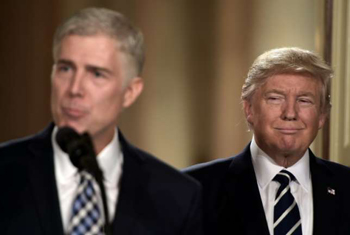
Trump, in the second week of his already-unorthodox presidency, nominated Judge Neil Gorsuch to replace conservative justice Antonin Scalia, whose death last year sent the Supreme Court rocketing to the top of the list of presidential campaign issues.

"He'll be approved very quickly," Trump declared on Wednesday.

But that confidence belies what looks to be a tough confirmation fight in the Republican-controlled Senate, after Trump's party refused for much of last year to fill the vacant court seat with Barack Obama's nominee.

Trump is pushing for Senate Republicans led by Mitch McConnell to prevent a likely Democratic filibuster by using what is known as the "nuclear option."

That procedure would change Senate rules to push Gorsuch through with a simple majority in the 100-seat chamber rather than a supermajority of 60 votes. Republicans hold 52 Senate seats.

"If we end up with that gridlock I would say, 'If you can, Mitch, go nuclear,'" Trump said on Wednesday.

Senate minority leader Chuck Schumer pushed right back.

"The answer should not be to change the rules of the Senate, but to change the nominee to someone who can earn 60 votes," Schumer said.

McConnell has not revealed whether he would seek to invoke the nuclear option.

The acrimonious row over Trump's ban on travelers from seven Muslim-majority countries has further complicated efforts to get his cabinet nominees confirmed.

Secretary of state pick Rex Tillerson, the former chief executive of ExxonMobil, was expected to be confirmed in a Senate vote Wednesday.

But some Democrats demanded further review of his record. Tillerson "needs to tell us where he stands on this dangerous policy," Senator Martin Heinrich said.

'Governing By Tantrum'

Democrats have vowed to slow-walk confirmation votes on several cabinet nominees.

Their boycott of votes on two Trump picks was dramatically overturned Wednesday when leaders of the Senate finance committee suspended the panel's rules and approved the nominees for Treasury, Steven Mnuchin, and health, Tom Price, with no Democrats present.

Democrats also boycotted a committee vote Wednesday for Scott Pruitt, Trump's choice to head the Environmental Protection Agency.

Republican Senator Jerry Moran, speaking to a half-empty hearing room, described it as "governing by tantrum."

Despite the obstruction, Trump's attorney general pick Jeff Sessions was finally approved by the Senate Judiciary Committee Wednesday following an eight-day delay.

The Supreme Court is likely to be a protracted fight.

If confirmed, Gorsuch would tilt the bench five-to-four in conservatives' favor.

At 49, the silver-haired jurist from Colorado with a flair for writing incisive rulings is the youngest nominee in a generation.

His appointment could have a major impact on cases ranging from business regulation to gender rights to gun control.

'Special Burden'

Gorsuch was a remarkably orthodox pick for a president who has scythed through norms and precedent during his brief time in office.

Like Scalia, Gorsuch is considered an "originalist" -- guided in his legal thinking by the constitution's original intent and meaning.

Democrats warn they will probe carefully to ensure that he holds centrist views and is not intent on rewriting existing law.

Schumer, on the Senate floor, charged that the new administration has shown "less respect for the rule of law than any in recent memory," placing a "special burden on this nominee" to be an independent jurist.

The Supreme Court is the final arbiter of many of the most sensitive issues of US life and law. Its members are named to life terms so their influence is long-lasting.

With an eye to a bitter Congressional fight Gorsuch headed Wednesday to Capitol Hill with Vice President Mike Pence to huddle with McConnell.

"We're all thrilled" with Trump's pick, the Senate majority leader said, as he expressed eagerness to begin the confirmation process.

Comments

Add new comment

  • Coastaldigest.com reserves the right to delete or block any comments.
  • Coastaldigset.com is not responsible for its readers’ comments.
  • Comments that are abusive, incendiary or irrelevant are strictly prohibited.
  • Please use a genuine email ID and provide your name to avoid reject.
News Network
July 3,2020

Islamabad, Jul 3: The US embassy here in a statement on Friday said the Trump administration through the US Agency for International Development (USAID) “donated a shipment of 100 brand-new, state-of-the-art ventilators” to Pakistan.

The ventilators arrived in Karachi on July 2 and will be sent to hospitals across Pakistan.

“This donation delivers on President Donald Trump’s generous offer of these critically-needed supplies and supports Pakistan’s urgent response to the pandemic,” the embassy said.

Made in America, the ventilators are valued at about $3 million and reflect the latest in cutting-edge medical design and technology, it said.

They are compact, easily deployable, and will enable Pakistan to more effectively treat patients suffering from Covid-19.

The US-Pakistan health partnership to curb the spread of the novel coronavirus is helping to improve and expand laboratory testing, disease monitoring, case tracking, infection prevention and control and patient care, the embassy said.

The US has contributed nearly $27 million in new funding so far to this vital partnership that is growing every day. "We are also thankful for Pakistan's contribution of medical supplies to help fight coronavirus in the US," the embassy said in the statement.

Ambassador Paul Jones said, “The US stands with Pakistan in its fight against the coronavirus. These American-made ventilators will help Pakistani patients in the most acute need of medical care."

The announcement comes days after Pakistan said it had started producing locally designed ventilators.

Pakistan reported 78 more deaths from the coronavirus in the past 24 hours, raising virus-related fatalities to 4,551 while the total number of confirmed cases has increased to 221,896.

On Friday, the health authorities said 1,13,623 persons have recovered from the coronavirus, surpassing the number of active Covid-19 infections in the country for the first time.

Comments

Add new comment

  • Coastaldigest.com reserves the right to delete or block any comments.
  • Coastaldigset.com is not responsible for its readers’ comments.
  • Comments that are abusive, incendiary or irrelevant are strictly prohibited.
  • Please use a genuine email ID and provide your name to avoid reject.
News Network
May 8,2020

May 8: Thousands of migrants have been stranded “all over the world” where they face a heightened risk of COVID-19 infection, the head of the UN migration agency International Organization for Migration (IOM) has said.

IOM Director-General António Vitorino said that more onerous health-related travel restrictions might discriminate disproportionately against migrant workers in future.

“Health is the new wealth,” Vitorino said, citing proposals by some countries to introduce the so-called immunity passports and use mobile phone apps designed to prevent the spread of the new coronavirus.

“In lots of countries in the world, we already have a system of screening checks to identify the health of migrants, above all malaria, tuberculosis… HIV-AIDS, and now I believe that there will be increased demands in health controls for regular migrants,” he said on Thursday.

Travel restrictions to try to limit the spread of the pandemic has left people on the move more vulnerable than ever and unable to work to support themselves, Vitorino told journalists via videoconference.

“There are thousands of stranded migrants all over the world.

 “In South-East Asia, in East Africa, in Latin America, because of the closing of the borders and with the travel restrictions, lots of migrants who were on the move; some of them wanted to return precisely because of the pandemic,” he said.

They are blocked, some in large groups, some in small, in the border areas, in very difficult conditions without access to minimal care, especially health screening, Vitorino said.

“We have been asking the governments to allow the humanitarian workers and the health workers to have access to (them),” he said.

Turning to Venezuelan migrants, who are believed to number around five million amidst a worsening economic crisis in the country, the IOM chief said “thousands… have lost their jobs in countries like Ecuador and Colombia and are returning back to Venezuela in large crowds without any health screening and being quarantined when they go back”.

In a statement, the IOM highlighted the plight of migrants left stranded in the desert in west, central and eastern Africa, either after having been deported without the due process, or abandoned by the smugglers.

The IOM’s immediate priorities for migrants include ensuring that they have access to healthcare and other basic social welfare assistance in their host country.

Among the UN agency’s other immediate concerns is preventing the spread of new coronavirus infection in more than 1,100 camps that it manages across the world.

They include the Cox’s Bazar complex in Bangladesh, home to around one million mainly ethnic Rohingya from Myanmar, the majority having fled persecution.

So far, no cases of infection have been reported there, the IOM chief said, adding that preventative measures have been communicated to the hundreds of thousands of camp residents, while medical capacity has been boosted.

Beyond the immediate health threat of COVID-19 infection, migrants also face growing stigmatization from which they need protection, Vitorino said.

Allowing hate speech and xenophobic narratives to thrive unchallenged also threatens to undermine the public health response to COVID-19, he said, before noting that migrant workers make up a significant percentage of the health sector in many developed countries including the UK, the US and Switzerland.

Populist narratives targeting migrants as carriers of disease could also destabilise national security through social upheaval and countries’ post-COVID economic recovery by removing critical workers in agriculture and service industries, he said.

Remittances have already seen a 30 per cent drop during the pandemic, Vitorino said, citing the World Bank data, meaning that some USD 20 billion has not been sent home to families in countries where up to 15 per cent of their gross domestic product comes from pay packets earned abroad.

Vitorino, in a plea, urged to give the health of migrants as much attention as that of the host populations in all countries.

“It is quite clear that health is the new wealth and that health concerns will be introduced in the mobility systems - not just for migration - but as a whole; where travelling for business or professional reasons, health will be the new gamechanger in town.

“If the current pandemic leads to a two or even three-tier mobility system, then we will have to try to solve the problem – the problem of the pandemic - but at the same time we have created a new problem of deepening the inequalities,” he said.

Comments

Add new comment

  • Coastaldigest.com reserves the right to delete or block any comments.
  • Coastaldigset.com is not responsible for its readers’ comments.
  • Comments that are abusive, incendiary or irrelevant are strictly prohibited.
  • Please use a genuine email ID and provide your name to avoid reject.
News Network
April 2,2020

United Nations, Apr 2: The global economy could shrink by up to one per cent in 2020 due to the coronavirus pandemic, a reversal from the previous forecast of 2.5 per cent growth, the UN has said, warning that it may contract even further if restrictions on the economic activities are extended without adequate fiscal responses.

The analysis by the UN Department of Economic and Social Affairs (DESA) said the COVID-19 pandemic is disrupting global supply chains and international trade. With nearly 100 countries closing national borders during the past month, the movement of people and tourism flows have come to a screeching halt.

"Millions of workers in these countries are facing the bleak prospect of losing their jobs. Governments are considering and rolling out large stimulus packages to avert a sharp downturn of their economies which could potentially plunge the global economy into a deep recession. In the worst-case scenario, the world economy could contract by 0.9 per cent in 2020," the DESA said, adding that the world economy had contracted by 1.7 per cent during the global financial crisis in 2009.

It added that the contraction could be even higher if governments fail to provide income support and help boost consumer spending.

The analysis noted that before the outbreak of the COVID-19, world output was expected to expand at a modest pace of 2.5 per cent in 2020, as reported in the World Economic Situation and Prospects 2020.

Taking into account rapidly changing economic conditions, the UN DESA's World Economic Forecasting Model has estimated best and worst-case scenarios for global growth in 2020.

In the best-case scenario with moderate declines in private consumption, investment and exports and offsetting increases in government spending in the G-7 countries and China global growth would fall to 1.2 per cent in 2020.

"In the worst-case scenario, the global output would contract by 0.9 per cent instead of growing by 2.5 per cent in 2020," it said, adding that the scenario is based on demand-side shocks of different magnitudes to China, Japan, South Korea, the US and the EU, as well as an oil price decline of 50 per cent against our baseline of USD 61 per barrel.

The severity of the economic impact will largely depend on two factors - the duration of restrictions on the movement of people and economic activities in major economies; and the actual size and efficacy of fiscal responses to the crisis.

A well-designed fiscal stimulus package, prioritising health spending to contain the spread of the virus and providing income support to households most affected by the pandemic would help to minimise the likelihood of a deep economic recession, it said.

According to the forecast, lockdowns in Europe and North America are hitting the service sector hard, particularly industries that involve physical interactions such as retail trade, leisure and hospitality, recreation and transportation services. Collectively, such industries account for more than a quarter of all jobs in these economies.

The DESA said as businesses lose revenue, unemployment is likely to increase sharply, transforming a supply-side shock to a wider demand-side shock for the economy.

Against this backdrop, the UN-DESA is joining a chorus of voices across the UN system calling for well-designed fiscal stimulus packages which prioritize health spending and support households most affected by the pandemic.

Urgent and bold policy measures are needed, not only to contain the pandemic and save lives, but also to protect the most vulnerable in our societies from economic ruin and to sustain economic growth and financial stability, Under-Secretary-General for Economic and Social Affairs Liu Zhenmin said.

The analysis also warns that the adverse effects of prolonged economic restrictions in developed economies will soon spill over to developing countries via trade and investment channels.

A sharp decline in consumer spending in the European Union and the United States will reduce imports of consumer goods from developing countries.

Developing countries, particularly those dependent on tourism and commodity exports, face heightened economic risks. Global manufacturing production could contract significantly, and the plummeting number of travellers is likely to hurt the tourism sector in small island developing States, which employs millions of low-skilled workers, it said.

Meanwhile, the decline in commodity-related revenues and a reversal of capital flows are increasing the likelihood of debt distress for many nations. Governments may be forced to curtail public expenditure at a time when they need to ramp up spending to contain the pandemic and support consumption and investment.

UN Chief Economist and Assistant Secretary-General for Economic Development Elliot Harris said the collective goal must be a resilient recovery which puts the planet back on a sustainable track. We must not lose sight how it is affecting the most vulnerable population and what that means for sustainable development, he said.

The alarms raised by UN-DESA echo another report, released on March 31, in which UN experts issued a broad appeal for a large-scale, coordinated, comprehensive multilateral response amounting to at least 10 per cent of global gross domestic product (GDP).

According to estimates by the Johns Hopkins University, confirmed coronavirus cases across the world now stand at over 932,600 and over 42,000 deaths.

Comments

Add new comment

  • Coastaldigest.com reserves the right to delete or block any comments.
  • Coastaldigset.com is not responsible for its readers’ comments.
  • Comments that are abusive, incendiary or irrelevant are strictly prohibited.
  • Please use a genuine email ID and provide your name to avoid reject.