


Bruising Fight Looms Over Key Donald Trump Nominees

February 2, 2017

Washington, Feb 2: President Donald Trump has seized a chance to swing the US Supreme Court back to conservative leanings but a drawn-out battle loomed Wednesday over this and other nominations, jarring with his vow to sweep aside politics as usual.
BruisingFight

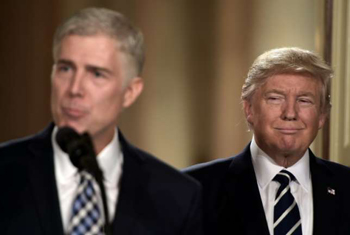
Trump, in the second week of his already-unorthodox presidency, nominated Judge Neil Gorsuch to replace conservative justice Antonin Scalia, whose death last year sent the Supreme Court rocketing to the top of the list of presidential campaign issues.

"He'll be approved very quickly," Trump declared on Wednesday.

But that confidence belies what looks to be a tough confirmation fight in the Republican-controlled Senate, after Trump's party refused for much of last year to fill the vacant court seat with Barack Obama's nominee.

Trump is pushing for Senate Republicans led by Mitch McConnell to prevent a likely Democratic filibuster by using what is known as the "nuclear option."

That procedure would change Senate rules to push Gorsuch through with a simple majority in the 100-seat chamber rather than a supermajority of 60 votes. Republicans hold 52 Senate seats.

"If we end up with that gridlock I would say, 'If you can, Mitch, go nuclear,'" Trump said on Wednesday.

Senate minority leader Chuck Schumer pushed right back.

"The answer should not be to change the rules of the Senate, but to change the nominee to someone who can earn 60 votes," Schumer said.

McConnell has not revealed whether he would seek to invoke the nuclear option.

The acrimonious row over Trump's ban on travelers from seven Muslim-majority countries has further complicated efforts to get his cabinet nominees confirmed.

Secretary of state pick Rex Tillerson, the former chief executive of ExxonMobil, was expected to be confirmed in a Senate vote Wednesday.

But some Democrats demanded further review of his record. Tillerson "needs to tell us where he stands on this dangerous policy," Senator Martin Heinrich said.

'Governing By Tantrum'

Democrats have vowed to slow-walk confirmation votes on several cabinet nominees.

Their boycott of votes on two Trump picks was dramatically overturned Wednesday when leaders of the Senate finance committee suspended the panel's rules and approved the nominees for Treasury, Steven Mnuchin, and health, Tom Price, with no Democrats present.

Democrats also boycotted a committee vote Wednesday for Scott Pruitt, Trump's choice to head the Environmental Protection Agency.

Republican Senator Jerry Moran, speaking to a half-empty hearing room, described it as "governing by tantrum."

Despite the obstruction, Trump's attorney general pick Jeff Sessions was finally approved by the Senate Judiciary Committee Wednesday following an eight-day delay.

The Supreme Court is likely to be a protracted fight.

If confirmed, Gorsuch would tilt the bench five-to-four in conservatives' favor.

At 49, the silver-haired jurist from Colorado with a flair for writing incisive rulings is the youngest nominee in a generation.

His appointment could have a major impact on cases ranging from business regulation to gender rights to gun control.

'Special Burden'

Gorsuch was a remarkably orthodox pick for a president who has scythed through norms and precedent during his brief time in office.

Like Scalia, Gorsuch is considered an "originalist" -- guided in his legal thinking by the constitution's original intent and meaning.

Democrats warn they will probe carefully to ensure that he holds centrist views and is not intent on rewriting existing law.

Schumer, on the Senate floor, charged that the new administration has shown "less respect for the rule of law than any in recent memory," placing a "special burden on this nominee" to be an independent jurist.

The Supreme Court is the final arbiter of many of the most sensitive issues of US life and law. Its members are named to life terms so their influence is long-lasting.

With an eye to a bitter Congressional fight Gorsuch headed Wednesday to Capitol Hill with Vice President Mike Pence to huddle with McConnell.

"We're all thrilled" with Trump's pick, the Senate majority leader said, as he expressed eagerness to begin the confirmation process.

Comments

Add new comment

  • Coastaldigest.com reserves the right to delete or block any comments.
  • Coastaldigset.com is not responsible for its readers’ comments.
  • Comments that are abusive, incendiary or irrelevant are strictly prohibited.
  • Please use a genuine email ID and provide your name to avoid reject.
News Network
February 6,2020

Washington, Feb 6: U.S. president Donald Trump drew on staunch Republican support to defeat the gravest threat yet to his three-year-old presidency on Wednesday, winning acquittal in the Senate on impeachment charges of abuse of power and obstruction of Congress.

Only the third U.S. leader ever placed on trial, Trump readily defeated the Democratic-led effort to expel him from office for having illicitly sought help from Ukraine to bolster his 2020 re-election effort.

Trump immediately claimed "victory" while the White House declared it a full "exoneration" for the president -- even as Democrats rejected the acquittal as the "valueless" outcome of an unfair trial.

Despite being confronted with strong evidence, Republicans stayed loyal and mustered a majority of votes to clear the president of both charges -- by 52 to 48 on abuse of power and 53 to 47 on obstruction of Congress -- falling far short of the two-thirds supermajority required for conviction.

"Two thirds of the senators present not having found him guilty of the charges contained therein, it is therefore ordered and adjudged that the said Donald John Trump be, and he is hereby, acquitted," said Supreme Court chief justice John Roberts, who presided over the trial.

The months-long impeachment of the 45th US leader shone a harsh light on America's political divide, with Trump's core support base united behind him in rejecting it as a "hoax."

One Republican, senator Mitt Romney, a longtime Trump foe, risked White House wrath to vote alongside Democrats on the first count, saying Trump was "guilty of an appalling abuse of public trust." He voted not guilty on the second charge.

But the verdict was never truly in question since the House of Representatives formally impeached Trump in December, and has now cleared out a major hurdle for the president to fully plunge into his campaign for re-election in November.

Trump to speak Thursday

Responding to the verdict, Trump announced he would deliver a formal statement Thursday from the White House "to discuss our Country's VICTORY on the Impeachment Hoax!"

Shortly before, the president tweeted a montage depicting a fake cover of Time magazine declaring him president for all eternity.

The White House declared that Trump had obtained "full vindication and exoneration."

But Nancy Pelosi, the House Speaker and top Democrat in Congress, said that by clearing Trump, the Republicans had "normalized lawlessness."

"There can be no acquittal without a trial, and there is no trial without witnesses, documents and evidence," she said.

"Sadly, because of the Republican Senate's betrayal of the Constitution, the president remains an ongoing threat to American democracy, with his insistence that he is above the law and that he can corrupt the elections if he wants to."

Senate minority leader Chuck Schumer said the acquittal was "virtually valueless" since Republicans refused witnesses at his trial.

'Forever impeached'

The Democrats' intense 78-day House investigation faced public doubts and high-pressure stonewalling from the White House.

Concerned about the political risk for the party, Pelosi rejected a call early last year to impeach Trump on evidence compiled by then-special counsel Robert Mueller that he had obstructed the Russia election meddling investigation.

But her concerns melted after new allegations surfaced in August that Trump had pressured Ukraine for help for his 2020 campaign.

Though doubtful from the outset that they would win support from Republicans, an investigation amassed with surprising speed strong evidence to support the allegations.

The evidence showed that from early in 2019, Trump's private lawyer Rudy Giuliani and a close political ally, Ambassador to the European Union Gordon Sondland, were scheming to pressure Kiev to help smear Democrats, including Trump's potential 2020 rival Joe Biden, by opening investigations into them.

"We must say enough -- enough! He has betrayed our national security, and he will do so again," Adam Schiff, who led the House investigation, argued on the Senate floor this week.

"He has compromised our elections, and he will do so again," Schiff said.

'Colossal' mistake

In the trial, Trump's defence was not seen as having undermined the facts compiled by Schiff's probe, and several Republican senators acknowledged he did wrong.

But his lawyers and Senate defenders argued, essentially, that Trump's behaviour was not egregious enough for impeachment and removal.

And, pointing to the December House impeachment vote, starkly along party lines, they painted it as a political effort to "destroy the president" in an election year and insisted voters should be allowed to decide Trump's fate.

Senate majority leader Mitch McConnell said impeachment will benefit Republicans.

"Right now this is a political loser for them. They initiated it. They thought this was a great idea. At least for the short term, it has been a colossal political mistake."

Comments

Add new comment

  • Coastaldigest.com reserves the right to delete or block any comments.
  • Coastaldigset.com is not responsible for its readers’ comments.
  • Comments that are abusive, incendiary or irrelevant are strictly prohibited.
  • Please use a genuine email ID and provide your name to avoid reject.
News Network
July 1,2020

Tehran, Jul 1 As many as 19 people have been killed in an explosion and fire at a medical facility in Tehran.

A total of 19 people, including 15 men and 4 women, were killed in the explosion, the emergency services confirmed, RT reported citing KhabarOnline website.

According to a regional official, a gas leak caused the incident. Sputnik quoted a deputy head of Tehran police as saying to YJC news outlet that oxygen tanks exploded in the semi-basement of the clinic.

Comments

Add new comment

  • Coastaldigest.com reserves the right to delete or block any comments.
  • Coastaldigset.com is not responsible for its readers’ comments.
  • Comments that are abusive, incendiary or irrelevant are strictly prohibited.
  • Please use a genuine email ID and provide your name to avoid reject.
News Network
April 28,2020

Washington, Apr 28: After nearly three weeks in an intensive care unit in Los Angeles, doctors treating 41-year-old Broadway actor Nick Cordero for COVID-19 were forced to amputate his right leg.

The flow of blood had been impeded by a blood clot: yet another dangerous complication of the disease that has been bubbling up in frontline reports from China, Europe and the United States.

To be sure, so-called "thrombotic events" occur for a variety of reasons among intensive care patients, but the rates among COVID-19 patients are far higher than would be otherwise expected.

"I have had 40-year-olds in my ICU who have clots in their fingers that look like they'll lose the finger, but there's no other reason to lose the finger than the virus," Shari Brosnahan, a critical care doctor at NYU Langone said.

One of these patients is suffering from a lack of blood flow to both feet and both hands, and she predicts an amputation may be necessary, or the blood vessels may get so damaged that an extremity could drop off by itself.

Blood clots aren't just dangerous for our limbs, but can make their way to the lungs, heart or brain, where they may cause lethal pulmonary embolisms, heart attacks, and strokes.

A recent paper from the Netherlands in the journal Thrombosis Research found that 31 percent of 184 patients suffered thrombotic complications, a figure that the researchers called "remarkably high" -- even if extreme consequences like amputation are rare.

Behnood Bikdeli, a doctor at New York-Presbyterian Hospital, assembled an international consortium of experts to study the issue. Their findings were published in the Journal of The American College of Cardiology.

The experts found the risks were so great that COVID-19 patients "may need to receive blood thinners, preventively, prophylactically," even before imaging tests are ordered, said Bikdeli.

What exactly is causing it? The reasons aren't fully understood, but he offered several possible explanations.

People with severe forms of COVID-19 often have underlying medical conditions like heart or lung disease -- which are themselves linked to higher rates of clotting.

Next, being in intensive care makes a person likelier to develop a clot because they are staying still for so long. That's why for example people are encouraged to stretch and move around on long haul flights.

It's also now clear the COVID-19 illness is associated with an abnormal immune reaction called "cytokine storm" -- and some research has indicated this too is linked to higher rates of clotting.

There could also be something about the virus itself that is causing coagulation, which has some precedent in other viral illnesses.

A paper in the journal The Lancet last week showed that the virus can infect the inner cell layer of organs and of blood vessels, called the endothelium. This, in theory, could interfere with the clotting process.

According to Brosnahan, while thinners like Heparin are effective in some patients, they don't work for all patients because the clots are at times too small.

"There are too many microclots," she said. "We're not sure exactly where they are."

Autopsies have in fact shown some people's lungs filled with hundreds of microclots.

The arrival of a new mystery however helps solve a slightly older one.

Cecilia Mirant-Borde, an intensive care doctor at a military veterans hospital in Manhattan, told AFP that lungs filled with microclots helped explain why ventilators work poorly for patients with low blood oxygen.

Earlier in the pandemic doctors were treating these patients according to protocols developed for acute respiratory distress syndrome, sometimes known as "wet lung."

But in some cases, "it's not because the lungs are occupied with water" -- rather, it's that the microclotting is blocking circulation and blood is leaving the lungs with less oxygen than it should.

It has just been a little under five months since the virus emerged in Wuhan, China, and researchers are learning more about its impact every day.

"While we react surprised, we shouldn't be as surprised as we were. Viruses tend to do weird things," said Brosnahan.

While the dizzying array of complications may seem daunting, "it's possible there'll be one or a couple of unifying mechanisms that describe how this damage happens," she said.

"It's possible it's all the same thing, and that there'll be the same solution."

Comments

Add new comment

  • Coastaldigest.com reserves the right to delete or block any comments.
  • Coastaldigset.com is not responsible for its readers’ comments.
  • Comments that are abusive, incendiary or irrelevant are strictly prohibited.
  • Please use a genuine email ID and provide your name to avoid reject.