


Bruising Fight Looms Over Key Donald Trump Nominees

February 2, 2017

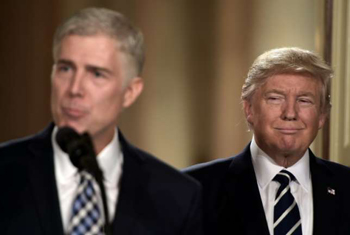
Washington, Feb 2: President Donald Trump has seized a chance to swing the US Supreme Court back to conservative leanings but a drawn-out battle loomed Wednesday over this and other nominations, jarring with his vow to sweep aside politics as usual.
BruisingFight

Trump, in the second week of his already-unorthodox presidency, nominated Judge Neil Gorsuch to replace conservative justice Antonin Scalia, whose death last year sent the Supreme Court rocketing to the top of the list of presidential campaign issues.

"He'll be approved very quickly," Trump declared on Wednesday.

But that confidence belies what looks to be a tough confirmation fight in the Republican-controlled Senate, after Trump's party refused for much of last year to fill the vacant court seat with Barack Obama's nominee.

Trump is pushing for Senate Republicans led by Mitch McConnell to prevent a likely Democratic filibuster by using what is known as the "nuclear option."

That procedure would change Senate rules to push Gorsuch through with a simple majority in the 100-seat chamber rather than a supermajority of 60 votes. Republicans hold 52 Senate seats.

"If we end up with that gridlock I would say, 'If you can, Mitch, go nuclear,'" Trump said on Wednesday.

Senate minority leader Chuck Schumer pushed right back.

"The answer should not be to change the rules of the Senate, but to change the nominee to someone who can earn 60 votes," Schumer said.

McConnell has not revealed whether he would seek to invoke the nuclear option.

The acrimonious row over Trump's ban on travelers from seven Muslim-majority countries has further complicated efforts to get his cabinet nominees confirmed.

Secretary of state pick Rex Tillerson, the former chief executive of ExxonMobil, was expected to be confirmed in a Senate vote Wednesday.

But some Democrats demanded further review of his record. Tillerson "needs to tell us where he stands on this dangerous policy," Senator Martin Heinrich said.

'Governing By Tantrum'

Democrats have vowed to slow-walk confirmation votes on several cabinet nominees.

Their boycott of votes on two Trump picks was dramatically overturned Wednesday when leaders of the Senate finance committee suspended the panel's rules and approved the nominees for Treasury, Steven Mnuchin, and health, Tom Price, with no Democrats present.

Democrats also boycotted a committee vote Wednesday for Scott Pruitt, Trump's choice to head the Environmental Protection Agency.

Republican Senator Jerry Moran, speaking to a half-empty hearing room, described it as "governing by tantrum."

Despite the obstruction, Trump's attorney general pick Jeff Sessions was finally approved by the Senate Judiciary Committee Wednesday following an eight-day delay.

The Supreme Court is likely to be a protracted fight.

If confirmed, Gorsuch would tilt the bench five-to-four in conservatives' favor.

At 49, the silver-haired jurist from Colorado with a flair for writing incisive rulings is the youngest nominee in a generation.

His appointment could have a major impact on cases ranging from business regulation to gender rights to gun control.

'Special Burden'

Gorsuch was a remarkably orthodox pick for a president who has scythed through norms and precedent during his brief time in office.

Like Scalia, Gorsuch is considered an "originalist" -- guided in his legal thinking by the constitution's original intent and meaning.

Democrats warn they will probe carefully to ensure that he holds centrist views and is not intent on rewriting existing law.

Schumer, on the Senate floor, charged that the new administration has shown "less respect for the rule of law than any in recent memory," placing a "special burden on this nominee" to be an independent jurist.

The Supreme Court is the final arbiter of many of the most sensitive issues of US life and law. Its members are named to life terms so their influence is long-lasting.

With an eye to a bitter Congressional fight Gorsuch headed Wednesday to Capitol Hill with Vice President Mike Pence to huddle with McConnell.

"We're all thrilled" with Trump's pick, the Senate majority leader said, as he expressed eagerness to begin the confirmation process.

Comments

Add new comment

  • Coastaldigest.com reserves the right to delete or block any comments.
  • Coastaldigset.com is not responsible for its readers’ comments.
  • Comments that are abusive, incendiary or irrelevant are strictly prohibited.
  • Please use a genuine email ID and provide your name to avoid reject.
Agencies
August 7,2020

Colombo, Aug 7: Sri Lankan President Gotabaya Rajapaksa's party and its allies won an overwhelming two-thirds majority in a parliament election, results showed on Friday, giving him the power to enact sweeping changes to the constitution.

The governing Sri Lanka Podujana Peramuna and its allies had won 150 seats in the 225-member parliament, according to the tally published by the election commission from Wednesday's vote.

Rajapaksa had sought a two-thirds majority in parliament to be able to restore full executive powers to the presidency, which he says are necessary to implement his agenda to make the tiny island economically and militarily secure.

He is likely to install his older brother and former President Mahinda Rajapaksa as the next prime minister. The brothers are best known for crushing the Tamil Tiger rebels fighting for a separate homeland for minority Tamils during the elder Rajapaksa's presidency in 2009.

On a congratulatory phone call from Prime Minister Narendra Modi of India, which is keen to check Chinese influence on its southern neighbour, Mahinda Rajapaksa vowed to deepen ties between the two countries.

"With the strong support of the people of Sri Lanka, I look forward to working with you closely to further enhance the long-standing cooperation between our two countries," he told Modi. "Sri Lanka and India are friends and relations."

The tourism-dependent nation of 21 million people has been struggling economically since deadly Islamist militant attacks on hotels and churches last year followed by lockdowns to slow the spread of the coronavirus. 

Comments

Add new comment

  • Coastaldigest.com reserves the right to delete or block any comments.
  • Coastaldigset.com is not responsible for its readers’ comments.
  • Comments that are abusive, incendiary or irrelevant are strictly prohibited.
  • Please use a genuine email ID and provide your name to avoid reject.
Agencies
March 25,2020

Beijing:  Around 5,000 people have signed up for the phase I clinical trial of recombinant novel coronavirus vaccine in Chinese city Wuhan where the virus first emerged late last year.

The recruitment for participants ended this week with nearly 5,000 volunteers signing up for the trial, state-run Beijing News reported on Wednesday.

A single-centre, open and dose-escalation phase I clinical trial for recombinant novel coronavirus vaccine (adenoviral vector) will be tested in healthy adults aged between 18 and 60 years, according to the ChiCTR (China Clinical Trial Register).

The trial, led by experts from the Academy of Military Medical Sciences, gained its approval on March 16 and the research is expected to last half a year.

Requiring at least 108 participants, the trial will be conducted in Wuhan, capital of Hubei province, the region worst-affected by the virus in the country, state-run China Daily reported.

Participants will experience 14-day quarantine restrictions after being vaccinated and their health condition will be recorded every day.

Chinese scientists are hastening the development of COVID-19 vaccines through five approaches --- inactivated vaccines, genetic engineering subunit vaccines, adenovirus vector vaccines, nucleic acid vaccines and vaccines using attenuated influenza virus as vectors.

So far, most teams are expected to complete preclinical research in April and some are moving forward faster, Wang Junzhi, an academician with the Chinese Academy of Engineering said.

Wang noted that research and development of COVID-19 vaccines in China is not slower than foreign counterparts and has been carried out in a scientific, standardised and orderly way.

China has stepped up the process to finalise vaccines to counter COVID-19 after Kaiser Permanente research facility in Seattle and Washington stole the march and began human trials.

China lifted tough restrictions on the Hubei province on Wednesday after a months-long lockdown as the country reported no new domestic cases.

But there were another 47 imported infections from overseas, the National Health Commission said. In total, 474 imported infections have been diagnosed in China -- mostly Chinese nationals returning home.

Comments

Add new comment

  • Coastaldigest.com reserves the right to delete or block any comments.
  • Coastaldigset.com is not responsible for its readers’ comments.
  • Comments that are abusive, incendiary or irrelevant are strictly prohibited.
  • Please use a genuine email ID and provide your name to avoid reject.
News Network
April 28,2020

Washington, Apr 28: After nearly three weeks in an intensive care unit in Los Angeles, doctors treating 41-year-old Broadway actor Nick Cordero for COVID-19 were forced to amputate his right leg.

The flow of blood had been impeded by a blood clot: yet another dangerous complication of the disease that has been bubbling up in frontline reports from China, Europe and the United States.

To be sure, so-called "thrombotic events" occur for a variety of reasons among intensive care patients, but the rates among COVID-19 patients are far higher than would be otherwise expected.

"I have had 40-year-olds in my ICU who have clots in their fingers that look like they'll lose the finger, but there's no other reason to lose the finger than the virus," Shari Brosnahan, a critical care doctor at NYU Langone said.

One of these patients is suffering from a lack of blood flow to both feet and both hands, and she predicts an amputation may be necessary, or the blood vessels may get so damaged that an extremity could drop off by itself.

Blood clots aren't just dangerous for our limbs, but can make their way to the lungs, heart or brain, where they may cause lethal pulmonary embolisms, heart attacks, and strokes.

A recent paper from the Netherlands in the journal Thrombosis Research found that 31 percent of 184 patients suffered thrombotic complications, a figure that the researchers called "remarkably high" -- even if extreme consequences like amputation are rare.

Behnood Bikdeli, a doctor at New York-Presbyterian Hospital, assembled an international consortium of experts to study the issue. Their findings were published in the Journal of The American College of Cardiology.

The experts found the risks were so great that COVID-19 patients "may need to receive blood thinners, preventively, prophylactically," even before imaging tests are ordered, said Bikdeli.

What exactly is causing it? The reasons aren't fully understood, but he offered several possible explanations.

People with severe forms of COVID-19 often have underlying medical conditions like heart or lung disease -- which are themselves linked to higher rates of clotting.

Next, being in intensive care makes a person likelier to develop a clot because they are staying still for so long. That's why for example people are encouraged to stretch and move around on long haul flights.

It's also now clear the COVID-19 illness is associated with an abnormal immune reaction called "cytokine storm" -- and some research has indicated this too is linked to higher rates of clotting.

There could also be something about the virus itself that is causing coagulation, which has some precedent in other viral illnesses.

A paper in the journal The Lancet last week showed that the virus can infect the inner cell layer of organs and of blood vessels, called the endothelium. This, in theory, could interfere with the clotting process.

According to Brosnahan, while thinners like Heparin are effective in some patients, they don't work for all patients because the clots are at times too small.

"There are too many microclots," she said. "We're not sure exactly where they are."

Autopsies have in fact shown some people's lungs filled with hundreds of microclots.

The arrival of a new mystery however helps solve a slightly older one.

Cecilia Mirant-Borde, an intensive care doctor at a military veterans hospital in Manhattan, told AFP that lungs filled with microclots helped explain why ventilators work poorly for patients with low blood oxygen.

Earlier in the pandemic doctors were treating these patients according to protocols developed for acute respiratory distress syndrome, sometimes known as "wet lung."

But in some cases, "it's not because the lungs are occupied with water" -- rather, it's that the microclotting is blocking circulation and blood is leaving the lungs with less oxygen than it should.

It has just been a little under five months since the virus emerged in Wuhan, China, and researchers are learning more about its impact every day.

"While we react surprised, we shouldn't be as surprised as we were. Viruses tend to do weird things," said Brosnahan.

While the dizzying array of complications may seem daunting, "it's possible there'll be one or a couple of unifying mechanisms that describe how this damage happens," she said.

"It's possible it's all the same thing, and that there'll be the same solution."

Comments

Add new comment

  • Coastaldigest.com reserves the right to delete or block any comments.
  • Coastaldigset.com is not responsible for its readers’ comments.
  • Comments that are abusive, incendiary or irrelevant are strictly prohibited.
  • Please use a genuine email ID and provide your name to avoid reject.