


Bruising Fight Looms Over Key Donald Trump Nominees

February 2, 2017

Washington, Feb 2: President Donald Trump has seized a chance to swing the US Supreme Court back to conservative leanings but a drawn-out battle loomed Wednesday over this and other nominations, jarring with his vow to sweep aside politics as usual.
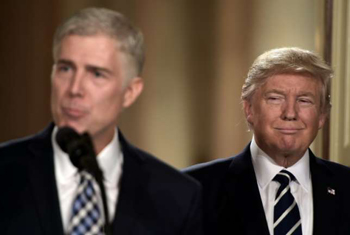
BruisingFight

Trump, in the second week of his already-unorthodox presidency, nominated Judge Neil Gorsuch to replace conservative justice Antonin Scalia, whose death last year sent the Supreme Court rocketing to the top of the list of presidential campaign issues.

"He'll be approved very quickly," Trump declared on Wednesday.

But that confidence belies what looks to be a tough confirmation fight in the Republican-controlled Senate, after Trump's party refused for much of last year to fill the vacant court seat with Barack Obama's nominee.

Trump is pushing for Senate Republicans led by Mitch McConnell to prevent a likely Democratic filibuster by using what is known as the "nuclear option."

That procedure would change Senate rules to push Gorsuch through with a simple majority in the 100-seat chamber rather than a supermajority of 60 votes. Republicans hold 52 Senate seats.

"If we end up with that gridlock I would say, 'If you can, Mitch, go nuclear,'" Trump said on Wednesday.

Senate minority leader Chuck Schumer pushed right back.

"The answer should not be to change the rules of the Senate, but to change the nominee to someone who can earn 60 votes," Schumer said.

McConnell has not revealed whether he would seek to invoke the nuclear option.

The acrimonious row over Trump's ban on travelers from seven Muslim-majority countries has further complicated efforts to get his cabinet nominees confirmed.

Secretary of state pick Rex Tillerson, the former chief executive of ExxonMobil, was expected to be confirmed in a Senate vote Wednesday.

But some Democrats demanded further review of his record. Tillerson "needs to tell us where he stands on this dangerous policy," Senator Martin Heinrich said.

'Governing By Tantrum'

Democrats have vowed to slow-walk confirmation votes on several cabinet nominees.

Their boycott of votes on two Trump picks was dramatically overturned Wednesday when leaders of the Senate finance committee suspended the panel's rules and approved the nominees for Treasury, Steven Mnuchin, and health, Tom Price, with no Democrats present.

Democrats also boycotted a committee vote Wednesday for Scott Pruitt, Trump's choice to head the Environmental Protection Agency.

Republican Senator Jerry Moran, speaking to a half-empty hearing room, described it as "governing by tantrum."

Despite the obstruction, Trump's attorney general pick Jeff Sessions was finally approved by the Senate Judiciary Committee Wednesday following an eight-day delay.

The Supreme Court is likely to be a protracted fight.

If confirmed, Gorsuch would tilt the bench five-to-four in conservatives' favor.

At 49, the silver-haired jurist from Colorado with a flair for writing incisive rulings is the youngest nominee in a generation.

His appointment could have a major impact on cases ranging from business regulation to gender rights to gun control.

'Special Burden'

Gorsuch was a remarkably orthodox pick for a president who has scythed through norms and precedent during his brief time in office.

Like Scalia, Gorsuch is considered an "originalist" -- guided in his legal thinking by the constitution's original intent and meaning.

Democrats warn they will probe carefully to ensure that he holds centrist views and is not intent on rewriting existing law.

Schumer, on the Senate floor, charged that the new administration has shown "less respect for the rule of law than any in recent memory," placing a "special burden on this nominee" to be an independent jurist.

The Supreme Court is the final arbiter of many of the most sensitive issues of US life and law. Its members are named to life terms so their influence is long-lasting.

With an eye to a bitter Congressional fight Gorsuch headed Wednesday to Capitol Hill with Vice President Mike Pence to huddle with McConnell.

"We're all thrilled" with Trump's pick, the Senate majority leader said, as he expressed eagerness to begin the confirmation process.

Comments

Add new comment

  • Coastaldigest.com reserves the right to delete or block any comments.
  • Coastaldigset.com is not responsible for its readers’ comments.
  • Comments that are abusive, incendiary or irrelevant are strictly prohibited.
  • Please use a genuine email ID and provide your name to avoid reject.
Agencies
August 7,2020

Russia boasts that it's about to become the first country to approve a Covid-19 vaccine, with mass vaccinations planned as early as October using shots that are yet to complete clinical trials -- and scientists worldwide are sounding the alarm that the headlong rush could backfire.

Moscow sees a Sputnik-like propaganda victory, recalling the Soviet Union's launch of the world's first satellite in 1957.

But the experimental Covid-19 shots began first-in-human testing on a few dozen people less than two months ago, and there's no published scientific evidence yet backing Russia's late entry to the global vaccine race, much less explaining why it should be considered a front-runner.

“I'm worried that Russia is cutting corners so that the vaccine that will come out may be not just ineffective, but also unsafe,” said Lawrence Gostin, a global public health law expert at Georgetown University. “It doesn't work that way... Trials come first. That's really important.”

According to Kirill Dmitriev, head of Russia's Direct Investment Fund that bankrolled the effort, a vaccine developed by the Gamaleya research institute in Moscow may be approved in days, before scientists complete what's called a Phase 3 study.

That final-stage study, usually involving tens of thousands of people, is the only way to prove if an experimental vaccine is safe and really works.

Health Minister Mikhail Murashko said members of “risk groups,” such as medical workers, may be offered the vaccine this month.

He didn't clarify whether they would be part of the Phase 3 study that is said to be completed after the vaccine receives “conditional approval.”

Deputy Prime Minister Tatyana Golikova promised to start “industrial production” in September, and Murashko said mass vaccination may begin as early as October.

Dr Anthony Fauci, the top US infectious disease specialist, questioned the fast-track approach last week.

“I do hope that the Chinese and the Russians are actually testing a vaccine before they are administering the vaccine to anyone, because claims of having a vaccine ready to distribute before you do testing I think is problematic at best," he said.

Questions about this vaccine candidate come after the US, Britain and Canada last month accused Russia of using hackers to steal vaccine research from Western labs.

Delivering a vaccine first is a matter of national prestige for the Kremlin as it tries to assert the image of Russia as a global power capable of competing with the US and China.

The notion of being “the first in the world” dominated state news coverage of the effort, with government officials praising reports of the first-step testing.

In April, President Vladimir Putin ordered state officials to shorten the time of clinical trials for a variety of drugs, including potential coronavirus vaccines.

According to Russia's Association of Clinical Trials Organizations, the order set “an unattainable bar” for scientists who, as a result, "joined in on the mad race, hoping to please those at power.”

The association first raised concern in late May, when professor Alexander Gintsburg, head of the Gamaleya institute, said he and other researchers tried the vaccine on themselves.

The move was a “crude violation of the very foundations of clinical research, Russian law and universally accepted international regulations" the group said in an open letter to the government, urging scientists and health officials to adhere to clinical research standards.

But a month later, the Health Ministry authorized clinical trials of the Gamaleya product, with what appeared to be another ethical issue.

Human studies started June 17 among 76 volunteers. Half were injected with a vaccine in liquid form and the other half with a vaccine that came as soluble powder.

Some in the first half were recruited from the military, which raised concerns that servicemen may have been pressured to participate.

Some experts said their desire to perform well would affect the findings. “It's no coincidence media reports we see about the trials among the military said no one had any side effects, while the (other group) reported some," said Vasily Vlassov, a public health expert with Moscow's Higher School of Economics.

As the trials were declared completed and looming regulatory approval was announced last week, questions arose about the vaccine's safety and effectiveness.

Government assurances the drug produced the desired immune response and caused no significant side effects were hardly convincing without published scientific data describing the findings.

The World Health Organization said all vaccine candidates should go through full stages of testing before being rolled out.

“There are established practices and there are guidelines out,” WHO spokesman Christian Lindmeier said Tuesday.

“Between finding or having a clue of maybe having a vaccine that works, and having gone through all the stages, is a big difference.”

Offering an unsafe compound to medical workers on the front lines of the outbreak could make things worse, Georgetown's Gostin said, adding: “What if the vaccine started killing them or making them very ill?”

Vaccines that are not properly tested can cause harm in many ways — from a negative impact on health to creating a false sense of security or undermining trust in vaccinations, said Thomas Bollyky, director of the global health program at the Council on Foreign Relations. 

Comments

Add new comment

  • Coastaldigest.com reserves the right to delete or block any comments.
  • Coastaldigset.com is not responsible for its readers’ comments.
  • Comments that are abusive, incendiary or irrelevant are strictly prohibited.
  • Please use a genuine email ID and provide your name to avoid reject.
Agencies
April 20,2020

Hong Kong, Apr 20: Oil prices collapsed to more than two-decade lows Monday as traders grow concerned that storage facilities are reaching their limits, while equities were mixed, with some support coming from signs that the coronavirus may have peaked in Europe and the United States.

US crude benchmark West Texas Intermediate briefly plunged almost 20 percent to below 15 -- its lowest since 1999 -- as stockpiles continue to build owing to a crash in demand caused by the COVID-19 pandemic.

Analysts said this month's agreement between top producers to slash output by 10 million barrels a day was having little impact on the oil crisis because of lockdowns and travel restrictions that are keeping billions of people at home.

WTI was hit particularly hard as its main US storage facilities in Cushing, Oklahoma, were filling up.

ANZ said "crude oil prices remained under pressure, as projections of weaker demand weigh on sentiment".

"Despite the OPEC+ alliance agreeing to an unprecedented cut in output, the physical market is awash with oil," it said, referring to the Organization of the Petroleum Exporting Countries and non-OPEC partners.

And AxiCorp's Stephen Innes added: "It's a dump at all cost as no one... wants delivery of oil, with Cushing storage facilities filling by the minute.

"It hasn't taken long for the market to recognise that the OPEC+ deal will not, in its present form, be enough to balance oil markets." Stock traders were in slightly more buoyant mood as governments start to consider how and when to ease lockdowns that have crippled the global economy.

Italy, Spain, France and Britain reported drops in daily death tolls and slowing infection rates.

"We are scoring points against the epidemic," said Prime Minister Edouard Philippe, while insisting "we are not out of the health crisis yet".

Meanwhile, in the US, Andrew Cuomo, governor of badly hit New York state, said the disease was "on the descent", though he cautioned it was "no time to get cocky".

Mounting evidence suggests that the lockdowns and social distancing are slowing the spread of the virus.

That has intensified planning in many countries to begin loosening curbs on movement and easing the crushing pressure on national economies.

Adding to the sense of hope was a report indicating promising research on a drug to treat coronavirus.

Hong Kong, Shanghai and Seoul were each up 0.1 percent, while Wellington added 0.4 percent.

However, Tokyo went into the break 0.9 percent lower, while Sydney and Manila dropped one percent apiece. There were also losses in Taipei, Singapore and Jakarta.

"The longer investors have to contemplate future economic issues while they wait for more countries to be on the downward slope of the pandemic curve, the more scope there is of risk assets pricing in a difficult future," Chris Iggo, of AXA Investment Managers UK, said.

Investors are keeping an eye on Washington, where Congress and the White House are working towards a 450 billion economic relief plan for small business to add to the trillions already pledged to support the economy.

Big-name companies including IBM, Netflix and Coca-Cola are due to deliver their earnings reports.

Comments

Add new comment

  • Coastaldigest.com reserves the right to delete or block any comments.
  • Coastaldigset.com is not responsible for its readers’ comments.
  • Comments that are abusive, incendiary or irrelevant are strictly prohibited.
  • Please use a genuine email ID and provide your name to avoid reject.
Agencies
July 8,2020

Washington D.C, Jul 8:  US Secretary of State, Mike Pompeo on Tuesday (local time) announced visa restrictions on some Chinese officials under the Reciprocal Access to Tibet Act, 2018.

"Today I am announcing visa restrictions on PRC government and Chinese Communist Party officials determined to be "substantially involved in the formulation or execution of policies related to access for foreigners to Tibetan areas," pursuant to the Reciprocal Access to Tibet Act of 2018," Pompeo said.

"Access to Tibetan areas is increasingly vital to regional stability, given the PRC's human rights abuses there, as well as Beijing's failure to prevent environmental degradation near the headwaters of Asia's major rivers," he said.

The US Secretary of State pointed out that Beijing has continued "systematically to obstruct travel to the Tibetan Autonomous Region (TAR) and other Tibetan areas" by U.S. diplomats and other officials, journalists, and tourists, while PRC officials and other citizens enjoy far greater access to the United States.

"The United States will continue to work to advance the sustainable economic development, environmental conservation, and humanitarian conditions of Tibetan communities within the People's Republic of China and abroad," he said.

Pompeo said US also remains "committed to supporting meaningful autonomy for Tibetans, respect for their fundamental and unalienable human rights, and the preservation of their unique religious, cultural, and linguistic identity".

"In the spirit of true reciprocity, we will work closely with the U.S. Congress to ensure U.S. citizens have full access to all areas of the People's Republic of China, including the TAR and other Tibetan areas," he said.

Comments

Add new comment

  • Coastaldigest.com reserves the right to delete or block any comments.
  • Coastaldigset.com is not responsible for its readers’ comments.
  • Comments that are abusive, incendiary or irrelevant are strictly prohibited.
  • Please use a genuine email ID and provide your name to avoid reject.