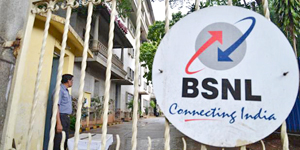
BSNL to tie-up with cable operators to provide broadband services

March 12, 2017

Karimnagar, Mar 12: The Bharat Sanchar Nigam Limited (BSNL) will soon be tying up with local cable network operators in Telangana to provide broadband services to its customers.

bsnl"We have already tied up our broadband services with some of the local cable operators in Warangal district successfully. By May 2017 we will tie up with private cable operators in Karimnagar too," BSNL AP Circle Chief General Manager L Anantharam told reporters here today.

"BSNL will provide cable and maintenance besides infrastructure to the cable operators. They will run their cable television and we will give landline, broadband and voice calls to our customers," he said.

The NGN (Next Generation Network) exchange of 4,000 lines is commissioned by replacing existing new technology exchange in three exchanges in Karimnagar town, the official said.

With this, the landline subscribers can avail IP Centrex, video calling, group video conferencing facilities, he said.

By March 15 as many as 20 hotspots for Wi-Fi will be launched in Karimnagar, the Chief General Manager said.

Giving details of new prepaid connections, he said 96,650 new customers have been added into BSNL prepaid services and the number will cross one lakh by the end of this month.

Comments

Add new comment

  • Coastaldigest.com reserves the right to delete or block any comments.
  • Coastaldigset.com is not responsible for its readers’ comments.
  • Comments that are abusive, incendiary or irrelevant are strictly prohibited.
  • Please use a genuine email ID and provide your name to avoid reject.
Agencies
May 22,2020

Kochi, May 22: During the nationwide COVID-19 lockdown, Kerala recorded the highest number of cyber attacks followed by Punjab and Tamil Nadu, a study by anti-virus software firm K7 Computing said on Thursday.

In a statement issued in Chennai, the company said its K7 Computing's Cyber Threat Report, a comprehensive analysis of cyber attacks during the lockdown has found that Kerala recorded the highest number of cyber attacks during this period. The report analyses various cyber attacks within India during the pandemic and reveals that threat actors targeted the state with COVID-themed attacks aimed at exploiting user trust.

In Kerala, regions like Kottayam, Kannur, Kollam, and Kochi saw the highest hits with 462, 374, 236, and 147 attacks respectively, while the state as a whole saw around 2,000 attacks during the period - the highest thus far in the country.

This was followed by Punjab with 207 attacks and Tamil Nadu with 184 attacks, the company said.

The sudden surge in the frequency of attacks witnessed from February 2020 to mid-April 2020 indicates that scamsters across the world were exploiting the widespread panic around coronavirus at both the individual and corporate level.

These attacks aimed to compromise computers and mobile devices to gain access to users' confidential data, banking details, and cryptocurrency accounts.

The key threats seen during this period ranged from phishing attacks to rogue apps disguised as COVID-19 information apps that targeted users' sensitive data. Phishing attacks were noticed more in Tier-II and Tier-III cities while the metros fared better. Smaller cities saw over 250 attacks being blocked per 10,000 users.

Users from Ghaziabad and Lucknow seem to have faced almost 6 and 4 times the number of attacks as Bengaluru users.

According to the statement, a majority of the recorded attacks were phishing attacks with sophisticated campaigns that could easily snare even the most educated users. These attacks were aimed at heightening users' fears and creating a sense of urgency to take action.

K7 Labs noticed phishing attacks where scamsters posed as representatives of the United States Department of Treasury, the World Health Organization (WHO), and the Centres for Disease Control and Prevention (CDC), the company said.

Users were encouraged to visit links that would automatically download malware on the host computer such as the Agent Tesla keylogger or Lokibot information-stealing malware, infamous banking Trojans such as Trickbot or Zeus Sphinx, and even disastrous ransomware.

Other attacks included infected COVID-19 Android apps like CoronaSafetyMask that scam users with promises of masks for an upfront payment; the spyware app Project Spy; and seemingly genuine apps that are infected with dangerous malware like banking Trojans such as Ginp, Anubis and Cerberus.

"Covid-19 has created an ideal situation for various threat actors to target individuals and enterprises alike. The panic caused by the stringent lockdown measures and rapid spread of this virus has left many people looking for more information on the situation," J. Kesavardhanan, Founder and CEO of K7 Computing was quoted as saying in the statement.

"Threat actors exploit this fear to their advantage and scam users into downloading malicious software and divulging sensitive information like banking codes. The need to be cyber cautious has never been greater. This is more so in the case of corporates who have adopted a work from home policy hurriedly without adequate cyber hygiene. We have seen an increase in attacks on enterprises and SME employees as well," he added.

Such attacks are expected to continue till normalcy returns. Social engineering attacks targeted at winning users' trust will gain momentum.

Healthcare institutions, well-known government offices, and international organisations will continue to be a prime target throughout the pandemic, the statement said.


Comments

Add new comment

  • Coastaldigest.com reserves the right to delete or block any comments.
  • Coastaldigset.com is not responsible for its readers’ comments.
  • Comments that are abusive, incendiary or irrelevant are strictly prohibited.
  • Please use a genuine email ID and provide your name to avoid reject.
News Network
January 17,2020

New Delhi, Jan 17: E-commerce major Amazon on Friday said it plans to create one million new jobs in India over the next five years through investments in technology, infrastructure and its logistics network.

These jobs are in addition to the seven lakh jobs Amazon's investments have enabled over the last six years in the country.

"Amazon plans to create one million new jobs in India by 2025," the company said in a statement, adding that the jobs - created both directly and indirectly - will be across industries, including information technology, skill development, content creation, retail, logistics, and manufacturing.

Amazon.com Inc chief Jeff Bezos had on Wednesday announced USD 1 billion (over Rs 7,000 crore) investment in India to help bring small and medium businesses online and committed to exporting USD 10 billion worth of India-made goods by 2025.

"We are investing to create a million new jobs here in India over the next five years," Bezos said.

"We’ve seen huge contributions from our employees, extraordinary creativity from the small businesses we've partnered with, and great enthusiasm from the customers who shop with us—and we’re excited about what lies ahead," Bezos added.

India has prioritised job creation and skilling initiatives – including the training of more than 400 million people by 2022 – in rural and urban areas.

"Amazon’s job creation commitment and investment in traders and micro, small and medium enterprises (MSMEs) complement this social inclusion and social mobility efforts by creating more opportunities for people in India to find employment, build skills, and expand entrepreneurship opportunities," the statement said.

The new investments will help to hire talent to fill roles across Amazon in India, including software development engineering, cloud computing, content creation, and customer support.

Since 2014, Amazon has grown its employee base more than four times, and last year inaugurated its new campus building in Hyderabad – Amazon’s first fully-owned campus outside the United States and the largest building globally in terms of employees (15,000) and space (9.5 acres).

The investments will also help in expanding growth opportunities for the more than 5,50,000 traders and micro, small, and medium-sized businesses – including local shops – through programs like Saheli, Karigar, and “I Have Space”.

Comments

Add new comment

  • Coastaldigest.com reserves the right to delete or block any comments.
  • Coastaldigset.com is not responsible for its readers’ comments.
  • Comments that are abusive, incendiary or irrelevant are strictly prohibited.
  • Please use a genuine email ID and provide your name to avoid reject.
Agencies
June 24,2020

New Delhi, Jun 24: The Centre has made it mandatory for sellers to enter the 'Country of Origin' while registering all new products on government e-marketplace (GeM).

The e-marketplace is a special purpose vehicle (SPV) under the Ministry of Commerce and Industry which facilitates the entry of small local sellers in public procurement, while implementing 'Make in India' and MSE Purchase Preference Policies of the Centre.

Accordingly, the ministry said the move has been made to promote 'Make in India' and 'Atma Nirbhar Bharat'.

The provision has been enabled via the introduction of new features on GeM.

Besides the registration process, the new feature also reminds sellers who have already uploaded their products, to disclose their products' 'Country of Origin' details.

The ministry further said that failing to disclose the detail will lead to removal of the products from the e-marketplace.

"GeM has taken this significant step to promote 'Make in India' and 'Aatmanirbhar Bharat'," the ministry said in a statement.

"GeM has also enabled a provision for indication of the percentage of local content in products. With this new feature, now, the 'Country of Origin' as well as the local content percentage are visible in the marketplace for all items. More importantly, the 'Make in India' filter has now been enabled on the portal. Buyers can choose to buy only those products that meet the minimum 50 per cent local content criteria."

In case of bids, the ministry said that buyers can now reserve any bid for a "Class I Local suppliers. For those bids below Rs 200 crore, only Class I and Class II Local Suppliers are eligible to bid, with Class I supplier getting purchase preference".

In addition to this, the Department for Promotion of Industry and Internal Trade (DPIIT) has reportedly called for a meeting with all e-commerce companies such as Amazon and Flipkart to display the country of origin on the products sold on their platform, as well as the extent of value added in India.

Comments

Add new comment

  • Coastaldigest.com reserves the right to delete or block any comments.
  • Coastaldigset.com is not responsible for its readers’ comments.
  • Comments that are abusive, incendiary or irrelevant are strictly prohibited.
  • Please use a genuine email ID and provide your name to avoid reject.