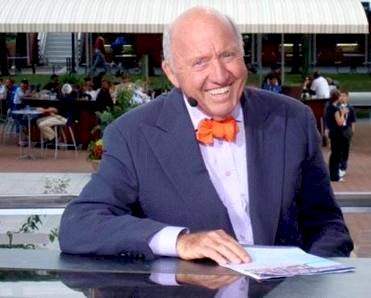
Bud Collins, long-time US tennis authority, dead at 86

March 5, 2016

New York, Mar 5: Bud Collins, a veteran television commentator and newspaper columnist known for his flamboyant trousers and tennis expertise, has died at age 86, his long-time newspaper the Boston Globe announced today.

CollinsCollins, who died at his home in the Boston suburb of Brookline, made one of his final public appearances last September, when the media center at the US Open was named in his honor, and he wrote both an encyclopedia and history of tennis that became authoritative standards in the sport.

"No media figure in history in my mind has ever been as important to one sport as Bud Collins was to the sport of tennis," said Mike Lupica, the New York Daily News sports columnist and ESPN commentator who followed the path Collins pioneered from the print ranks to TV fame.

"You can't minimize it. He became the de facto ambassador to that sport as it was exploding in this country. He educated. He entertained."

The self-described "scribbler and babbler" was known sartorially for bow ties and custom-tailored pants that feature bright, vivid colors and often wild designs and unique as the man who wore them as he spent more than half a century covering major tennis events.

His tailor, Charlie Davidson from Harvard Square, used swaths of cloth Collins brought from as far away as New Zealand, Bangkok and the Himalayas. One pair of pants was made from Vietnamese flags.

Collins had his first byline for the Globe in 1963 from Australia covering the Davis Cup. His last came in 2011, a story about Serena Williams from the US Open.

He covered Wimbledon 44 times, the first of them in 1968, making "Breakfast at Wimbledon" his realm during the years when the sport enjoyed its greatest US interest.

Collins was inducted into the International Tennis Hall of Fame in 1994.

Collins also wrote Globe travel stories that includes looks at such exotic locals as Cambodia, China, India, Italy, Nepal, Tanzania, and Tibet.

Comments

Add new comment

  • Coastaldigest.com reserves the right to delete or block any comments.
  • Coastaldigset.com is not responsible for its readers’ comments.
  • Comments that are abusive, incendiary or irrelevant are strictly prohibited.
  • Please use a genuine email ID and provide your name to avoid reject.
Agencies
April 2,2020

Lausanne, Apr 2: The postponement of the Tokyo Olympics and the shutdown of the sporting calendar because of the coronavirus pandemic are going to hit international sports federations hard financially.

Many sports that are part of the Games depend heavily on the payouts every four years from the International Olympic Committee (IOC).

"The situation is tense and very gloomy. An assessment will be made, but clearly some posts are under threat," said an official of a major international federation.

The 28 international federations (IF) of the sports that were due to be present at the Tokyo Olympics, would have received substantial sums from the IOC.

However, the postponement of the Games until 2021 could lead to a freeze of their payment.

"We have a lot of IF with substantial reserves, but others work on a different business model, they have income from major events which are suspended, which can be a problem for the cashflow if they don't have enough reserves," said Andrew Ryan, director general of the Association of International Olympic Summer Sports Federations (ASOIF), which is responsible for distributing this money.

The five additions to the Tokyo Games programme - karate, surfing, skateboarding, climbing and baseball/softball - are not eligible.

The Olympic payout totalled 520 million after the Rio Games, four years ago.

"The Olympic money could be less than for Rio 2016," Ryan warned before adding: "My advice is to budget the same as in Rio".

The federations receive money on a sliding scale determined by their audience and size.

The three largest (athletics, swimming and gymnastics) can expect approximately 40 million.

For the second tier, made up of cycling, basketball, volleyball, football and tennis, the sum is 25 million.

For group three, which contains eight sports, including boxing, rowing, judo and table tennis, it is 17 million.

The nine sports in the next level (including sailing, canoing and fencing) receive 12 million.

For the three in the last category (rugby, golf, modern pentathlon) the payout is 7 million.

For the largest associations, such as football's FIFA which has a 1.5 billion nest egg, or basketball body FIBA which has CHF 44.4 million (42 million euros) in reserves, IOC aid represents a small proportion of their income.

For others, it is vital.

"Some IF probably don't have the cashflow to survive one year," said Ryan.

For most federations, the postponement of the Olympic Games has a domino effect, forcing them to reschedule their own money-earning competitions.

"The revenues from these events will eventually come in," said Ryan. "But this impacts the cashflow." World Athletics has already postponed the 2021 World Championships in Eugene, Oregon to 2022.

The International Swimming Federation (FINA) will have to do the same for its World Championships scheduled for next summer in Fukuoka, Japan, when they would probably clash with the Tokyo Games.

"One edition of the World Championships means for us 10 million in revenues," said one sports federation official, speaking on condition of anonymity.

"If this income is postponed, totally or partially, for a year, we will face major problems, especially if the IOC money, originally expected in September, is not paid out."

The Singapore-based International Table Tennis Federation has already taken steps, with "the Executive Committee agreeing to reduce their expenses and senior staff offering to take a salary reduction," said marketing director Matt Pound, but, he added,"further cuts will take place if needed."

- 'Significant loss of revenue' -

The ITTF has suspended all its competitions until June and that is costly.

Kim Andersen, the Danish president of London-based World Sailing, said commercial revenues are not immune.

"The IOC will eventually pay out its aid, but what weighs most heavily is the uncertainty about whether our competitions will be held and whether our sponsors will be maintained," he said.

The IOC is not prepared to go into details of what it plans.

"It is not possible at this stage to assess the overall impact" of the postponement of the Tokyo Olympics, an official told AFP.

"It depends on a number of variables that are currently being studied." According to an official of one federation: "the IOC will discuss on a case-by-case basis, sport by sport".

Another option is for the federations to ask for a share of the public aid set up to deal with the coronavirus crisis, in Switzerland, where 22 ASOIF members are based and also in the United Kingdom, home of World Sailing.

"Can sports federations benefit from federal aid? The answer is yes, in principle," Philippe Leuba, State Councillor of the canton of Vaud, in charge of the economy and sport, told.


Comments

Add new comment

  • Coastaldigest.com reserves the right to delete or block any comments.
  • Coastaldigset.com is not responsible for its readers’ comments.
  • Comments that are abusive, incendiary or irrelevant are strictly prohibited.
  • Please use a genuine email ID and provide your name to avoid reject.
News Network
February 21,2020

Wellington, Feb 22: shant Sharma's lion-hearted bowling effort met its match in Kane Williamson's elegance as New Zealand ended an attritional second day of the opening Test against India with a slight upper-hand, here on Saturday.

After another lower-order collapse that saw India get bundled out for 165, Ishant, coming straight back from an ankle injury, took three for 31 in 15 overs despite Williamson's effortless 89 in New Zealand's day-end score of 216 for 5.

New Zealand now lead by 51 runs.

Mohammed Shami (1/61 in 17 overs), during his final spell of the day, removed Williamson, who couldn't check an uppish drive. Henry Nicholls' (17 off 62 balls) struggle seemed to have hampered Williamson's rhythm.

During the final hour, Ravichandran Ashwin (1/60 in 21 overs), who also bowled beautifully throughout the day, relieved Nicholls' of his agony with a delivery that had drift and a hint of turn as India skipper Virat Kohli snapped the low catch at second slip.

Williamson looked good as he hit some delightful strokes square off the wicket. The square drive on the rise off Jasprit Bumrah (0/62 in 18.1 overs), followed by a cover drive, showed his class.

In all, the New Zealand skipper hit 11 boundaries off 153 balls.

Bumrah, in particular, was punished by Williamson, who also back-cut him for a boundary and Taylor then punished another half volley through the covers.

There were quite a few loose deliveries on offer from the Indian pacers and in between a few did beat the bat. With the 'Basin' baked in sunshine, batting became lot more easier and Black Caps seized the initiative.

Bumrah, in particular, failed to find his length consistently. Either he bowled too full and drivable length deliveries or too short that even Rishabh Pant failed to gather with the ball going a couple feet over his head.

This is where Ishant came into the picture. While he was lucky to get opener Tom Latham out with a delivery drifting on leg-stump, the other opener Tom Blundell (30) had a typical Ishant dismissal written all over it.

The ball was full on the off-stump channel and jagged back enough to find the gap between his bat and pad.

Williamson and Taylor then had a partnership of 93 runs during which New Zealand also got the lead before Ishant, coming back for his third spell, bowled one that reared up from good length and proved to be an easy catch for Cheteshwar Pujara at short-leg.

Once Nicholls came in, Williamson, who was batting fluently, suddenly had a player at the opposite end who scored only 4 off 34 balls.

Looking good for his 22nd Test hundred, Williamson, in his bid to get another boundary, couldn't check a cover drive and the low catch was taken by substitute fielder Ravindra Jadeja.

Earlier, New Zealand's debutant Kyle Jamieson and veteran Tim Southee took four wickets apiece as Indian innings folded in 68.1 overs.

Jamieson (4/49 in 16 overs) and Southee (4/49 in 20.1 overs) took four of the five wickets that fell on the second morning with India adding only 43 runs to their overnight score of 122 for 5.

Rishabh Pant (19) started with a six but then a horrible mix-up with senior partner Ajinkya Rahane (46) resulted in a run-out and the little chance of recovery was gone for good.

It was a poor call from the senior player and Pant had to sacrifice his wicket in the process.

Ashwin then received a beauty from Southee, pretty similar to what Prithvi Shaw got, while Rahane inside edged one while trying to leave it alone.

With India at 132 for 7, Rahane knew that time was running out as he played a square drive off Trent Boult to get him a boundary.

Southee then got rid of Rahane when he tried to shoulder arm a delivery that made a late inward movement. Mohammed Shami's entertaining 21 then enabled the visitors to cross the 150-run mark.

Comments

Add new comment

  • Coastaldigest.com reserves the right to delete or block any comments.
  • Coastaldigset.com is not responsible for its readers’ comments.
  • Comments that are abusive, incendiary or irrelevant are strictly prohibited.
  • Please use a genuine email ID and provide your name to avoid reject.
News Network
January 20,2020

Jan 20: Both Steve Smith and Rohit Sharma made sparkling centuries in Bengaluru, but it was the Indian who finished on the winning side, leading his team to a 2-1 series win.

Smith, having run out his captain Aaron Finch early on, dug in to bring up his ninth ODI century, his 131 off 132 balls setting India a target of 287 on Sunday, 19 January. Continuing the dazzling display of batting at the M Chinnaswamy stadium, Rohit struck 119 in 128 balls, and skipper Virat Kohli chipped in with 89, as the hosts chased down the target with seven wickets to spare in 47.3 overs.

With Shikhar Dhawan hurting his shoulder in the fifth over of the day and sidelined for the rest of the match, Rohit was reunited with KL Rahul – who had a chance to open the innings after coming in at No.3 and No.5 in the first two matches, while also standing in as wicket-keeper. The vice-captain was on the ball right away, dominating the scoring as India raced to 61/0 in the first 10 overs.

The introduction of spin gave Australia a vital breakthrough: Ashton Agar trapped Rahul in front on review, and although the new pair of Rohit and Kohli weren't unduly troubled, the run-rate slowed down. Josh Hazlewood, playing his first ODI in India and his first match in the format in 14 months, was especially miserly, conceding just 10 runs in his first five overs.

But, having settled in, the duo built a useful partnership of 137 and gave themselves the chance to hit out with wickets in hand. The part-time bowling of Finch and Marnus Labuschagne was punished, Rohit lapping up the short balls and sending them soaring into the stands. His century, his eighth against Australia, came with a single to third man.

Zampa finally got the breakthrough, having him caught in the deep going for another big one. But with Kohli having loosened his arms with a couple of beautiful fours off Pat Cummins to go past his half-century, India remained on course.

The skipper missed out on a hundred, but with Shreyas Iyer too clearing the ropes, there were no hurdles as India wrapped up an entertaining series win.

Earlier, the Indian bowlers struggled to find their lines after Australia chose to bat, but Australia weren't able to fully capitalise. David Warner was thrown by the movement to nick Mohammed Shami to the wicket-keeper, while Finch was caught short after Smith pulled out of a run, to leave the hosts at 46/2.

Labuschagne and Smith, though, combined for another special partnership, going at a brisk rate and showing delectable timing against spin. They had guided their side to 173 in the 32nd over when the a sharp piece of fielding from the home captain and strong bowling pulled things back.

Kohli, at cover, plucked a drive from Labuschagne soon after the batsman had reached his maiden fifty. Ravindra Jadeja had his second of the over when the experiment to send Mitchell Starc at No.5 lasted just three balls.

Alex Carey gave Smith company as he brought up a well-earned century, having fallen just short the previous game. The former skipper stepped up the scoring once he crossed three figures, a wristy helicopter six over deep square leg the highlight of his innings. But, excellent death bowling by Shami, who finished with four wickets, ensured the tourists were kept to under 300 – a total that proved below par.

Comments

Add new comment

  • Coastaldigest.com reserves the right to delete or block any comments.
  • Coastaldigset.com is not responsible for its readers’ comments.
  • Comments that are abusive, incendiary or irrelevant are strictly prohibited.
  • Please use a genuine email ID and provide your name to avoid reject.