Bus driver Abdul Rasheed suffers heart attack, but saves all before dying

[email protected] (News Network)
June 14, 2016

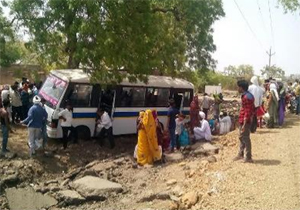
Indore, Jun 14: A major accident was averted when a bus driver suffered a massive heart attack when he was driving at a high speed, but he managed to bring the vehicle to halt without causing any injury to the passengers in Khandwa district of Madhya Pradesh on Monday.

arThough the driver lost his life to the cardiac arrest, 29 passengers of the bus had a narrow brush with death.

The incident took place in the afternoon when Rasheed was driving the bus belonging to Arya Travels from Khandwa to Kohdar. As he neared village Chhoti Borgaon, he suffered a heart attack, police said.

Despite the pain, he gained control of the vehicle and brought it to a halt. The bus had left the road and came to a standstill near a tree, they added.

Passengers called emergency services and the police, but Rasheed passed away before help could reach him. His death led to emotional outbursts from passengers, who blamed the police for delay in getting Rasheed to a hospital.

Police have seized the bus and were in the process of recording the death.

Comments

SHAJI
 - 
Tuesday, 14 Jun 2016

Hats off this hero who saved lives of many people on sacrificing his own life. Govt should award compensation to his family and provide a job to his son / daughter. Govt should show humanity on such deserved people.

SK
 - 
Tuesday, 14 Jun 2016

RIP......Martyr... condolences to his Family

Add new comment

  • Coastaldigest.com reserves the right to delete or block any comments.
  • Coastaldigset.com is not responsible for its readers’ comments.
  • Comments that are abusive, incendiary or irrelevant are strictly prohibited.
  • Please use a genuine email ID and provide your name to avoid reject.
News Network
June 11,2020

Mangaluru, Jun 11: City police on Thursday filed a 700-page chargesheet in connection with the arrest of Aditya Rao, 36, accused of planting an IED at Mangaluru International Airport on January 20.

The chargesheet said the bag placed near MIA entrance had a real bomb, as per the FSL report. The IED in the tin box was made of sulphur, ammonium nitrate, potassium chlorate and charcoal.

Rao, an engineer, who learnt bomb-making through online videos, had also placed a timer along with it and sharp objects such as nails and metals. However, he had not fixed wires to trigger a blast. “His intention was not to cause a blast but only to create a scare,” said sources.

The bomb was made in less than two weeks. However, it had taken Rao several days to procure raw materials. Police had completed the chargesheet process in April.

Comments

Add new comment

  • Coastaldigest.com reserves the right to delete or block any comments.
  • Coastaldigset.com is not responsible for its readers’ comments.
  • Comments that are abusive, incendiary or irrelevant are strictly prohibited.
  • Please use a genuine email ID and provide your name to avoid reject.
News Network
June 26,2020

Bengaluru, Jun 26: The National Restaurant Association of India (NRAI) on Thursday came up with a Standard Operating Procedure (SOP) for restaurants whereby among other physical distancing norms, it has suggested a 2-metre gap between tables.

Formulated in partnership with Releski, a Bengaluru based skill-tech company, the SoP suggests that in case of back-to-back seating, people sitting with their backs towards each other will have their seats divided by 'Plexiglass' divider raised up to 2 meters from the ground.

"In a typical restaurant, the improvised seating plan should have a minimum distance of 2 metres between tables. The distance of 2 metres (6 feet) between tables should measure from one edge of the table to the other table's edge," it said.

In case of loose or free seating such as in banquet style or food court style seating, a minimum 2 meters of distance should be maintained between tables.

The guidelines noted that, to encourage physical distancing, restaurants have to sacrifice their seating capacity, to promote health and safety, and also to gain trust from their patrons.

"In order to perform this, divide your restaurants under different sectors. Pull out your restaurant's floor plan and colour code different sections red and yellow. Red sections are potential areas where maximum footfall or traffic is observed. Yellow sections are areas where the footfalls are average," it said.

All the red sections are encircled or bordered by placing barricades or Q manager and will open at specific points to access the yellow section and all the opening points will have hand sanitisers and sprays, and every guest who walks from red zones to yellow zones will sanitise himself/herself to reduce the chances of contamination.

For air conditioning, the guidelines of CPWD shall be followed which inter alia emphasises that the temperature setting of all air conditioning devices should be in the range of 24-30 degree Celsius, relative humidity should be in the range of 40- 65 per cent, intake of fresh air should be as much as possible and cross ventilation should be adequate, the guidelines suggested.

The industry body has also suggested appointment of a COVID-free Ambassador who would operate as the Chief Health Officer within the restaurant team, preferably from the management team in each shift.

The ambassador's would put the new daily work routines into practice, to monitor compliance with good practice and to lead the preventative measures, adapt to health & safety recommendations and requirements of the restaurant and oversee the implementation of the norms.

Anurag Katriar, President of NRAI and CEO & Executive Director of deGustibus Hospitality, said: "Every restaurant cutting across formats is facing the harsh reality of subdued to shut business volumes in the present and the uncertainty of business environment in the future. One thing is certain that hygiene and safety will be a key differentiator in the post-pandemic restaurant operations."


Comments

Add new comment

  • Coastaldigest.com reserves the right to delete or block any comments.
  • Coastaldigset.com is not responsible for its readers’ comments.
  • Comments that are abusive, incendiary or irrelevant are strictly prohibited.
  • Please use a genuine email ID and provide your name to avoid reject.
coastaldigest.com news network
July 30,2020

Mangaluru, July 30: Medical doctor turned IAS officer K V Rajendra assumed charge as the 130th deputy commissioner of Dakshina Kannada district here today.

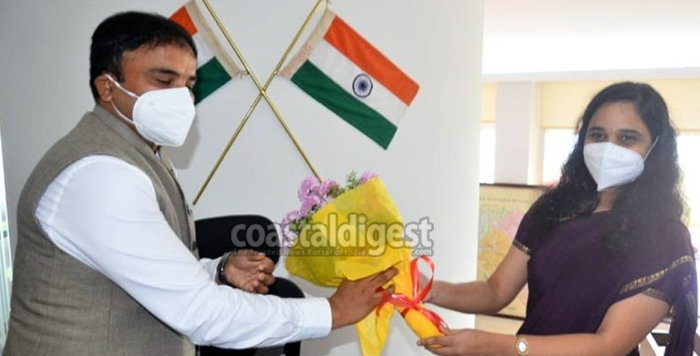
The 2013 batch Karnataka cadre officer succeeds Sindhu B Rupesh, who was transferred as Director of Electronic Delivery of Citizen Services (EDCS), Bengaluru. The outgoing DC welcomed the new DC in the presence of staff. 

Dr Rajendra said that he expects cooperation from all stakeholders in administering the district, amidst the mounting Covid-19 cases.

Rajendra, an alumnus of JJM Medical College, Davanagere, was serving as the CEO of Belagavi zilla panchayat before being posted as DC of this coastal district. 

Having served as assistant commissioner of Puttur sub-division for nearly a year from December 2015, Dr Rajendra, hails from Thirthahalli in Shivamogga district, had his probationary training in Bidar. He posted as CEO of Ballari ZP where he worked for nearly three till 21, 2019.

He also had a brief stint as assistant secretary in the department of fertiliser with the ministry of chemicals and fertilisers.

Sindhu who was the CEO of Udupi zilla panchayat had succeeded Sasikanth Senthil, who resigned from the Indian Administrative Service on September 6, 2019. She had taken charge on September 7, 2019.

Comments

Add new comment

  • Coastaldigest.com reserves the right to delete or block any comments.
  • Coastaldigset.com is not responsible for its readers’ comments.
  • Comments that are abusive, incendiary or irrelevant are strictly prohibited.
  • Please use a genuine email ID and provide your name to avoid reject.